
Ask ten people what is investment banking and you’ll probably get ten different half-answers. Some picture Wall Street trading floors. Others think of the analysts working brutal hours on spreadsheets late into the night. Both images have some truth to them, but neither actually explains what the job is.
Here’s the thing — investment banking isn’t one single activity. It’s a cluster of related financial services, all built around one core idea: helping large organizations raise money, make deals, and manage complex financial decisions that a regular bank branch simply isn’t equipped to handle.
This guide breaks down what investment banking actually involves, how it differs from the banking most people use daily, and a few facts that tend to surprise people learning about the industry for the first time.
What Is Investment Banking, In Plain Terms?
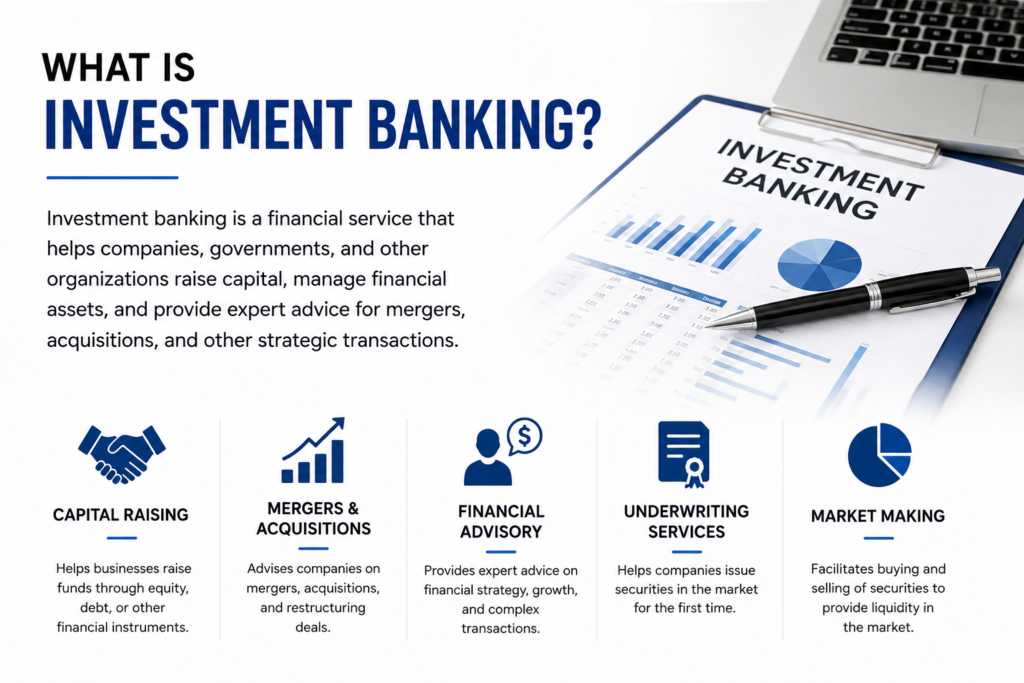
At its core, investment banking is a segment of the financial industry focused on helping companies, governments, and large institutions raise capital and execute major financial transactions. That’s very different from retail or commercial banking, which deals with everyday checking accounts, personal loans, and mortgages.
Investment banks act as intermediaries. They connect organizations that need money — through issuing stocks or bonds — with investors who have capital to deploy. They also advise on major corporate decisions, like whether to acquire another company or how to restructure debt.
Quick takeaway: If you remember one distinction, make it this one: retail banking serves individuals, while investment banking serves large institutions and corporations on complex, high-stakes transactions.

1. It’s Built Around Raising Capital
One of the clearest answers to what is investment banking comes down to a single function: helping organizations raise money. Companies that want to expand, invest in new projects, or fund acquisitions often need more capital than they can generate internally.
- Investment banks help companies issue new shares of stock to the public, commonly through an IPO
- They also help issue bonds, allowing companies or governments to borrow directly from investors
- Pricing, timing, and structuring these offerings correctly can make a significant difference in how much capital is actually raised
Takeaway: If you’re researching a company that’s about to go public, look at which investment bank is leading the offering — their reputation and track record often influence how the market receives the deal.
2. Mergers and Acquisitions Are a Core Business Line
When one company buys another, or two companies combine, investment banks are almost always involved behind the scenes — a core part of the answer to what is investment banking beyond just raising capital. This is one of the most visible and, in recent years, one of the busiest areas of the industry.
- Bankers advise on deal structure, valuation, and negotiation strategy
- M&A volume has been notably strong recently, with sponsor-driven exits and large deals leading momentum
- Advisory teams often work exclusively for either the buyer or the seller in a given transaction, not both
Takeaway: M&A advisory fees are typically tied to deal size and complexity, which is part of why banks compete aggressively for large, high-profile transactions rather than smaller deals.
3. Underwriting Means Taking On Real Risk
A less obvious part of understanding what is investment banking involves underwriting — the process where a bank agrees to buy new securities directly from the issuing company, then resells them to investors.
- The bank takes on the risk that it might not sell all the securities at the expected price
- In exchange for that risk, the bank earns underwriting fees
- Underwriting requires accurately gauging investor demand before the securities are even issued
Takeaway: Strong underwriting performance depends heavily on a bank’s relationships with institutional investors — it’s part of why established banks tend to win the largest underwriting mandates.
4. Trading Desks Operate Alongside Advisory Work
Many investment banks run active trading operations, separate from their advisory and underwriting teams — another piece of what is investment banking that often gets overlooked. These desks buy and sell securities like stocks, bonds, currencies, and derivatives.
- Some trading is done on behalf of clients, executing orders and providing liquidity
- Other trading uses the bank’s own capital, seeking to profit directly from market movements
- Trading revenue can be highly sensitive to market volatility, sometimes performing exceptionally well during uncertain periods
Takeaway: If you’re evaluating an investment bank’s overall performance, remember that trading results can swing dramatically quarter to quarter — a single strong or weak quarter isn’t necessarily representative of the broader business.
5. Research Supports Nearly Everything Else
Investment banks typically employ research analysts who study specific companies, sectors, and broader economic trends — research is often the least visible piece of what is investment banking, yet it supports nearly every other function within the bank.
- Research helps investors make informed buy, sell, or hold decisions
- It also supports the bank’s own underwriting and advisory pitches with credible market analysis
- Analysts often specialize deeply in a single sector, like technology, healthcare, or energy
Takeaway: When reading equity research, remember the analyst’s bank may also have a business relationship with the company being covered — it’s worth checking multiple sources before treating any single report as the full picture.
6. Technology Is Reshaping the Junior Analyst Role
One of the more significant recent shifts in the industry involves how technology, particularly AI, is changing entry-level work — a shift that’s quietly reshaping the modern answer to what is investment banking for the newest generation of hires. Tasks that once consumed enormous junior analyst time, like pitch book preparation and data entry, are increasingly being automated.
- Some experts see this as compressing the time needed to develop foundational skills
- Others see it as freeing junior bankers to focus on more strategic, client-facing work sooner
- Either way, the traditional “grind it out for years” path into strategic roles is shifting
Takeaway: If you’re considering a career in investment banking, ask prospective employers directly how AI tools are changing junior analyst responsibilities — the answer varies significantly between firms.
7. The Hours and Pay Are Both Genuinely Extreme
No honest explanation of what is investment banking skips over the lifestyle, especially at the analyst and associate levels. Long hours are a well-known feature of the industry, particularly during active deal periods.
- Compensation, including bonuses, is typically well above average for entry-level finance roles
- Bonus structures can shift meaningfully year to year based on deal activity and firm performance
- Hybrid work arrangements have become more common recently, though demanding hours during live deals remain typical
Takeaway: Before pursuing an investment banking career specifically for the pay, talk to people currently working in the role about the actual day-to-day workload — the compensation reflects a genuinely demanding schedule, not just prestige.
How Investment Banking Fits Into the Broader Financial System
Once you understand these individual pieces, the bigger picture of what is investment banking becomes much clearer. It’s not a single job or product — it’s a collection of specialized services that all revolve around large-scale capital movement and corporate strategy.
Since certain regulatory changes decades ago, commercial banks and investment banks have often operated under the same corporate parent, even though the functions themselves remain distinct. A single large financial institution might handle your personal checking account and also advise a Fortune 500 company on a multi-billion-dollar acquisition, all under one broader corporate umbrella.
Takeaway: If you’re researching a specific bank, check whether you’re looking at its retail division, its investment banking division, or both — the same company name can represent very different services depending on which side you’re evaluating.
Final Thoughts
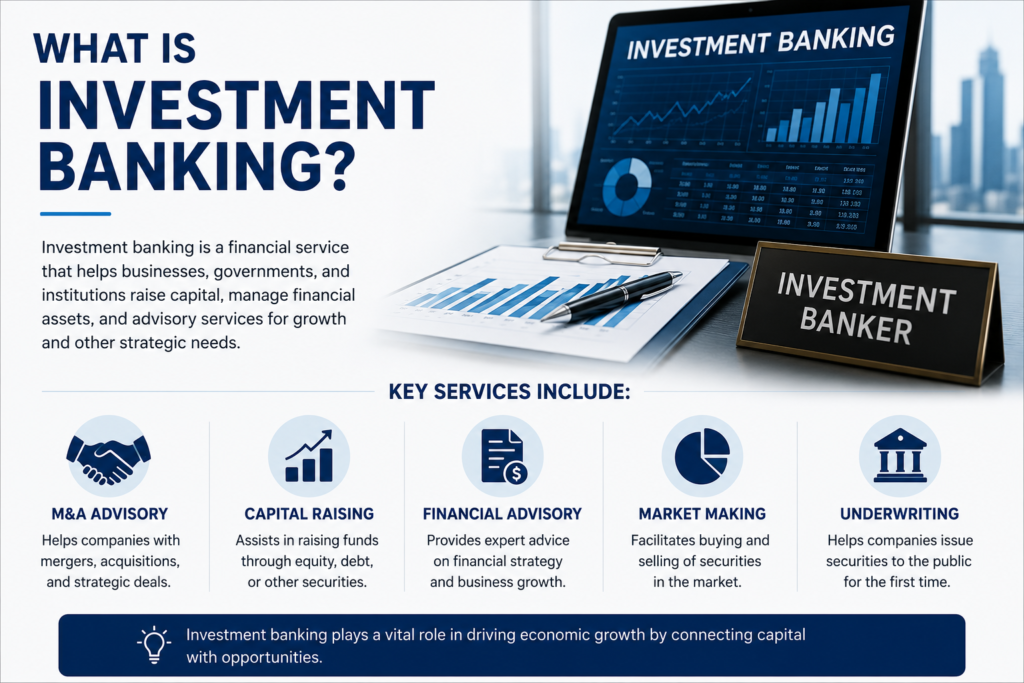
So, what is investment banking, in the simplest possible terms? It’s the part of the financial industry dedicated to helping large organizations raise capital, execute major transactions, and navigate complex financial decisions — built on a combination of capital raising, M&A advisory, underwriting, trading, and research.
The industry is also changing quickly. AI is reshaping junior roles, deal volumes are shifting with market conditions, and firms are increasingly selective about where they deploy talent and capital. Whether you’re researching the industry out of curiosity, considering a career in it, or just trying to understand a headline about a major acquisition, understanding these core building blocks makes the rest of the financial news far easier to follow.
5. FAQs Section
1. What is investment banking in simple terms? Investment banking is the part of the financial industry that helps companies, governments, and large institutions raise capital and complete major financial transactions, like mergers, acquisitions, and public stock offerings.
2. How is investment banking different from regular banking? Regular or retail banking serves individual customers with checking accounts, mortgages, and personal loans. Investment banking serves large institutions with capital raising, M&A advisory, and trading services instead.
3. What do investment bankers actually do day to day? Work varies by role, but common tasks include building financial models, preparing pitch books for clients, valuing companies, and supporting live deal execution, often under tight deadlines.
4. Do you need a specific degree to work in investment banking? Most entry-level roles favor degrees in finance, economics, or business, though strong analytical and quantitative skills matter more than any single specific major.
5. Why is investment banking known for long working hours? Deal timelines are often tight and client-driven, meaning teams frequently work intensive hours to meet deadlines, particularly during active transactions like IPOs or acquisitions.
6. Is investment banking a good career choice right now? It depends on individual goals. The industry currently shows strong deal activity and compensation, but it also involves demanding hours and an evolving role for junior analysts as AI tools take on more routine tasks.