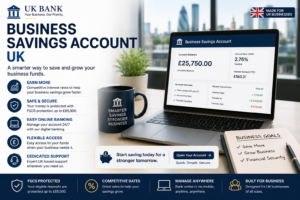
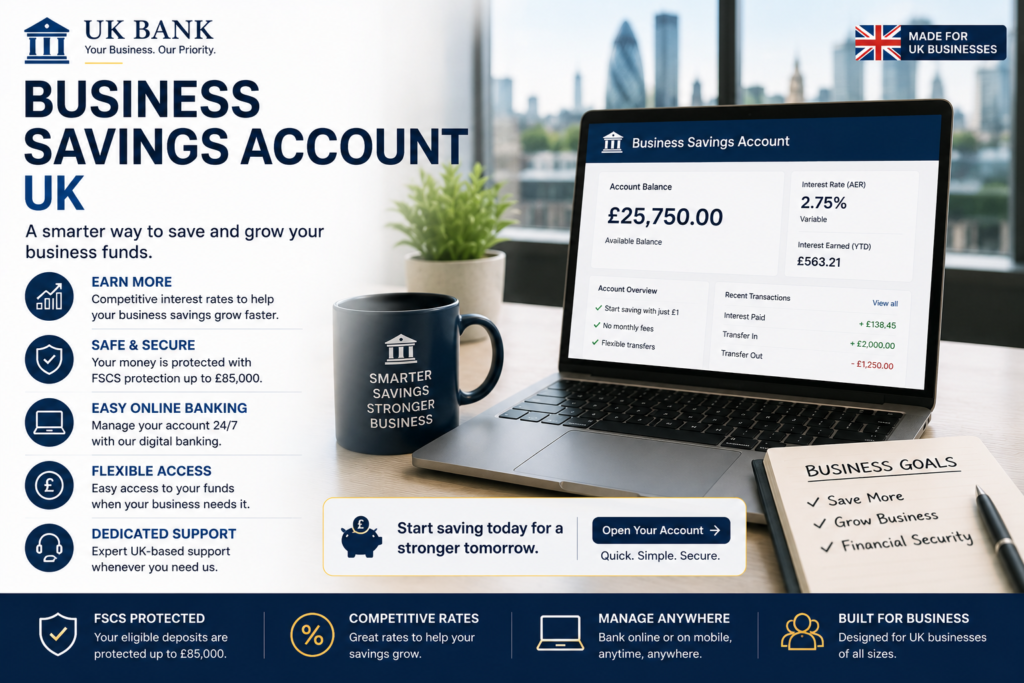
If your business current account is sitting there holding more cash than it needs for day-to-day expenses, you’re probably losing out on interest you could otherwise be earning. A business savings account UK providers offer can be a genuinely simple way to make idle cash work harder, without locking it away completely.
Here’s the thing: most business owners open a current account and never think twice about savings. It’s understandable — you’re busy running the business, not managing a portfolio. But even modest interest rates can add up meaningfully over a year, especially as balances grow.
It’s also one of those decisions that feels like it can wait. There’s always something more urgent — payroll, suppliers, tax deadlines — and comparing savings accounts rarely feels like the priority. But the businesses that do take the time usually end up wondering why they didn’t start sooner, once they see the difference even a modest interest rate makes over twelve months.
This guide walks through exactly how business savings accounts work in the UK, what to actually look for when comparing providers, and the common mistakes that quietly cost businesses money — so you can make a confident decision rather than picking the first option that appears in a search.

Why a Business Savings Account UK Providers Offer Is Worth Considering
Cash sitting in a standard business current account typically earns little to no interest at all. Moving surplus funds into a dedicated savings account means that money starts working for you, even while it remains fully available for future business needs.
This matters more than it might seem at first glance. A business holding £50,000 in idle reserves could be missing out on a meaningful amount of interest annually, simply by not moving funds into an account designed to earn it. Over several years, that gap compounds into a genuinely significant sum — money that could otherwise go toward hiring, equipment, or simply cushioning against a slower quarter.
It’s also worth remembering that this isn’t about taking on risk. A standard savings account carries none of the volatility of investing in stocks or funds — it’s simply a more efficient place to store money you’re not actively spending.
Takeaway: Idle cash in a current account is a missed opportunity — a savings account puts that same money to better use.
Tip #1: Understand Instant Access vs Fixed-Term Options
Instant access accounts offer flexibility, letting you withdraw funds whenever your business needs them, though typically at a lower interest rate. Fixed-term accounts reward you with better rates in exchange for locking funds away for a set period, often ranging from three months to several years.
The right choice depends entirely on your cash flow needs. If you might need the funds unexpectedly, instant access makes more sense, even at a lower rate.
Takeaway: Match the account type to how predictable your cash flow actually is, not just to the advertised interest rate.
Tip #2: Compare More Than Just the Interest Rate
It’s tempting to simply pick whichever business savings account UK banks are advertising with the highest headline rate. But other factors matter just as much:
- Minimum and maximum deposit limits
- Withdrawal restrictions or penalties
- Whether the rate is fixed or variable
- Any linked current account requirements
- Online account management features
A variable rate might look attractive today but drop within months, while a fixed rate offers certainty but won’t rise if broader interest rates increase later. Similarly, some providers require you to also hold a current account with them, which may or may not suit your existing banking setup.
Takeaway: The highest advertised rate isn’t always the best deal once you factor in restrictions and requirements.

Tip #3: Check FSCS Protection Carefully
Most UK banks and building societies protect deposits up to £85,000 per institution under the FSCS scheme. If your business holds savings above this threshold, it’s worth spreading funds across multiple institutions to keep everything protected.
This becomes especially relevant for growing businesses accumulating larger cash reserves over time.
Takeaway: Don’t assume unlimited protection — check the threshold and spread larger balances accordingly.
Tip #4: Factor In Notice Periods
Some business savings accounts require advance notice — sometimes 30, 60, or 90 days — before you can withdraw funds without penalty. This can catch businesses off guard if an unexpected expense arises.
Before committing, make sure any notice period genuinely fits with how predictable your business’s cash needs actually are.
Takeaway: A great interest rate isn’t worth much if a notice period leaves you unable to access funds when you actually need them.
Tip #5: Consider Multiple Accounts for Different Goals
Rather than lumping all surplus cash into a single account, some businesses benefit from splitting savings across multiple accounts — one for emergency reserves with instant access, and another fixed-term account for longer-term surplus funds.
This approach balances flexibility with better overall returns, without sacrificing access to funds you might need on short notice. For example, a business might keep three months of operating costs in an instant access account, while placing any additional surplus into a fixed-term account offering a noticeably higher rate.
It does mean slightly more administration — tracking two or three accounts instead of one — but for businesses with healthy cash reserves, the extra interest earned usually outweighs the minor added complexity.
Takeaway: Splitting savings by purpose often earns more overall than keeping everything in one account.
Tip #6: Review Rates Regularly
Interest rates on business savings accounts change fairly often, particularly variable-rate accounts tied to wider economic conditions. An account that offered a great rate a year ago might no longer be competitive today, especially as the broader interest rate environment shifts.
Many businesses set up a savings account once and simply forget about it, assuming the rate they signed up for remains competitive indefinitely. In reality, providers frequently launch new accounts with better rates aimed at attracting new customers, while leaving existing account holders on older, less competitive terms.
Setting a reminder to review your account every six to twelve months ensures you’re not quietly losing out on better rates elsewhere. It’s a small task that takes perhaps thirty minutes, but the potential savings make it well worth the effort.
Takeaway: Treat your savings account as something to revisit periodically, not a one-time decision.
Tip #7: Don’t Overlook Digital-Only Providers
Alongside traditional high street banks, several digital-only providers now offer competitive business savings accounts, often with faster account opening and more transparent fee structures. They may not suit every business, particularly those needing in-branch support, but they’re worth including in any comparison.
Digital challengers have pushed the wider market to become more competitive too, sometimes forcing traditional banks to improve their own rates in response. Ignoring this segment of the market entirely means potentially missing out on some of the best rates currently available.
Takeaway: Widening your comparison beyond familiar high street names can uncover noticeably better rates.
What You’ll Typically Need to Open One
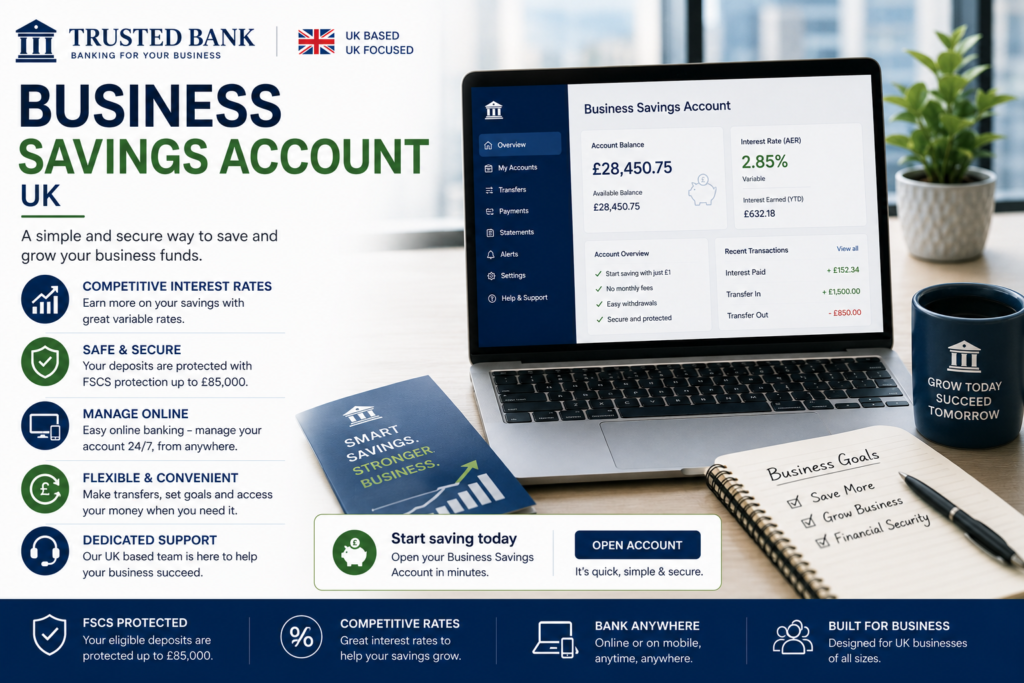
Opening a business savings account UK banks offer usually requires a similar set of documents to any other business banking product:
- Proof of business registration (company number, if applicable)
- Proof of identity and address for account signatories
- Details of your existing business current account
- An estimate of the amount you plan to deposit
- In some cases, recent business bank statements
Newer businesses may face slightly more scrutiny during onboarding, particularly around the source of funds being deposited, so having clear documentation ready in advance helps speed things along.
Takeaway: Prepare your documents before applying to avoid unnecessary delays in getting your savings account up and running, especially if your business has a more complex ownership structure or multiple signatories involved.
Frequently Asked Questions
1. What is a business savings account in the UK? It’s a dedicated account for storing surplus business funds, separate from your everyday current account, that earns interest over time. Unlike personal savings accounts, it’s specifically designed for company or sole trader use.
2. Can any business open a savings account in the UK? Most limited companies, sole traders, and partnerships can open one, though eligibility requirements vary between providers, particularly around minimum deposit amounts and business turnover.
3. Are business savings accounts protected in the UK? Yes, most are protected under the Financial Services Compensation Scheme (FSCS) up to £85,000 per banking institution, though it’s worth confirming this with your specific provider.
4. What’s the difference between instant access and fixed-term business savings accounts? Instant access accounts let you withdraw funds anytime, usually with lower interest rates. Fixed-term accounts lock your money away for a set period in exchange for typically higher interest rates.
5. Do I pay tax on business savings account interest? Yes, interest earned is generally treated as taxable income for your business and needs to be accounted for in your company’s tax return or self-assessment, depending on your business structure.
6. How much should a small business keep in a savings account? This varies by business, but many advisors suggest keeping a cash reserve equivalent to three to six months of operating expenses, with any surplus beyond that considered for savings or investment.
Final Thoughts
A business savings account UK companies use effectively isn’t complicated — it simply means putting surplus cash somewhere it can earn interest, rather than letting it sit idle in a current account. The key is matching the account type, notice period, and provider to your business’s actual cash flow needs, rather than chasing the highest advertised rate alone.
It’s a decision that rarely feels urgent, which is exactly why so many businesses put it off longer than they should. But once it’s set up, it largely runs in the background — quietly earning interest on money that would otherwise be doing nothing at all.
Take the time to compare properly, review your choice periodically, and you’ll likely find your business’s cash reserves working noticeably harder over time.