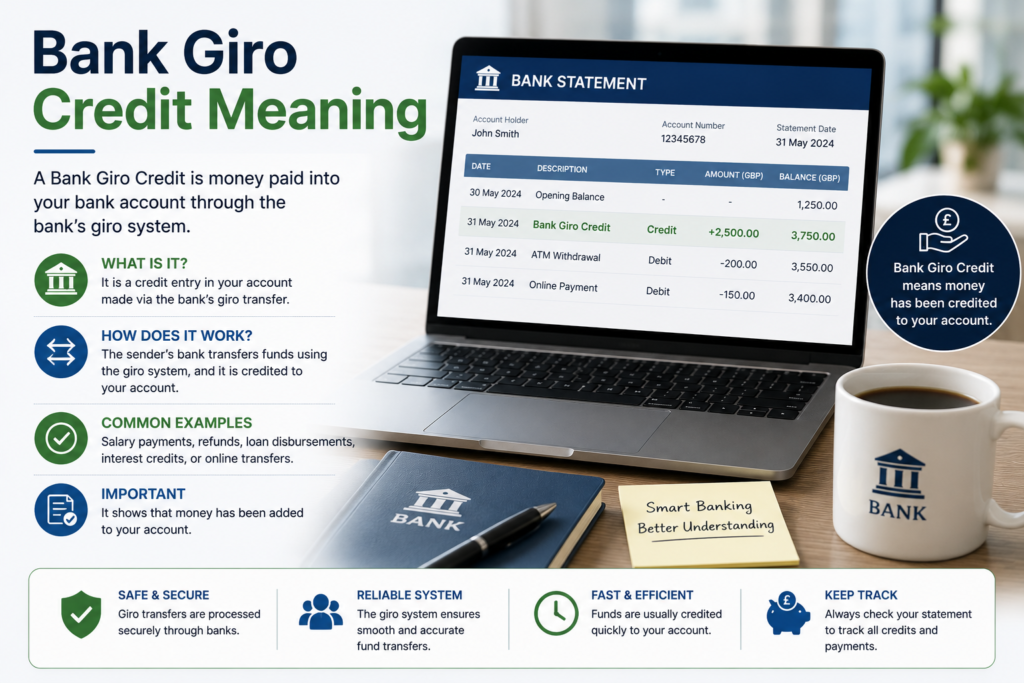
If you’ve ever checked your bank statement and spotted the letters “BGC” next to a payment, you’ve probably paused and thought, what does that actually mean? The bank giro credit meaning is simpler than it looks, but it’s one of those banking terms that rarely gets explained properly anywhere.
Here’s the thing: BGC payments show up more often than people realise — tax refunds, insurance payouts, even certain benefit payments can all land in your account labelled this way. Yet most people never learn what’s actually happening behind that little abbreviation.
It’s a strange gap in financial literacy, really. We’re taught to check our statements, watch for fraud, and reconcile our accounts — but almost nobody explains what half the labels on those statements actually mean. BGC is one of the most common examples, and once you understand it, a surprising number of “mystery payments” suddenly make sense.
This guide breaks it down properly — what a bank giro credit actually is, where the term comes from, why it still matters even in today’s world of instant bank transfers, and how to tell a genuine one apart from something you should question.
Where the Term “Giro” Actually Comes From
The word “giro” comes from the Greek term for a circle or turn, later adopted across European banking systems to describe transferring money directly between accounts without physical cash changing hands. The UK adopted its own giro system decades ago, primarily through the Post Office and high street banks.
Back then, giro slips were a common way to pay bills, receive benefits, or transfer money without needing a chequebook. Someone without a personal bank account could still receive a payment or settle a bill through a Post Office giro counter, which made the system especially important before current accounts became universal.
Many European countries — Germany, the Netherlands, and others — still use giro-based systems as a core part of everyday banking, sometimes even more prominently than the UK does today. That’s partly why the term can feel unfamiliar to younger UK account holders, even though it’s been part of British banking for generations.
While digital banking has largely replaced the physical process, the terminology has stuck around on modern bank statements, quietly surviving as a label long after the paper slips themselves became rare.
Takeaway: BGC isn’t a glitch or unusual label — it’s a legacy term that’s simply carried over into modern banking systems.

Understanding the Bank Giro Credit Meaning in Everyday Banking
In practical terms, a bank giro credit is just a payment into your account that’s been routed through this particular clearing process rather than a standard transfer. You’ll typically see it when:
- HMRC issues a tax refund
- An insurance company pays out a claim
- Certain government benefits or grants are processed
- A business pays in cash or cheques on your behalf at a bank counter
Takeaway: If you see “BGC” on your statement, it almost always relates to an institutional payment rather than a personal transfer from a friend or family member.
Common Examples of Bank Giro Credit Payments You Might See
To make this more concrete, here are situations where a BGC entry commonly shows up on a UK bank statement:
- HMRC tax refunds — overpaid tax, self-assessment adjustments, or PAYE corrections often arrive labelled this way
- Insurance claim payouts — many insurers still process settlements through batch giro payments
- Court-ordered payments — compensation or settlement amounts sometimes route through this system
- Pension adjustments — backdated or corrected pension payments can appear as BGC
- Business cash and cheque deposits — when someone pays cash or a cheque into your account on your behalf at a bank counter
Seeing any of these on your statement is generally nothing to be concerned about — it simply reflects how the sending institution processed the payment on their end, rather than anything unusual happening with your account.
Takeaway: Recognising these common scenarios makes it much easier to match a BGC entry to something you were already expecting.
How to Identify a Genuine Bank Giro Credit vs Something to Question
Most BGC entries are completely legitimate, but it’s still worth knowing how to sanity-check one, especially if the amount or timing catches you off guard.
Start by looking at the amount and date. Does it line up with something you were expecting — a refund you applied for, a claim you filed, or a payment you knew was due? If so, that’s usually enough to put your mind at ease.
If nothing matches, the next step is checking your online banking app or statement for any additional reference details. Many banks include a partial reference or sender name alongside the BGC label, even if it’s abbreviated.
When in doubt, contact your bank directly using the number on the back of your card or their official app — never a number or link sent to you unexpectedly by text or email. This protects you from potential scams that try to piggyback on legitimate-sounding banking terms.
Takeaway: A genuine BGC payment will usually match something you’re already expecting — when it doesn’t, verifying directly with your bank is always the safer move.

How Bank Giro Credit Differs From BACS and Standing Orders
It’s easy to lump all these payment types together, but they work quite differently:
- BACS is the standard electronic system used for salary payments, direct debits, and most everyday transfers, usually taking up to three working days.
- Standing orders are recurring, fixed-amount payments you set up yourself.
- Bank giro credit typically refers to one-off payments processed through the older giro clearing system, often by institutions rather than individuals.
Takeaway: If the payment came from a company or government body rather than a person, BGC is often simply how that transaction gets labelled.
Can You Still Use a Giro Slip to Pay Money In?
Yes — though it’s becoming increasingly rare. Some banks and the Post Office still accept giro paying-in slips, allowing you to deposit cash or cheques into someone else’s account without needing their card details or online banking access.
This can be genuinely useful for older customers, small businesses handling cash payments, or situations where digital transfer isn’t practical.
Takeaway: If you’re ever handed a giro slip, it’s simply a manual way to pay funds into an account — not something to be wary of.
Is a Bank Giro Credit Payment Something to Worry About?
Generally, no. Seeing “BGC” on your statement is a normal part of UK banking and doesn’t indicate fraud or an error on its own. That said, it’s always sensible to double-check unfamiliar transactions, regardless of how they’re labelled.
If you genuinely don’t recognise the payment, contacting your bank directly — using the number on your card or official app, never a number from an unexpected text or email — is the safest way to confirm its source.
Takeaway: Treat an unfamiliar BGC entry the same way you’d treat any unrecognised transaction: verify it directly with your bank rather than assuming the worst.
Why Understanding the Bank Giro Credit Meaning Still Matters Today
Even with instant transfers and mobile banking apps everywhere, older systems like giro credit haven’t fully disappeared. Government departments, in particular, still rely on established, secure processes for handling large volumes of refunds and payments — and giro remains part of that infrastructure.
Understanding what these labels mean helps you read your bank statement with more confidence, spot genuine payments quickly, and avoid unnecessary panic over unfamiliar terminology.
Takeaway: A little banking literacy goes a long way — knowing what BGC means turns a confusing label into a simple, reassuring fact. It’s a small piece of knowledge, but one that saves genuine time and worry whenever it shows up unannounced on your statement.
Frequently Asked Questions
1. What does bank giro credit mean? Bank giro credit (BGC) refers to a payment made into your account through the UK’s giro clearing system, historically via a paying-in slip at a bank counter. Today it’s mostly used to label certain automated credits on your statement.
2. Why does BGC appear on my bank statement? It usually appears when a payment has been processed through the giro system rather than a standard BACS transfer or standing order — often used by government bodies, insurers, or older payment processes.
3. Is a bank giro credit the same as a bank transfer? Not exactly. While both move money into your account, a giro credit historically involved a physical paying-in slip system, whereas a standard transfer is processed electronically between accounts directly.
4. Can I still use a bank giro credit slip today? Yes, some banks still accept giro slips for paying in cash or cheques at a counter or Post Office, though usage has declined significantly with the rise of digital banking.
5. Is a bank giro credit payment safe? Yes, it’s a standard, secure UK banking process. However, if you don’t recognise the sender, it’s worth checking your statement details or contacting your bank to confirm the source.
6. Why do refunds sometimes show as BGC instead of a bank name? Government departments and certain institutions often batch-process payments through the giro system, which is why the label shows “BGC” rather than a specific company or individual name.

Final Thoughts
The bank giro credit meaning really comes down to this: it’s a payment routed through an older, established clearing system, still used today mainly for institutional payments like refunds, benefits, and insurance payouts. It’s not something to worry about — just a legacy term that’s stuck around in modern banking.
Understanding it also puts you in a slightly stronger position as a bank customer. Instead of feeling confused or slightly anxious every time an unfamiliar label appears on your statement, you’ll be able to quickly assess whether it fits a pattern you recognise — and know exactly what steps to take if it doesn’t.
Next time you spot “BGC” on your statement, you’ll know exactly what it means and why it’s there — no guesswork required