If you have ever looked at a UK bank statement and seen “BGC”, you may have wondered what it means.
BGC stands for Bank Giro Credit. It refers to a credit payment made through the Bank Giro system, and “BGC” can also appear as a transaction description on bank statements.
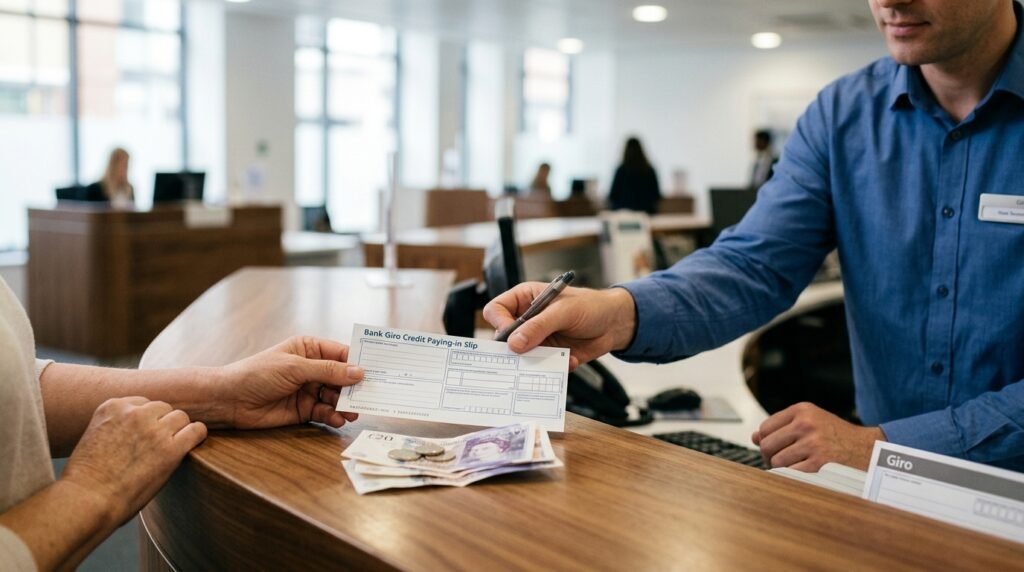
Bank Giro is an established UK payment method that historically allowed people and businesses to pay money into another account using a paper payment slip at a bank or other participating payment location. The system still exists, although everyday banking has increasingly moved towards electronic payments.
It is important not to confuse Bank Giro Credit with BACS. They are different payment methods. HMRC’s own guidance distinguishes Bank Giro from BACS and describes Bank Giro as a credit transfer system that can involve payment through a bank branch.
Quick answer: If “BGC” appears beside money coming into your account, it generally means the transaction has been classified as a Bank Giro Credit. To identify exactly who sent the money or how it was processed, check the transaction details or contact your bank.
What Is a Bank Giro Credit?
A Bank Giro Credit (BGC) is a UK payment method used to credit money to a bank account.
Historically, a payer could use a Bank Giro Credit slip containing information needed to direct the payment to the recipient’s account. The payment could then be made through an appropriate bank or payment location.
Pay.UK continues to maintain standards for Bank Giro Credit vouchers, including requirements covering their design, code lines, printing and security.
The important distinction is:
- Bank Giro Credit = a payment method/system
- BGC = the abbreviation commonly used for Bank Giro Credit
- BGC on a bank statement = a transaction description/type used by the bank
- BACS = a separate electronic payment system
In simple terms
Think of Bank Giro Credit as a way of getting money into an account using payment instructions associated with the Bank Giro system.
The physical paper slip is less common today, but the Bank Giro terminology has not completely disappeared.

What Does BGC Mean on a Bank Statement?
If you see BGC on your UK bank statement, it normally means Bank Giro Credit.
For example, a statement might show something similar to:
| Date | Description | Money in |
|---|---|---|
| 17 Aug 2026 | BGC – Example Company | £250 |
| 18 Aug 2026 | FPI – Example Customer | £100 |
| 19 Aug 2026 | BACS – Salary | £2,000 |
The exact wording and transaction codes vary between banks.
Some banks explicitly define BGC as Bank Giro Credit in their statement documentation. For example, Lloyds statement materials list “BGC” as “Bank Giro Credit.”
Does BGC tell you who sent the money?
Not necessarily.
The BGC code identifies the payment type, while the accompanying transaction description may provide information about the sender.
If you do not recognise the payment:
- Check the full transaction description.
- Check the payment amount and date.
- Look for a related invoice, refund or payment.
- Contact your bank if you still cannot identify it.
Do not assume an unfamiliar BGC payment is a salary, refund or BACS payment simply because it is a credit into your account.
How Does Bank Giro Credit Work?
The traditional Bank Giro process can be understood in several steps.
Step 1: The recipient provides payment details
A business or organisation receiving money can provide a Bank Giro Credit voucher or paying-in information to the person making the payment.
Step 2: The payer completes the payment
Historically, the payer could take the relevant slip and payment to an appropriate bank or payment location.
Depending on the arrangement, payment could involve cash or a cheque.
Step 3: The payment is processed
The banking system processes the payment instruction and credits the receiving account.
Step 4: The recipient receives the credit
The money appears in the recipient’s account, with the bank potentially showing BGC or another transaction description.
Pay.UK’s current standards confirm that BGC vouchers remain subject to formal requirements when they pass through the UK credit-clearing system.
Is Bank Giro Credit the Same as a Paying-In Slip?
No, although the terms can be confusing because both involve paying money into a bank account.
A paying-in slip is generally associated with making a deposit into an account and contains the information needed to credit that account.
A Bank Giro Credit voucher is a specific type of credit-payment document used within the Bank Giro system.
The exact process and terminology can depend on the bank and payment arrangement.
For that reason, it is better not to treat every paying-in slip as a Bank Giro Credit.
Bank Giro Credit vs BACS
This is one of the most important distinctions to understand.
Bank Giro Credit and BACS are separate payment methods.
HMRC’s glossary describes BACS as an automated service used by banks and building societies for clearing electronic payments. It separately describes Bank Giro as a credit transfer system that enables payment through a bank branch.
| Feature | Bank Giro Credit | BACS |
| Common abbreviation | BGC | BACS |
| Type | Bank Giro payment | Electronic clearing service |
| Historical use | Branch/payment-slip transactions | Electronic payments |
| Physical voucher | Can involve a BGC voucher | No physical BACS voucher required |
| Common business use | Payments using Bank Giro arrangements | Salaries, supplier payments and other bulk payments |
| Same system? | No | No |
Important clarification
A BGC entry should not automatically be described as a BACS payment.
HMRC’s payment documentation treats Bank Giro and BACS as distinct categories.

Bank Giro Credit vs Faster Payments
Faster Payments is a modern electronic payment service used for many everyday UK bank transfers.
Bank Giro Credit is a different payment method with roots in paper-based payment instructions.
| Feature | Bank Giro Credit | Faster Payments |
| Main purpose | Credit payment through Bank Giro | Electronic bank transfer |
| Physical slip | Historically common | No |
| Typical use today | More limited/legacy arrangements | Everyday transfers |
| Speed | Depends on processing route | Designed for rapid electronic payments |
| Statement code | May appear as BGC | Often shown as FPI or similar |
A Faster Payment should not be described as a BGC simply because both result in money being credited to an account.
Bank Giro Credit vs CHAPS
CHAPS is another separate UK payment system.
CHAPS is designed for same-day sterling payments, particularly where the transaction is time-critical and high-value.
Bank Giro Credit is not the same thing.
| Feature | Bank Giro Credit | CHAPS |
| Main role | Bank Giro credit payment | Same-day high-value payment |
| Typical environment | Traditional/legacy payment arrangements | Large or time-critical payments |
| Physical voucher | Historically possible | No |
| Payment system | Bank Giro | CHAPS |
For example, a property transaction might involve CHAPS because the payment needs to arrive within a specific timeframe. That does not make it a Bank Giro Credit.
Why Does Bank Giro Credit Still Exist?
Bank Giro Credit has survived partly because payment infrastructure changes gradually.
Many organisations historically used printed payment slips, particularly for:
- Utility bills
- Tax payments
- Government payments
- Invoices
- Membership payments
- Other recurring bills
Although customers now have more electronic payment options, Bank Giro Credit has not completely disappeared.
Pay.UK still publishes guidance covering the production and security of Bank Giro Credit vouchers.
HMRC documentation also continues to reference Bank Giro as an available payment method in certain circumstances. For example, HMRC’s Corporation Tax manual lists bank giro credit with a paying-in slip among accepted payment methods in the specified context.
Can You Still Pay by Bank Giro Credit?
In some circumstances, yes.
However, availability depends on the organisation receiving the payment and the payment instructions it provides.
For example, HMRC still documents situations where a bank giro credit paying-in slip can be used at a bank or building society branch.
This does not mean every business, biller or bank will accept a physical BGC slip.
If you have an old bill containing a Bank Giro Credit slip, check the issuer’s current payment instructions before attempting to use it.
Are Bank Giro Credit Slips Still Used?
Yes, but they are much less prominent than they were when paper-based banking was more common.
The continued existence of formal Pay.UK standards for BGC vouchers shows that the format remains part of the UK’s payment infrastructure.
However, consumers now have alternatives such as:
- Online banking
- Faster Payments
- Direct Debit
- Debit-card payments
- Mobile banking
- Other electronic payment services
The availability of each method depends on the organisation receiving the payment.
Is a Bank Giro Credit Safe?
Bank Giro Credit is an established payment method, but the safety of any payment depends on using the correct payment details and following the relevant bank or organisation’s instructions.
If you are paying using a physical BGC voucher:
- Check the recipient details carefully.
- Do not alter pre-printed account information unless instructed.
- Keep your payment receipt.
- Make sure the amount is correct.
- Follow the recipient’s current payment instructions.
Pay.UK’s BGC standards include security requirements for the production and printing of Bank Giro Credit vouchers.
If a BGC payment appears on your account that you do not recognise, contact your bank rather than assuming it is legitimate.
What Does BGC Mean for Businesses?
BGC can be particularly relevant when reconciling business bank statements.
A finance team might see:
BGC – Customer Name – £500
The first step is to recognise BGC as the transaction type.
The business should then match:
- Amount
- Date
- Customer
- Invoice reference
- Payment description
against its accounting records.
Example
Suppose a business has an unpaid £500 invoice.
Its bank statement later shows:
BGC – ABC Ltd – £500
The finance team can investigate whether the payment corresponds to that invoice.
However, the BGC label alone should not be treated as proof of the underlying payment route or the reason for the payment. If the transaction is unclear, the bank’s detailed transaction information should be checked.
What If You Do Not Recognise a BGC Payment?
An unexpected BGC credit does not automatically mean something is wrong.
It could relate to:
- A customer payment
- A refund
- An organisation paying you
- A business transaction
- A historical payment arrangement
- Another legitimate credit
But you should identify it before treating it as your own money to spend.
What to do
1. Check the description
Look for the sender’s name, reference or other information.
2. Check your records
Compare the payment with invoices, refunds, reimbursements or other expected credits.
3. Ask the sender
If you think the payment could be related to a particular organisation, contact it using independently verified contact details.
4. Contact your bank
If you still cannot identify the payment, ask your bank for help.
Do not send money back to an unknown person solely because someone contacts you and claims that a BGC payment was made accidentally.
Is BGC the Same as a Bank Transfer?
Not exactly.
“Bank transfer” is a broad everyday description for moving money between bank accounts.
Bank Giro Credit is a specific payment method.
Other bank-payment methods include:
- BACS
- Faster Payments
- CHAPS
- Direct Debit
- Card payments
- Bank Giro
The important point is that these systems have different characteristics and should not be treated as interchangeable.

Does BGC Mean Money Has Cleared?
A BGC entry showing as credited to your account generally indicates that your bank has recorded the transaction as a credit.
However, if you are dealing with a payment where finality, availability of funds or fraud risk is important, rely on your bank’s current information rather than assuming that the BGC label alone tells you everything about the status of the funds.
For business transactions, keep appropriate payment records and reconcile the transaction against the underlying invoice or payment reference.
Bank Giro Credit: Key Points to Remember
If you only remember a few things from this guide, remember these:
- BGC means Bank Giro Credit.
- It is a UK payment method with a long history.
- BGC vouchers traditionally used paper payment instructions.
- BGC and BACS are different payment methods.
- BGC may still appear as a transaction type on UK bank statements.
- Some organisations still provide Bank Giro payment options.
- Always check the exact payment details if you do not recognise a transaction.
- Current payment options vary between banks and organisations.
Frequently Asked Questions
What is a Bank Giro Credit?
A Bank Giro Credit is a UK payment method used to credit money to a bank account. Historically, it commonly involved a paper voucher or payment slip. Pay.UK continues to maintain standards for Bank Giro Credit vouchers.
What does BGC mean on a bank statement?
BGC normally stands for Bank Giro Credit. It identifies the transaction type, while the accompanying description may provide information about the sender or payment reference. Lloyds, for example, lists BGC as “Bank Giro Credit” in its statement payment-type information.
Is BGC the same as BACS?
No. Bank Giro Credit and BACS are separate payment methods. HMRC’s guidance distinguishes Bank Giro from BACS.
Is BGC the same as Faster Payments?
No. Faster Payments is a separate electronic payment service. A transaction identified as BGC should not automatically be assumed to have been made through Faster Payments.
Can I still use a Bank Giro Credit slip?
Sometimes. Availability depends on the organisation receiving the payment and its current payment instructions. HMRC, for example, continues to document Bank Giro Credit as an accepted method in certain circumstances.
Why is BGC showing on my bank statement?
Your bank may use BGC to identify a credit received through the Bank Giro payment method. Check the accompanying description to determine who sent the money.
Is a Bank Giro Credit a direct deposit?
Not necessarily. “Direct deposit” is not the standard UK term for every incoming bank payment. A Bank Giro Credit is a specific payment method.
Can a BGC payment be a salary?
It can be possible for a credit to be described in different ways by different banking systems, but you should not assume that every BGC transaction is a salary. Check the transaction description and your employer’s payment records.
Is Bank Giro Credit still used in the UK?
Yes. Although electronic payment methods are now much more common, Pay.UK still maintains standards for BGC vouchers, and HMRC documentation continues to reference Bank Giro payments.
What should I do if I receive an unknown BGC payment?
Check the transaction details and your financial records. If you still cannot identify it, contact your bank. Do not automatically transfer the money elsewhere based solely on an unexpected message or phone call.