If you’ve got a bit of extra cash each month and you’re wondering whether to put it toward your mortgage, a mortgage overpayment calculator UK lenders and comparison sites provide can show you exactly what that decision is worth. It’s one of those tools that looks simple on the surface but can genuinely change how you think about your mortgage.
Here’s the thing: most people know overpaying reduces what they owe, but few realise just how dramatically it can cut years off a mortgage term, or how much interest it actually saves over time. The numbers are often far more compelling than people expect — which is exactly why running them properly matters.
It’s also easy to get this decision slightly wrong without realising it — overpaying more than your lender allows, dipping into savings you actually need, or missing out on a better use for that same money elsewhere. None of these mistakes are obvious from the calculator screen alone.
This guide walks through how these calculators work, what to actually check before overpaying, and a handful of mistakes that quietly reduce the benefit if you’re not careful.
Why a Mortgage Overpayment Calculator UK Tool Is Worth Using
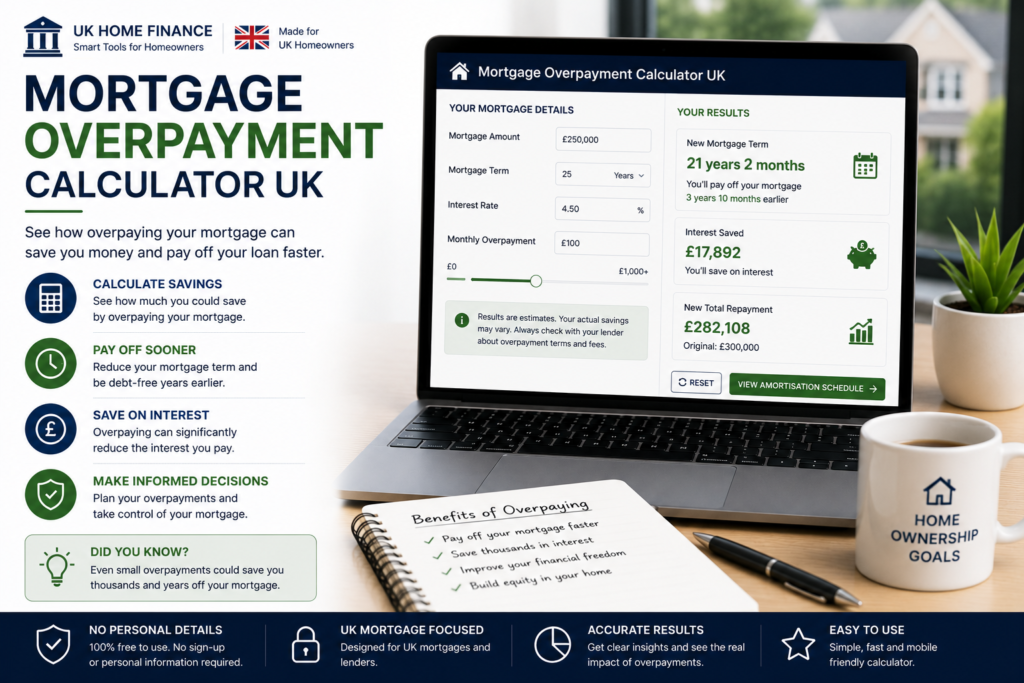
Numbers on a mortgage statement can feel abstract until you actually see them modelled out. A mortgage overpayment calculator UK tool takes your current balance, interest rate, and remaining term, then shows exactly how different overpayment amounts change your total interest paid and payoff date.
Seeing a concrete example — say, an extra £200 a month cutting four years off your mortgage — tends to be far more motivating than a vague sense that overpaying is “probably a good idea.” It transforms a fuzzy financial instinct into something you can actually plan around, whether that means adjusting your budget slightly or setting up a standing order for the extra amount.
Many calculators also let you model a one-off lump sum alongside regular monthly overpayments, which is useful if you’ve received a bonus, inheritance, or other unexpected windfall and you’re deciding what to do with it.
Takeaway: Running the actual numbers turns an abstract decision into a concrete, motivating one.

Tip #1: Check Your Lender’s Overpayment Allowance First
Before getting excited about a calculator’s projections, check how much you’re actually allowed to overpay without penalty. Most UK lenders permit up to 10% of your outstanding balance per year, though this varies, and exceeding it can trigger an early repayment charge that eats into your savings.
This allowance typically resets each year of your mortgage term, and some lenders calculate it slightly differently — either based on your original loan amount or your current outstanding balance. Checking your specific mortgage terms, rather than assuming a generic 10% figure, avoids an unpleasant surprise further down the line when you least expect it.
Takeaway: Confirm your lender’s specific overpayment limit before planning around calculator projections, since exceeding it can undo much of the benefit you were hoping to gain.
Tip #2: Decide Between Reducing Term or Reducing Payments
Most lenders let you choose how overpayments are applied — either shortening your mortgage term while keeping monthly payments the same, or reducing your monthly payment while keeping the term unchanged.
If your goal is becoming mortgage-free sooner, shortening the term typically saves more interest overall, since the loan is paid off faster and accrues less interest across its lifetime. If you want more monthly breathing room instead, reducing payments might suit your situation better, even though the total interest saved will usually be somewhat lower.
It’s worth checking with your lender directly, since some apply overpayments to reduce the term by default, while others reduce your monthly payment unless you specifically request otherwise.
Takeaway: Be clear on your actual goal — faster payoff or lower monthly costs — before choosing how overpayments are applied.
Tip #3: Don’t Overpay at the Expense of Your Emergency Fund
It’s tempting to put every spare pound toward your mortgage once you see how much interest a calculator says you’ll save. But locking cash into your mortgage means it’s no longer available for genuine emergencies — a boiler breakdown, job loss, or unexpected medical expense, for example.
Most financial advisors suggest keeping three to six months of expenses in an accessible savings account before prioritising mortgage overpayments with any remaining surplus. This isn’t about being overly cautious — it’s about making sure a short-term cash flow problem doesn’t force you into expensive borrowing elsewhere just because your spare cash is tied up in your mortgage, where it can’t easily be accessed again.
Takeaway: Build a solid emergency fund first — overpaying is most valuable once you already have a safety net in place.
Tip #4: Compare Overpaying Against Other Debts and Savings
If you’re carrying higher-interest debt elsewhere — credit cards or personal loans, for example — paying that off first usually saves more money than overpaying a mortgage at a lower interest rate. Credit card interest rates in particular are often several times higher than typical mortgage rates, making them the more urgent priority to clear before considering any overpayment plan at all.
Similarly, if your mortgage rate is unusually low, it’s worth comparing whether that spare cash might earn more in a competitive savings account or fixed rate bond instead. In some cases, especially with historically low mortgage rates, the maths can actually favour saving over overpaying.
Takeaway: Overpaying your mortgage isn’t automatically the best use of spare cash — compare it against your other financial priorities first.

Tip #5: Recalculate Regularly as Your Situation Changes
A mortgage overpayment calculator UK homeowners use once at the start of the year can quickly become outdated as your income, rates, or balance change. Revisiting the numbers every six to twelve months ensures your overpayment strategy still reflects your current circumstances.
This is particularly important if your mortgage comes off a fixed rate and moves to a different interest rate, since the savings from overpaying can shift significantly. A strategy that made perfect sense on a low fixed rate might look quite different once your mortgage reverts to a higher standard variable rate.
Life circumstances change too — a pay rise, a new expense, or a change in job security can all shift how much you can comfortably afford to overpay each month.
Takeaway: Treat overpayment planning as an ongoing habit, not a single calculation you set and forget.
What Information You’ll Need to Use a Calculator
Most mortgage overpayment calculators ask for a similar set of details:
- Outstanding mortgage balance
- Current interest rate
- Remaining mortgage term
- Proposed monthly or lump-sum overpayment amount
- Whether you want to reduce your term or your monthly payment
Having these figures ready from your latest mortgage statement makes the process quick and gives you an accurate, personalised projection rather than a rough estimate. Some calculators will also ask whether your mortgage has a fixed or variable rate, since this can affect how future payments and savings are projected.
Takeaway: Accurate inputs make the difference between a genuinely useful projection and a misleading one that leaves you disappointed later.
Common Mistakes That Undermine Overpayment Savings
A few avoidable mistakes can quietly reduce how much overpaying actually saves you:
- Exceeding your lender’s overpayment allowance and triggering a penalty
- Overpaying instead of clearing higher-interest debt elsewhere
- Depleting your emergency fund to fund overpayments
- Forgetting to confirm whether overpayments reduce your term or your monthly payment by default
- Not recalculating projections after a rate change
- Assuming every calculator uses identical assumptions about interest calculation methods
Avoiding these pitfalls means the savings a calculator shows you are far more likely to actually materialise, rather than being quietly eroded by an overlooked fee or a mismatched assumption.
Takeaway: A calculator’s projection is only as good as the assumptions and habits behind it.
Frequently Asked Questions
1. What does a mortgage overpayment calculator UK actually show? It shows how making extra payments beyond your regular mortgage instalment affects your total interest paid and remaining term, letting you compare different overpayment amounts side by side.
2. Is overpaying my mortgage always a good idea? Usually, yes, provided you’re not sacrificing an emergency fund or paying off higher-interest debt elsewhere first. It’s generally one of the more reliable ways to reduce long-term interest costs.
3. Are there limits on how much I can overpay my mortgage? Yes, most UK lenders cap overpayments at around 10% of the outstanding balance per year without triggering an early repayment charge, though this varies by provider and mortgage type.
4. Does overpaying reduce my monthly payment or my mortgage term? It depends on your lender and preference. Some let you choose whether extra payments shorten the term while keeping payments the same, or reduce your monthly payment while keeping the term unchanged.
5. Can I use a mortgage overpayment calculator for any type of mortgage? Most calculators work for standard repayment mortgages. Interest-only or more complex mortgage products may need a specialist calculator or direct confirmation from your lender.
6. Will overpaying my mortgage affect my credit score? No, overpaying doesn’t negatively affect your credit score. If anything, reducing your debt faster tends to reflect positively over time as your overall borrowing decreases.
Final Thoughts
A mortgage overpayment calculator UK homeowners rely on can turn a vague financial instinct into a clear, motivating plan. Seeing exactly how much time and interest you could save by overpaying often makes the decision to actually do it much easier, especially once the numbers are laid out in front of you rather than left as an abstract idea.
Just make sure you’re checking your lender’s allowance, protecting your emergency fund, and comparing overpaying against your other financial priorities before committing. Done properly, it’s one of the more reliable ways to reduce the overall cost of owning your home — and one of the few financial decisions where a few minutes with a calculator can genuinely save you thousands of pounds over the life of your mortgage.