Ask any bank executive what keeps them up at night, and legacy technology is usually somewhere near the top of the list. Systems built decades ago are still running the backbone of daily operations at plenty of institutions, and every year that gap between what’s possible and what’s actually running gets a little wider.
That’s exactly why the benefits of core banking solution adoption have become such a central conversation in financial services right now. It’s not just a technology upgrade — it’s a shift in how fast a bank can move, how much it costs to operate, and how well it can compete with far more agile digital-first competitors. Understanding the true benefits of core banking solution adoption is the first step toward building a realistic modernization roadmap.
This guide breaks down the real, practical benefits of modernizing your core banking system, along with what to actually expect during the transition.
What a Core Banking Solution Actually Does
Before getting into the benefits, it’s worth being clear about what a core banking solution actually is. It’s the central technology platform that manages a bank’s essential operations — customer onboarding, account management, payment processing, the general ledger, and reporting — all in one integrated system.
Modern platforms increasingly favor a modular, API-first, cloud-ready structure rather than the single, tightly bundled codebase that older systems relied on. That architectural shift is a big part of why the benefits of core banking solution modernization are more achievable today than they were even a few years ago.
Quick takeaway: Before evaluating any specific platform, get clear internally on whether you need a full core replacement or just a lighter integration layer on top of an existing system. The right answer changes which benefits actually apply to your institution.

1. Faster Product Launches
One of the most immediate benefits of core banking solution modernization is speed, and it’s often the one that gets noticed first internally. Cloud-native architectures let product teams roll out new account types, pricing structures, or features using configuration and APIs, rather than requiring heavy custom code changes.
- New products that once took months to launch can often go live in weeks
- Configuration-based product design reduces dependency on scarce engineering resources
- Faster iteration means banks can respond to competitor moves and customer feedback more quickly
Takeaway: If your institution is still measuring product launch timelines in quarters rather than weeks, that’s usually the clearest early signal that your core platform is holding you back.
2. Real-Time Transaction Processing
Older core systems often rely on batch processing, meaning transactions post overnight rather than instantly. Modern platforms process deposits, withdrawals, transfers, and loan disbursements in real time, reflecting updated balances immediately — one of the benefits of core banking solution upgrades that customers notice right away.
- Real-time processing supports instant payment rails and same-day settlement expectations
- Customers see accurate balances immediately, reducing disputes and support calls
- Fraud detection systems can act on real-time data instead of reviewing yesterday’s batch
Takeaway: If your institution still relies heavily on end-of-day batch cycles, ask your vendor directly what a realistic timeline looks like for moving core transaction types to real-time processing.
3. Elastic Scalability
Demand on banking systems is no longer predictable in the way it once was. A cloud-based core banking solution can scale resources up or down based on actual usage, rather than being sized for a fixed, worst-case capacity — a benefit that becomes obvious the first time volume spikes unexpectedly.
- Seasonal demand spikes, like tax season or major promotional campaigns, can be absorbed without over-provisioning hardware year-round
- Scalability reduces the risk of system slowdowns during high-traffic periods
- Institutions avoid the sunk cost of maintaining physical infrastructure for rare peak loads
Takeaway: When comparing core banking vendors, ask specifically how their platform handles sudden demand spikes — not just steady-state performance, which is far easier for any vendor to demonstrate.
4. Lower Total Cost of Ownership
It might seem counterintuitive, but modernizing a core system frequently reduces costs over time, even though the upfront investment can be significant — one of the more underappreciated benefits of core banking solution adoption. Cloud deployment removes much of the overhead tied to maintaining physical data centers and aging hardware.
- Institutions no longer need to staff and maintain specialized infrastructure teams solely for legacy hardware
- Pay-as-you-scale cloud pricing models align cost more closely with actual usage
- Reduced manual workarounds for compliance and reporting free up staff time for higher-value work
Takeaway: When building the business case for core modernization, include the hidden costs of your current system — manual workarounds, legacy maintenance contracts, and staff hours spent patching gaps — not just the sticker price of a new platform.
5. Stronger Compliance and Regulatory Reporting
Regulatory reporting requirements have only expanded in recent years, and a modern core banking solution can automate much of that burden directly from its data layer, generating structured reports without manual spreadsheet assembly — a clear example of the benefits of core banking solution automation in practice.
- Automated reporting reduces the risk of human error in regulatory submissions
- A core platform with built-in compliance automation improves audit readiness significantly
- Institutions without this automation face a growing staffing overhead with every new regulatory requirement
Takeaway: If your compliance team is still manually reformatting exports for regulatory submissions, that workload is a strong indicator of how much time a modern core platform could realistically save.
6. Better Data Access and Business Intelligence
Modern core banking platforms typically include native analytics, giving branch managers, compliance officers, and executives direct access to real-time dashboards rather than waiting on IT-generated reports — another one of the practical benefits of core banking solution modernization that pays off daily.
- Pre-configured dashboards can track loan portfolio performance, deposit trends, and delinquency rates as they happen
- Teams can slice and filter data without exporting to spreadsheets or submitting IT tickets
- Faster access to trends allows institutions to adjust underwriting or product strategy within days rather than weeks
Takeaway: Ask any prospective core banking vendor to demo their actual dashboard, not just describe it. The gap between “has reporting” and “has genuinely useful, real-time reporting” is often significant.
7. Improved Customer and Digital Experience
Ultimately, most of the technical benefits above connect back to one outcome: a better experience for the end customer. Among all the benefits of core banking solution modernization, this is arguably the one that matters most to the institution’s bottom line. A modern core banking solution supports faster account openings, more personalized digital interactions, and fewer service disruptions.
- API-driven cores integrate more smoothly with mobile apps, chatbots, and self-service channels
- Real-time data means customer service teams have accurate, up-to-date information the moment a customer calls
- Faster product innovation means customers get access to new features sooner, rather than waiting years behind competitors
Takeaway: When evaluating the customer-facing payoff of core modernization, look specifically at account opening time and first-contact resolution rates — both tend to improve measurably after a well-executed migration.
What to Expect During the Transition
Understanding the benefits of core banking solution modernization is one thing; managing the actual transition is another. Most successful migrations happen gradually, starting with peripheral applications before moving core components that benefit most from added flexibility and speed. Institutions that rush this step often undermine the very benefits of core banking solution adoption they set out to achieve.
A full core replacement is a significant undertaking, and rushing it tends to create more problems than it solves. Clear ownership of ledger and compliance strategy, realistic data migration timelines, and a willingness to run systems in parallel during the transition all matter more than picking the vendor with the longest feature list.
Takeaway: Resist the temptation to attempt a single, all-at-once core conversion. A phased approach, starting with lower-risk components, gives your team room to catch issues before they affect core account and payment functions.
Final Thoughts
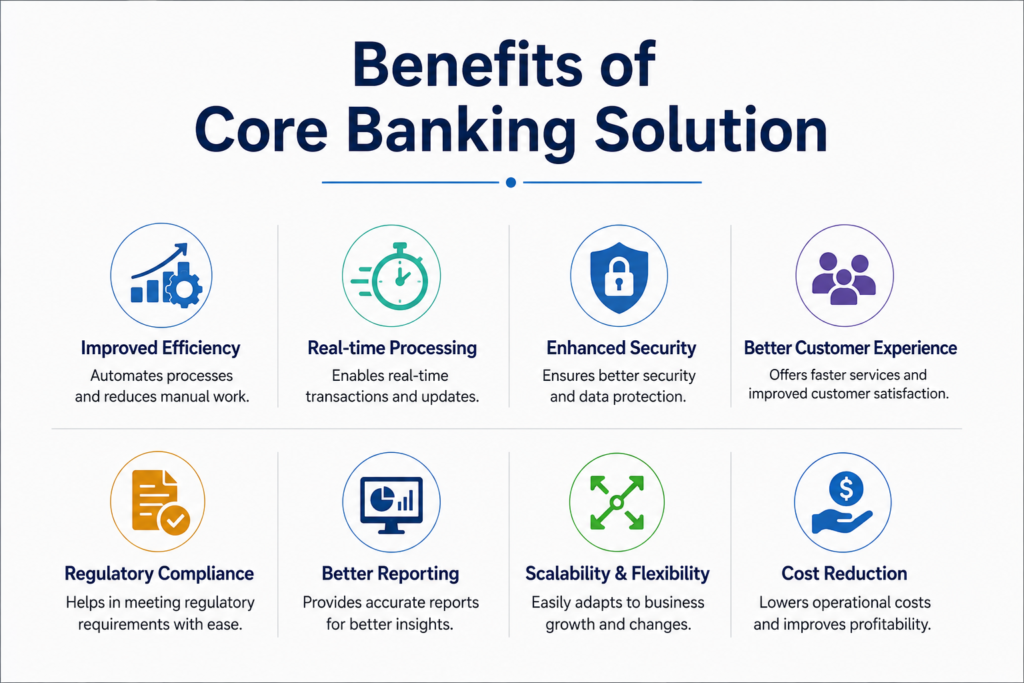
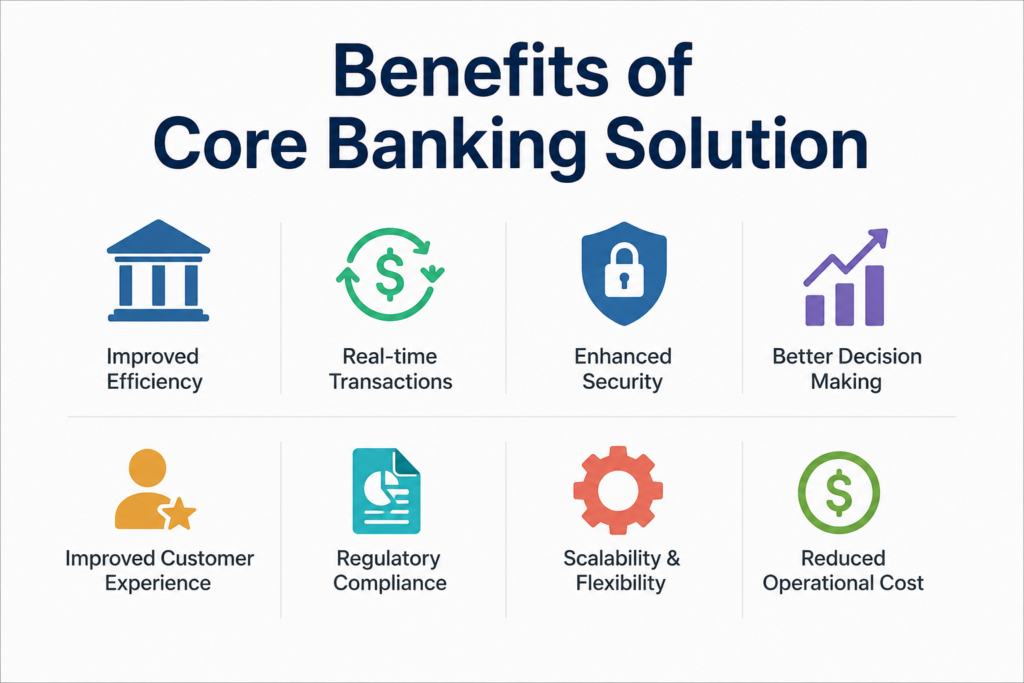
The benefits of core banking solution modernization go well beyond a simple technology refresh. Faster product launches, real-time processing, better scalability, lower long-term costs, stronger compliance automation, richer data access, and an improved customer experience all stem from the same underlying shift: moving away from rigid, legacy architecture toward modular, cloud-ready platforms.
That said, the right approach depends heavily on your institution’s size, existing infrastructure, and risk tolerance. A large enterprise bank and a growing credit union will reasonably choose very different paths to capture these same benefits. What matters most is starting with a clear-eyed assessment of where your current system is actually holding you back, rather than chasing the newest platform simply because it’s newest.
5. FAQs Section
1. What are the main benefits of core banking solution modernization? The core benefits include faster product launches, real-time transaction processing, elastic scalability, lower long-term costs, stronger regulatory compliance automation, better data access, and an improved customer experience.
2. Is a core banking solution only useful for large banks? No. Community banks, credit unions, and smaller financial institutions often see some of the most significant benefits, since the gap between legacy systems and modern platforms tends to be widest for smaller institutions.
3. How long does core banking modernization typically take? Timelines vary widely depending on scope, but most successful migrations happen gradually, starting with peripheral applications before transitioning core components, rather than attempting a single all-at-once conversion.
4. Does a core banking solution reduce compliance workload? Yes, in most cases. Modern platforms can automate regulatory report generation directly from their data layer, reducing manual data extraction and improving audit readiness significantly.
5. What’s the difference between a modular and monolithic core banking system? A monolithic system is built as a single, tightly integrated codebase, while a modular system breaks functions like accounts, payments, and compliance into independent components that can be updated separately.
6. Are the benefits of core banking solution adoption worth the upfront cost? For most institutions facing rising legacy maintenance costs and competitive pressure, yes — though the business case should weigh hidden legacy costs, not just the sticker price of the new platform.