
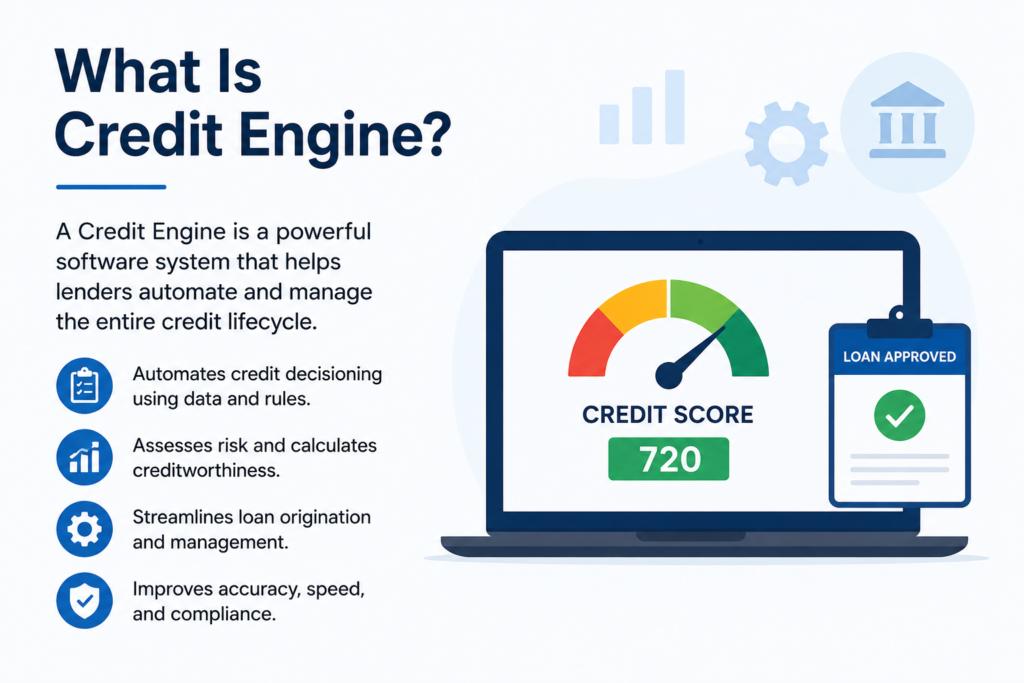
If you’ve ever applied for a loan or credit card and gotten an answer back in seconds instead of days, there’s a decent chance a credit engine made that happen behind the scenes. Most borrowers never think about the technology involved — they just notice the speed.
So what is credit engine technology, exactly? In simple terms, it’s the software system that automates how lenders assess creditworthiness. Instead of a loan officer manually reviewing paperwork line by line, a credit engine pulls in data, applies a set of rules or models, and produces a decision, often in a fraction of a second.
This guide breaks down what a credit engine actually does, how it fits into the broader lending process, and why it’s become such a foundational piece of modern financial technology.
What Is Credit Engine Technology, In Plain Terms?
A credit engine is a software platform that evaluates an applicant’s creditworthiness by analyzing data and applying decisioning rules or statistical models, rather than relying on manual, case-by-case human review.
It typically pulls together multiple data sources — credit bureau records, income information, banking transaction history, and sometimes alternative data like utility or rental payments — and produces a decision, a risk score, or both. Lenders then use that output to approve, decline, or adjust the terms of a loan or credit product.
Quick takeaway: If you’re comparing lending platforms or vendors, ask specifically what data sources their credit engine pulls from. The breadth and quality of data feeding the engine often matters more than the sophistication of the model itself.
1. It Replaces Manual, Case-by-Case Review
Understanding what is credit engine technology really comes down to appreciating what it replaces. Traditional credit assessment relied heavily on manual processes, personal interactions, and often inconsistent, subjective judgment calls.
- Manual review is slow, and inconsistent decisions between different loan officers were common
- A credit engine applies the same rules and logic to every applicant, improving consistency
- Automated evaluation dramatically reduces the time between application and decision
Takeaway: If your lending process still depends heavily on manual underwriting, look at how much time is genuinely spent on routine, low-risk applications — those are usually the easiest cases to automate first.
2. It Pulls From Multiple Data Sources at Once
A modern credit engine doesn’t rely on a single data point. It’s built to ingest and analyze many attributes simultaneously, often within a fraction of a second — a defining trait of what is credit engine software today compared to older systems.
- Credit bureau data from major bureaus is a foundational input for most engines
- Banking transaction data, sometimes sourced through providers like Plaid or similar aggregators, adds real income and spending visibility
- Alternative data, such as rental payment history, can help assess applicants with thin or limited credit files
Takeaway: If you’re evaluating applicants with limited traditional credit history, ask whether your credit engine supports alternative data sources — it can meaningfully expand who you’re able to responsibly lend to.

3. It Applies Rules, Scores, or Both
One of the more technical aspects of what is credit engine software involves how decisions actually get made. Most engines combine rule-based logic with statistical or machine learning models, rather than relying on just one approach. This hybrid setup is a defining feature once you look closely at what is credit engine architecture in most modern lending platforms.
- Rules-based logic handles clear-cut criteria, like minimum income thresholds or credit score cutoffs
- Statistical models and machine learning can identify more nuanced risk patterns across large datasets
- Many lenders build proprietary credit scores tailored to their own product and customer base, on top of standard bureau scores
Takeaway: Ask your credit engine provider whether custom rules can be layered on top of any built-in scoring models — flexibility here often determines how well the system fits your specific lending criteria.
4. Speed Is One of Its Biggest Advantages
Modern lending is largely a speed business, and credit engines are built to keep pace. That speed is one of the clearest, most tangible benefits people notice once they understand what is credit engine technology actually does. Applications that once took days to process can often be evaluated in seconds.
- Faster decisions improve the borrower experience and reduce application abandonment
- Real-time decisioning supports point-of-sale and embedded lending products, where speed is essential
- Speed doesn’t have to come at the cost of accuracy, provided the underlying data and models are sound
Takeaway: If your current decision process takes more than a few minutes for straightforward applications, that delay is usually a sign the underlying data pipeline — not just the scoring logic — needs attention.
5. Compliance and Explainability Are Built In
A responsible credit engine isn’t just fast — it also needs to operate within regulatory boundaries and produce decisions that can be explained if challenged.
- Decisioning rules need to reflect current regulatory requirements, which change over time
- Applicants are often entitled to understand or appeal a declined decision, so explainability matters
- Data privacy protections must be built into how applicant information is processed and stored
Takeaway: Before adopting or upgrading a credit engine, confirm how clearly it can explain an individual decision. An engine that can’t produce a clear reason for a decline creates real regulatory and reputational risk.
6. Data Quality Determines Real-World Performance
No matter how advanced the underlying algorithm is, a credit engine’s effectiveness depends heavily on the quality and completeness of the data feeding it. This is one of the most overlooked aspects of the technology.
- Integrating data from multiple, sometimes inconsistent sources is genuinely complex
- Non-conforming or poorly formatted data can produce unreliable results, even in an otherwise well-designed system
- Ongoing monitoring and data validation are necessary, not optional, for consistent performance over time
Takeaway: Before blaming a model for inconsistent decisions, check the data pipeline feeding it first. Data quality issues are a far more common culprit than most teams initially assume.
How Credit Engines Fit Into the Broader Lending Process
Once you understand what is credit engine technology actually doing under the hood, its role in the wider lending process becomes much clearer. It typically sits between the application intake step and the final approval or offer stage, acting as the decisioning layer that ties everything together.
Beyond the initial decision, many credit engines continue supporting the account throughout its lifecycle — segmenting customers, adjusting credit limits, and feeding into collections or risk management processes as circumstances change.
Takeaway: If you’re implementing a credit engine for the first time, map out its role across the full customer lifecycle, not just the initial approval decision — the ongoing value is often just as significant as the upfront speed gains.
Final Thoughts
So, what is credit engine technology, in the simplest terms? It’s the automated decisioning layer that modern lenders rely on to evaluate creditworthiness quickly, consistently, and at scale — pulling together bureau data, financial behavior, and sometimes alternative data sources into a single, fast decision. Understanding what is credit engine technology at this level makes it much easier to evaluate vendors and platforms with confidence.
That said, technology alone doesn’t guarantee good lending outcomes. A credit engine is only as reliable as the data feeding it and the rules governing its decisions. Lenders that invest in data quality, regulatory compliance, and explainability alongside the technology itself tend to get the most genuine value from it.
5. FAQs Section
1. What is a credit engine used for? A credit engine automates the process of assessing an applicant’s creditworthiness, analyzing data like credit history, income, and banking transactions to produce a lending decision or risk score.
2. How is a credit engine different from a credit score? A credit score is a single number representing risk, typically from a credit bureau. A credit engine is the broader software system that may use a credit score, along with other data, to make a full lending decision.
3. Can a credit engine work with limited credit history? Yes, many modern credit engines support alternative data sources, like rental or utility payment history, to help evaluate applicants who have thin or limited traditional credit files.
4. Is a credit engine only used by banks? No. Credit engines are used by banks, credit unions, telecoms, fintech lenders, and other businesses offering credit products, including point-of-sale and embedded lending platforms.
5. How fast can a credit engine make a lending decision? Many modern credit engines produce decisions within seconds, thanks to real-time data ingestion and automated rule or model application, compared to days for manual review.
6. What is credit engine explainability, and why does it matter? Explainability refers to a system’s ability to clearly justify why a decision was made. It matters because applicants may be entitled to understand or appeal a decline, and regulators often require transparent decisioning.