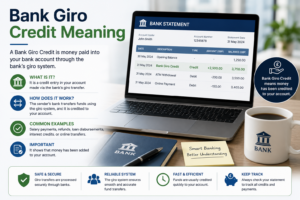
Look closely at an old chequebook, a utility bill, or even a modern bank statement, and you might spot the letters “BGC” somewhere. Most people scroll past it without a second thought — until they need to know exactly what it means.
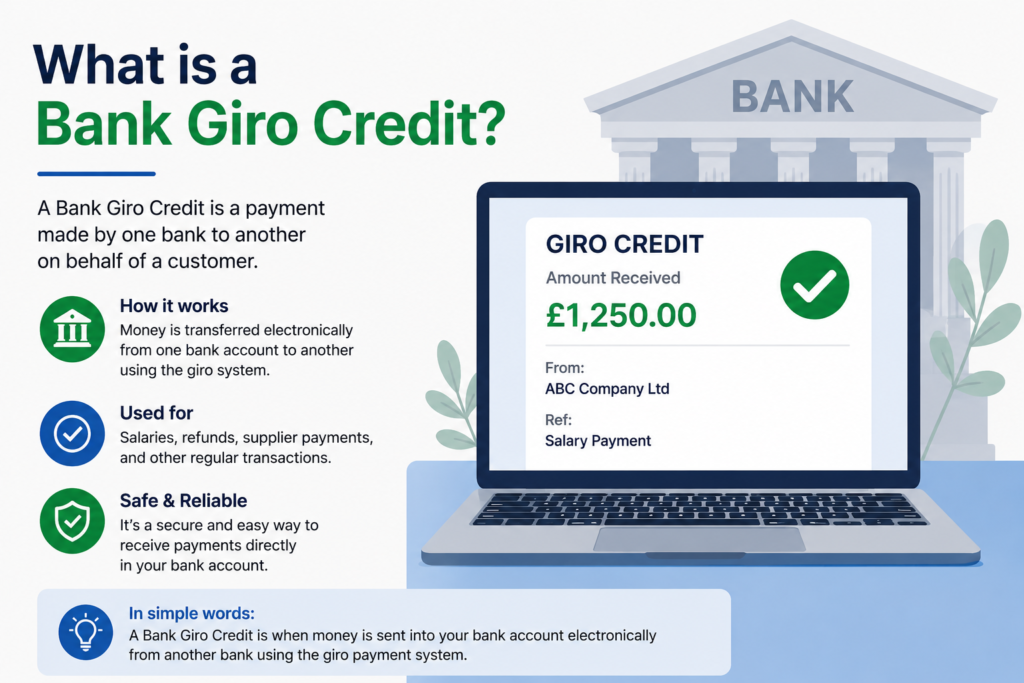
So what is a bank giro credit, really? At its core, it’s a UK payment method that lets money be paid into a bank account using a standardised slip, rather than an electronic instruction typed into an app. It’s one of those banking terms that feels old-fashioned, and in many ways it is, yet the label itself hasn’t fully disappeared from modern banking.
This guide breaks down exactly what a bank giro credit is, where the term came from, and why you might still see it referenced today even in an increasingly digital banking world.
What Is a Bank Giro Credit, In Plain Terms?
A bank giro credit, often shortened to BGC, is a standardised paper payment form used in the UK to instruct a bank to transfer money into a specific account. The word “giro” comes from the idea of the circulation of money, which gives a helpful mental picture of what the system was designed to do.
Importantly, the giro slip itself was never the money — it was the instruction that set a transfer in motion. It typically arrived pre-printed with the recipient’s account details, so the payer just needed to add the amount and hand it over with cash or a cheque at a bank or Post Office counter.
Quick takeaway: If you’re trying to understand a term on an old bill or bank statement, remember that a bank giro credit is an instruction slip, not the payment itself — the actual transfer happens once the bank processes it.

1. It Comes in Two Common Forms
One of the clearest ways to understand what is a bank giro credit is by looking at the two forms it typically takes for everyday customers, since the terminology can otherwise feel confusingly interchangeable.
- Paying-in slips are personalised with your own account details and are generally only accepted at the specific branch where you hold your account
- Bank giro credit transfer forms are similar but offer more flexibility, allowing transfers between different branches or payments to other people’s accounts
- Both are traditionally found at the back of a chequebook or in a separate pad of tear-out slips
Takeaway: If you still have an old chequebook lying around, check the back pages — you may already have both a paying-in slip and a bank giro credit form without realizing the distinction between them.
2. It’s How Many Bills Were Traditionally Paid
The most familiar version of a bank giro credit for many people is the tear-off slip found at the bottom of a paper utility bill or invoice — often the first place anyone actually encounters what is a bank giro credit in practice.
- The slip comes pre-printed with the service provider’s name, account details, and often a customer reference number
- The customer fills in the payment amount and either posts it back with a cheque or takes it to a bank or Post Office to pay by cash or cheque
- This method predates most digital billing systems and was, for decades, the standard way to settle a household bill in person
Takeaway: If you’re helping an older relative manage bills who’s used to paying this way, know that most billers still accept alternative digital methods even if a giro-style slip is included — it’s rarely the only option anymore.
3. Banks Verify Who Can Use Which Slip
There’s a practical security reason behind the difference between a paying-in slip and a bank giro credit form, and it comes down to fraud prevention — another detail worth knowing once you understand what is a bank giro credit at a basic level.
- Banks generally only accept paying-in slips from verified account holders, since this allows them to run anti-money-laundering checks
- Bank giro credit forms, being more flexible, may involve additional verification since they can move funds between different accounts or branches
- This structure exists specifically to reduce the risk of fraudulent deposits or misdirected funds
Takeaway: If a bank asks for identification when you’re using one of these slips, it’s a standard fraud-prevention step rather than anything unusual about your specific transaction.

4. The Term Predates Modern Electronic Payments
Understanding what is a bank giro credit also means understanding its place in UK banking history. The system originated in the mid-20th century, when the Post Office and high street banks worked together to move money efficiently around the country before electronic banking existed.
- It offered a way for people without a chequebook or bank card to still make and receive payments
- The system connected multiple banks, allowing transfers without directly handling cash between institutions
- As electronic payment infrastructure developed, methods like BACS, Faster Payments, and CHAPS gradually took over the bulk of everyday transactions
Takeaway: If you’re curious about UK banking history, the bank giro credit system is a useful reference point for understanding how far payment infrastructure has evolved in just a few decades.
5. BGC Still Appears on Modern Bank Statements
Here’s the part that surprises a lot of people: even though the physical giro slip has largely disappeared, the label “BGC” hasn’t. This is often the most practically useful fact in the whole discussion of what is a bank giro credit for anyone reading a modern statement. It still shows up on statements today, describing certain types of incoming payments.
- UK banks continue to use the BGC label for various incoming electronic credits, including salaries, refunds, and other customer payments
- These are often processed through legacy clearing routes, even though the underlying payment itself is fully electronic
- A payment labelled BGC on your statement may actually have been processed through the BACS network behind the scenes
Takeaway: If you see “BGC” next to an incoming payment on your bank statement, don’t assume it involved paper at all — in most cases today, it simply reflects how the payment is categorised internally, not how it was physically processed.
6. It’s Different From BACS, Faster Payments, and CHAPS
A common point of confusion is how a bank giro credit actually relates to the electronic payment systems most people use daily. Sorting out this distinction is often the last piece of genuinely understanding what is a bank giro credit versus the systems that replaced it. The key distinction is that BGC is a statement label describing a type of payment, while BACS, Faster Payments, and CHAPS are the underlying systems that actually clear and settle transactions.
- BACS Direct Credit typically takes a few business days and is widely used for salaries and supplier payments
- Faster Payments generally moves money within seconds to a couple of hours, prioritising speed for everyday transfers
- CHAPS is designed for high-value, same-day transfers, typically used for larger transactions like property purchases
Takeaway: If you’re comparing payment methods for a business, don’t confuse the BGC label with a specific processing speed — the actual settlement time depends on which underlying clearing system, like BACS or Faster Payments, is handling the transfer.
Why This Term Still Matters Today
Even though most people will never fill out a physical bank giro credit slip again, understanding what is a bank giro credit genuinely helps make sense of older bills, statement references, and how UK banking infrastructure evolved to where it is now. Anyone working in finance or bookkeeping benefits from knowing what is a bank giro credit the moment it appears unexpectedly on a reconciliation report.
For businesses and finance teams especially, recognising that a “BGC” label on a statement doesn’t necessarily indicate a legacy paper process, but often just a categorisation quirk, can prevent unnecessary confusion during reconciliation.
Takeaway: If a BGC entry on a business account statement looks unfamiliar, check with your bank about which underlying clearing system actually processed it rather than assuming it reflects an outdated paper-based payment.
Final Thoughts
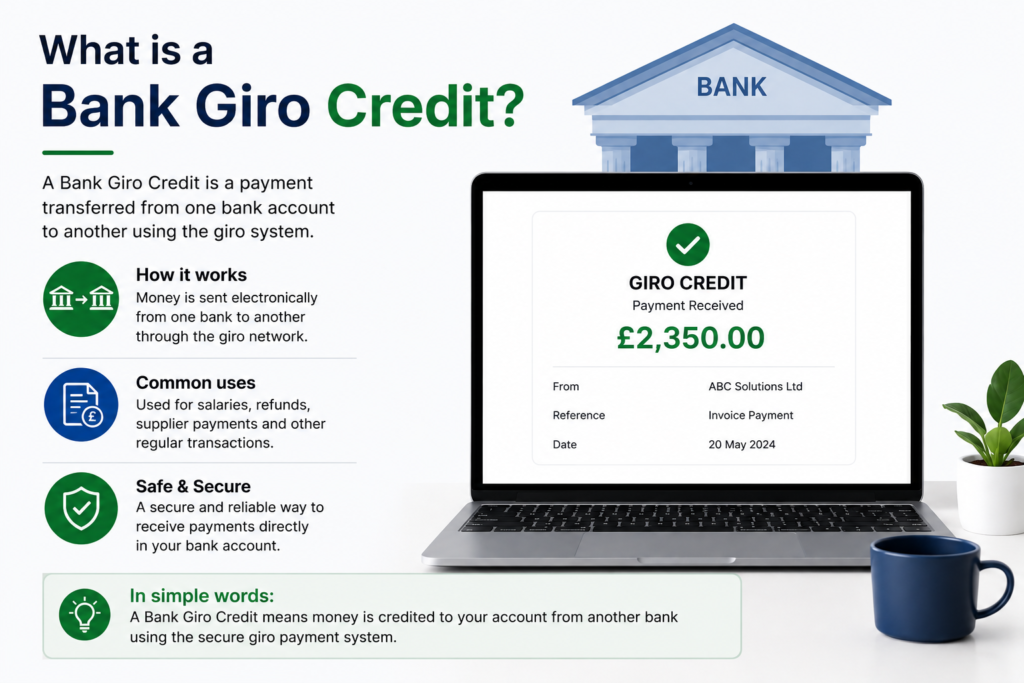
So, what is a bank giro credit, in the simplest terms? It’s a standardised UK payment form, and now a statement label, used to instruct or describe money being paid into a bank account — historically through a paper slip at a bank or Post Office counter, and today often simply reflecting how certain electronic payments are categorised.
The physical paper process has largely faded from daily use, replaced by BACS, Faster Payments, and CHAPS, but the terminology itself has proven surprisingly durable. Knowing what it means, and how it differs from the electronic systems that now do most of the actual work, is a genuinely useful piece of financial literacy, whether you’re managing an old chequebook or reconciling a modern business bank statement.
5. FAQs Section
1. What is a bank giro credit used for? A bank giro credit is a standardised UK payment form used to transfer money into a bank account, historically for paying bills or depositing cash and cheques at a bank or Post Office counter.
2. Is a bank giro credit the same as a paying-in slip? They’re similar but not identical. Paying-in slips are personalised to your own account and usually only accepted at your specific branch, while bank giro credit forms offer more flexibility for transfers between branches or to other accounts.
3. Why does BGC still appear on my bank statement? UK banks continue to use the BGC label for certain incoming electronic payments, like salaries or refunds, even though they’re processed through modern systems like BACS rather than a physical slip.
4. How is a bank giro credit different from BACS? BGC is a statement label describing a type of incoming payment, while BACS is the underlying clearing system that actually processes and settles the transaction, sometimes behind a payment labelled BGC.
5. Do UK banks still accept physical bank giro credit slips? Some banks and Post Offices may still process them, particularly for older bills, but most billing and banking has shifted toward digital payment methods, making physical slips increasingly rare.
6. Is a bank giro credit safe to use? Yes. Banks generally verify account holders before accepting paying-in slips and apply standard anti-money-laundering checks to bank giro credit transactions, similar to other payment methods.