Last updated: July 2026
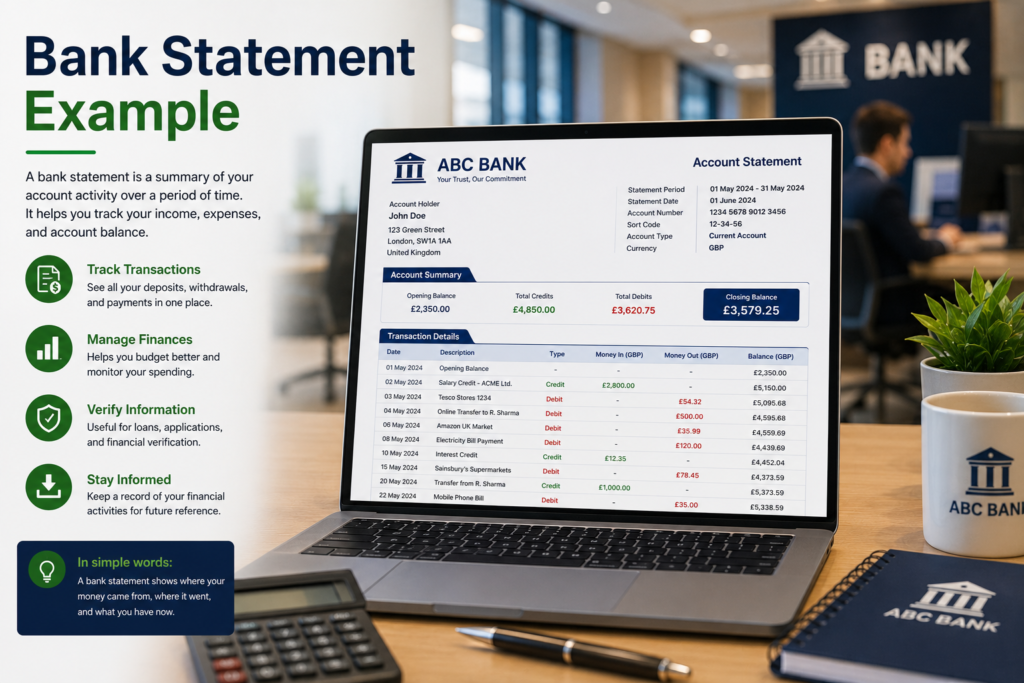
Lenders, landlords, and auditors all lean on one document more than any other when verifying your finances: the bank statement. Yet most people have never actually studied a bank statement example line by line — they just skim it and move on.
That gap matters more than it seems. Misreading a single section can mean missing an unauthorized charge, mismatching a loan application, or failing a reconciliation entirely.
This guide walks through a complete bank statement example, section by section, so you know exactly what every part means and why it’s there.
Quick-Reference: What a Bank Statement Actually Contains
| Section | What It Shows |
|---|---|
| Bank & account info | Institution details, your name, account number |
| Statement period | Exact start and end dates covered |
| Opening/closing balance | Account total at the start and end of the period |
| Deposits | All money credited, with dates and descriptions |
| Withdrawals | All money debited, with dates and descriptions |
| Fees & interest | Charges applied and any interest earned |
| Transaction codes | Abbreviations like ACH, POS, WDL, DEP |
What a Bank Statement Actually Is
A bank statement is an official document issued by a financial institution, typically every month, summarizing all account activity for that period. Unlike the real-time transaction feed in your banking app, a statement is a static snapshot — it captures a fixed opening balance, a fixed closing balance, and every transaction recorded in between.
That “static” nature is precisely why lenders, accountants, and auditors treat it as the authoritative record, rather than relying on a live app screen that can change by the minute.
Key takeaway: If you’re submitting financial documentation for a loan or rental application, always provide the official statement, not a screenshot of your live account — the static, dated format is what verifiers expect.

1. Bank and Account Information
Every bank statement example starts the same way: identifying exactly whose account and which institution the document covers.
- Fact: This section includes the bank’s name, address, and contact information
- Fact: It also lists the account holder’s name, address, and account number
- Purpose: This information confirms authenticity and allows any recipient to verify the statement’s source
Professional takeaway: When reviewing a statement for a loan or rental application, always confirm this section matches exactly — mismatched names or account numbers are an easy way to catch a doctored document.
2. The Statement Period
This is the timeframe every other section on the statement refers back to.
- Fact: The statement period lists the exact start and end dates, such as “May 1, 2026 – May 31, 2026”
- Fact: Most statements are issued monthly, though some accounts offer different reporting frequencies
- Why it matters: Every deposit, withdrawal, and fee listed on the statement falls specifically within this window
Professional takeaway: Before comparing two statements or reconciling records, double-check the statement periods actually line up — a mismatched date range is one of the most common reconciliation errors.
3. Opening and Closing Balance
Sometimes labeled the “account summary,” this section anchors the entire statement.
- Fact: The opening balance shows the amount in the account at the very start of the statement period
- Fact: The closing balance shows the amount at the very end, after every transaction is applied
- Formula: Closing Balance = Opening Balance + Total Deposits − Total Withdrawals − Fees
Professional takeaway: If your own math doesn’t match the stated closing balance, work through the formula above line by line — it’s the fastest way to isolate exactly which transaction is causing the discrepancy.

4. Deposits
This section lists every dollar that came into the account during the period.
- Fact: Each deposit entry typically includes the date, a description, and the amount credited
- Fact: Deposits can include payroll, transfers, check deposits, and refunds
- Tip: Recurring deposits, like a regular paycheck, are often the easiest line items to verify at a glance
Professional takeaway: When using a bank statement as proof of income, cross-check that deposit descriptions clearly identify payroll or client payments — vague entries can slow down loan or rental approval.
5. Withdrawals
The mirror image of the deposits section, covering every dollar that left the account.
- Fact: Withdrawal entries include ATM withdrawals, checks, and debit card purchases, each with a date, description, and amount debited
- Fact: This section is typically the longest part of a bank statement example, especially for active checking accounts
- Risk area: Unauthorized or unfamiliar withdrawal entries should be flagged and reported to your bank immediately
Professional takeaway: Scan the withdrawals section specifically for unfamiliar merchant names or repeated small charges — these are common fraud patterns that are easy to miss in a quick skim.
6. Fees and Interest
A section that’s easy to overlook, but genuinely worth reviewing every month.
- Fact: Any fees charged by the bank, such as monthly maintenance fees or overdraft charges, are itemized here
- Fact: Interest earned, if applicable, is also listed in this section separately from regular transactions
- Pattern to watch: Recurring fees that seem unusually high or unexplained are worth a direct call to your bank
Professional takeaway: Review this section every statement cycle specifically — small recurring fees are easy to miss individually but add up meaningfully over a year.
7. Transaction Codes and Abbreviations
The section that confuses more people than any other on a bank statement example.
- Fact: Banks compress transaction descriptions into short codes to fit limited space, such as “ACH,” “POS,” “WDL,” and “DEP”
- Fact: These codes follow general industry conventions, though exact formatting can vary slightly between institutions
- Practical tip: ACH typically indicates an electronic transfer, POS indicates a point-of-sale purchase, and WDL indicates a withdrawal
Professional takeaway: If a code on your statement is genuinely unclear, don’t guess — most banks provide a code glossary online or through customer service, and it’s worth checking before assuming a charge is unauthorized.

Reading a Bank Statement Example: Putting It All Together
Once you understand each of these seven sections individually, reading any bank statement example — regardless of which bank issued it — becomes far more manageable. Every institution structures these same core elements slightly differently, but the underlying information stays consistent.
Professional takeaway: When reviewing an unfamiliar statement format for the first time, use this seven-section framework as your checklist rather than trying to interpret the entire document at once.
The Bottom Line
A bank statement example, broken down properly, isn’t actually complicated — it’s seven consistent building blocks repeated every institution uses in some form:
- Bank and account info → Confirms authenticity
- Statement period → Defines the timeframe
- Opening/closing balance → Anchors the whole document
- Deposits → Money in
- Withdrawals → Money out
- Fees and interest → Charges and earnings
- Transaction codes → Shorthand explaining each line item
Master this framework once, and you’ll be able to read, verify, and reconcile any bank statement with genuine confidence, regardless of which bank issued it.
5. FAQs Section
1. What does a typical bank statement example include? A typical bank statement example includes bank and account information, the statement period, opening and closing balances, deposits, withdrawals, fees, and interest, along with transaction codes explaining each entry.
2. Why do lenders ask for a bank statement instead of a screenshot? A bank statement is a static, official, dated document, making it a more reliable and verifiable record than a live app screenshot that can change at any moment.
3. What do bank statement transaction codes like ACH and POS mean? ACH generally indicates an electronic transfer, POS indicates a point-of-sale purchase, and WDL indicates a withdrawal, though exact formatting can vary slightly between banks.
4. How can I use a bank statement example to spot fraud? Review the withdrawals section for unfamiliar merchant names or repeated small charges, and check that all deposits and withdrawals match your own records for the stated period.
5. What is the difference between opening and closing balance on a statement? The opening balance is the amount in the account at the start of the statement period, while the closing balance reflects the amount after all deposits, withdrawals, and fees during that period.
6. Can a bank statement be used as proof of income? Yes. Bank statements are commonly accepted as proof of income for loans, rental applications, or self-employed individuals, particularly when deposit descriptions clearly identify payroll or client payments.