Most banking guides only explain one direction of this mismatch: available balance dipping below current balance. But there’s a less common, genuinely confusing version of the problem — and if you’re here, you’re probably staring at it right now.
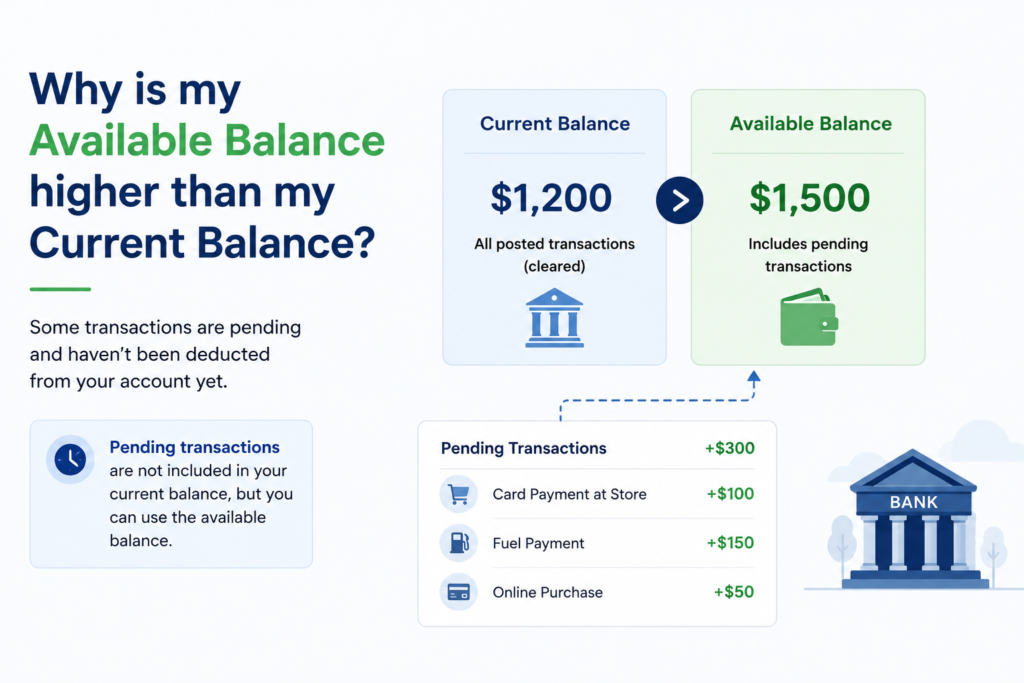
Why is my available balance higher than my current balance? It happens far less often than the reverse, and according to SoFi, it usually traces back to one of two specific causes: a posted refund, or your bank’s overdraft protection buffer showing up in the calculation.
This guide breaks down every realistic reason this can happen, and exactly what to check before you assume something’s wrong.
Quick-Reference: The Two Balance Mismatches
| Scenario | Typical Cause | How Common |
|---|---|---|
| Available balance lower than current | Pending debit, hold, or authorization | Very common |
| Available balance higher than current | Refund, overdraft buffer, or released hold | Less common |
The Core Reason: “Promised Payments” Work Both Ways
Your current balance reflects the total money in your account, including funds that have already been promised to someone else through pending transactions. Your available balance strips out those promised funds — but it can also add things back in, which is exactly why an available balance higher than current balance sometimes happens.
Key takeaway: If your available balance is higher than usual, don’t assume it’s simply “extra” spending money — trace it back to a specific cause first, using the reasons below.

1. A Refund Has Posted to Your Available Balance First
This is one of the two most common explanations, according to SoFi’s banking research, for an available balance higher than current balance.
- Fact: When a merchant issues a refund, it can reflect in your available balance before it’s fully processed into your current balance
- Fact: This creates a temporary window where your available balance appears higher, purely due to processing timing
- Resolution: This usually self-corrects within one to two business days as the refund fully posts
Professional takeaway: If you recently returned an item or disputed a charge, check your recent transaction history first — a pending refund is the single most likely explanation.
2. Your Overdraft Protection Buffer Is Included
The second explanation SoFi specifically points to — and one many account holders don’t realize applies to them when they wonder why is my available balance higher than my current balance.
- Fact: Some banks factor an overdraft protection buffer directly into your available balance calculation
- Fact: This buffer effectively raises your available balance above your actual current balance, since it represents borrowed capacity rather than your own funds
- Risk: Spending against this buffer means spending money you don’t technically have yet, which can trigger overdraft fees once the buffer is used
Professional takeaway: If you have overdraft protection enabled, confirm with your bank whether it’s included in your displayed available balance — treating buffer funds as spendable cash is a common, costly mistake.
3. An Authorization Hold Was Released
A more mechanical, timing-based cause that resolves itself quickly — and another common answer to why is my available balance higher than my current balance, particularly for anyone seeing an available balance higher than current balance right after travel-related purchases.
- Fact: Merchants like gas stations and hotels often place a temporary hold larger than the final transaction amount
- Fact: When that hold is released — because the final charge posted for less than the hold, or the hold simply expired — your available balance can jump upward before your current balance reflects the same update
- Timing: These holds typically clear within a few days, depending on the merchant and your bank’s processing schedule
Professional takeaway: If you recently used your card at a gas station, hotel, or car rental counter, a released hold is a strong candidate for the mismatch you’re seeing.

4. Overdraft Privilege Is Factored In for Specific Transaction Types
A more technical, bank-specific reason that varies by institution, and another explanation for an available balance higher than current balance.
- Fact: Some banks include an overdraft privilege limit specifically in the available balance shown for checks, ACH items, and recurring debit card transactions
- Fact: That same overdraft privilege limit may not be included when calculating available balance for ATM or everyday debit card transactions at the same bank
- Why it matters: This inconsistency between transaction types is a common source of confusion when comparing balances across different payment methods
Professional takeaway: If your bank offers overdraft privilege coverage, ask directly which transaction types include that limit in your displayed available balance — the answer isn’t always consistent even within the same account.
5. A Pending Debit Was Declined or Reversed
A less common but genuinely possible cause worth ruling out when you’re still asking why is my available balance higher than my current balance.
- Fact: If a pending debit transaction is declined by the merchant or reversed for any reason, the hold associated with it is released
- Fact: That release can cause your available balance to jump back up before your current balance fully catches up in your bank’s internal processing
- Verification: Checking your pending transactions list can confirm whether a previously pending charge has disappeared
Professional takeaway: If you recall a purchase that seemed to fail or get cancelled, check whether its hold has genuinely cleared — that’s often the simplest explanation for a sudden balance jump.
6. When in Doubt, Call Your Bank Directly
Not every cause of an available balance higher than current balance is easy to diagnose from your banking app alone.
- Fact: According to SoFi, when an available balance appears higher than expected, it’s specifically wise to contact your bank for clarification
- Fact: Bank representatives can see the exact pending items, holds, and buffers factored into your specific account, which your app may not display in full detail
- Practical step: Have your recent transaction dates ready when you call — it speeds up identifying the exact cause
Professional takeaway: If none of the five reasons above clearly explain your situation, don’t guess — a quick call to your bank is the fastest way to confirm your account is accurate and fee-free.
What to Do Next
Once you understand why your available balance might be higher than your current balance, the safest move is straightforward: don’t spend against the difference until you’ve confirmed the cause.
| If the Cause Is | Safe to Spend Against It? |
|---|---|
| Posted refund | Generally yes, once confirmed |
| Overdraft protection buffer | No — this is borrowed capacity, not your money |
| Released authorization hold | Generally yes, once confirmed |
| Unclear or unconfirmed | No — call your bank first |
Professional takeaway: Treat an unexplained available balance increase with the same caution you’d apply to any unexpected banking discrepancy — verify before you spend.

The Bottom Line
An available balance higher than current balance is uncommon, but it’s rarely a sign of a serious problem. In most cases, it traces back to one of these:
- A refund posting ahead of your current balance update
- An overdraft protection buffer built into your available balance calculation
- A released authorization hold from a merchant like a gas station or hotel
- Bank-specific overdraft privilege rules that vary by transaction type
- A declined or reversed pending debit
If you can’t confidently trace the mismatch to one of these causes, your bank’s customer service team can see the full picture your app might not show — and it’s always worth the call before spending against an unexplained increase.
5. FAQs Section
1. Why is my available balance higher than my current balance? This usually happens due to a posted refund, an overdraft protection buffer included in your available balance, or a released authorization hold from a merchant like a gas station or hotel.
2. Is it safe to spend money if my available balance is higher than my current balance? Not always. If the difference comes from an overdraft protection buffer, that money is borrowed capacity, not your own funds, and spending it can trigger fees.
3. How long does it take for available and current balances to match again? It typically resolves within one to two business days as refunds fully post or holds clear, though timing can vary by bank and transaction type.
4. Does overdraft protection affect my available balance? Yes, for some banks. Certain institutions include your overdraft protection buffer directly in your available balance, which can make it appear higher than your actual current balance.
5. Why did my available balance suddenly increase after a purchase? This can happen if an authorization hold from that purchase was released, either because the final charge was lower than the hold or the hold expired.
6. Should I call my bank if I don’t understand the balance difference? Yes. If you can’t clearly identify the cause using your transaction history, contacting your bank directly is the fastest way to confirm your account is accurate.