
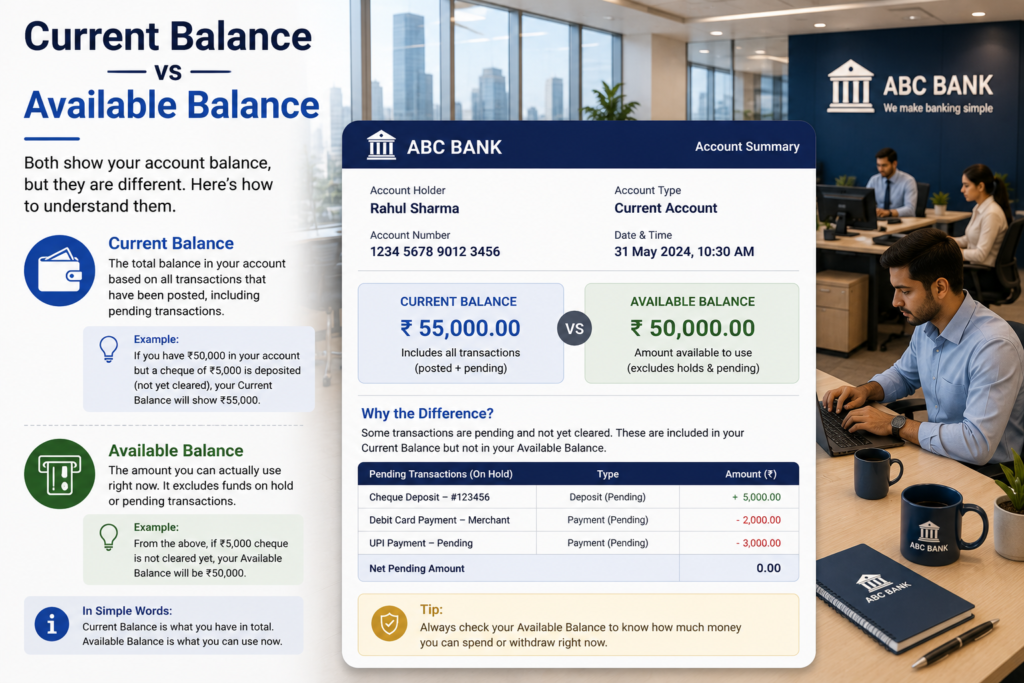
Log into your banking app, and you might see two different numbers staring back at you — and they don’t match. That gap has quietly triggered more overdraft fees than almost any other single point of confusion in personal banking.
Current balance vs available balance isn’t just banking jargon. Get the distinction wrong, and you can overdraw your account without ever spending more than you thought you had.
This guide gives you the precise definition of each, the formula banks actually use, and the specific mistakes that lead to unexpected fees.
Quick-Reference: The Two Balances Compared
| Current Balance | Available Balance | |
|---|---|---|
| What it shows | Total funds in the account right now | Funds you can actually spend today |
| Includes pending transactions? | Often not fully reflected | Yes — pending debits are subtracted |
| Best used for | General monthly budgeting | Daily spending decisions |
| Risk if ignored | Can look artificially higher | Most accurate for avoiding overdrafts |
Current Balance vs Available Balance: The Precise Definitions
Your current balance is the total amount of money recorded in your account at this moment, reflecting deposits, withdrawals, and purchases the bank has processed. Your available balance takes that number and subtracts pending transactions, holds, and uncollected funds — leaving you with the actual amount you can safely spend.
The relationship, expressed simply, looks like this: Available Balance = Current Balance − Pending Transactions − Authorization Holds − Uncollected Funds.
Key takeaway: When deciding how much you can safely spend today, always default to your available balance — it’s built specifically to prevent you from overdrawing your account.

1. Assuming the Two Numbers Are Always the Same
The single most common mistake in the current balance vs available balance debate.
- Fact: If there’s been no account activity in about a week, the two balances are often identical
- Fact: As soon as a pending transaction, hold, or uncollected deposit enters the picture, the numbers can diverge significantly
- Risk: Spending based on your current balance instead of your available balance is one of the most common causes of accidental overdrafts
Professional takeaway: Never assume the numbers match just because they usually do. Check both figures before making a large purchase or transfer.
2. Forgetting About Pending Debit and Credit Card Charges
Pending transactions are the single biggest reason these two balances disagree.
- Fact: A debit card purchase or bill payment can take a day or two to fully clear, even though it’s already been authorized
- Fact: During that window, your current balance may not reflect the charge yet, while your available balance has already subtracted it
- Example: A $500 current balance combined with a $200 pending credit card payment from yesterday can leave you with only $300 truly available
Professional takeaway: Before making a significant purchase, review your pending transactions list specifically — it’s the fastest way to explain any gap between the two balances.
3. Overestimating Funds From a Recent Check Deposit
Deposits create the opposite problem — money that looks available but isn’t quite there yet.
- Fact: A deposited check can show up in your current balance immediately, while your available balance withholds it until the funds clear
- Fact: Clearing times vary by deposit size and bank policy, and some banks make only a partial amount available the next business day
- Risk: Spending against a check deposit before it fully clears is a common way people unintentionally overdraw their account
Professional takeaway: Treat a recent check deposit as unavailable until your bank explicitly confirms it’s cleared, regardless of what your current balance shows.

4. Ignoring Authorization Holds at Gas Stations and Hotels
This is the mistake that catches even careful budgeters off guard.
- Fact: Gas stations frequently place a pre-authorization hold well above the final fill-up cost
- Fact: Hotels and car rental companies often hold funds covering the full estimated stay plus incidentals, not just the final charge
- Timing: These holds can tie up funds for several days until the final transaction amount replaces the temporary hold
Professional takeaway: If you’re travelling or filling up on a tight budget, expect your available balance to temporarily drop by more than the actual cost of the transaction.
5. Confusing Either Balance With the Ledger Balance
A lesser-known third figure that some banks display, adding an extra layer of confusion to the current balance vs available balance conversation.
- Fact: Some banks show a “ledger balance,” which is the official end-of-day figure posted after the previous business day’s processing closes
- Fact: Ledger balance is easy to mistake for current balance, since both can look similar depending on timing
- Clarification: Neither the ledger balance nor the current balance should be treated as your safe-to-spend number — that’s specifically what the available balance is for
Professional takeaway: If your bank displays three different balances, always identify which one is the “available” figure before making any spending decision.
Current Balance vs Available Balance: Which Should You Actually Use?
Understanding current balance vs available balance ultimately comes down to matching the right number to the right task.
| Your Task | Balance to Use |
|---|---|
| Daily spending decisions | Available balance |
| Avoiding overdraft fees | Available balance |
| Monthly budgeting overview | Current balance (with caution) |
| Reconciling with a spreadsheet or app | Current balance, cross-checked against pending items |
Professional takeaway: When in doubt, available balance is almost always the safer number to spend against — it’s specifically designed to account for money that’s already spoken for.
The Bottom Line
Current balance vs available balance isn’t just a technicality — it’s the difference between confident budgeting and an unexpected overdraft fee.
- Current balance → Total funds recorded in your account right now
- Available balance → What you can actually spend today, after pending transactions and holds are subtracted
- Ledger balance (if shown) → The official end-of-day figure, not a real-time spending guide
Make the available balance your default reference point for spending decisions, and you’ll sidestep the single most common cause of surprise overdraft fees.

5. FAQs Section
1. What is the difference between current balance vs available balance? Current balance shows the total funds recorded in your account, while available balance subtracts pending transactions, holds, and uncollected funds to show what you can actually spend right now.
2. Which balance should I check before making a purchase? Always check your available balance before spending. It’s specifically designed to reflect what you can safely use without risking an overdraft.
3. Why is my available balance lower than my current balance? This usually happens due to pending debit card transactions, authorization holds, or a recent check deposit that hasn’t fully cleared yet.
4. Can my available balance ever be higher than my current balance? It’s uncommon but possible in specific bank systems, though for most personal checking accounts, available balance is typically equal to or lower than current balance.
5. What is a ledger balance, and is it different from current balance? A ledger balance is the official end-of-day figure some banks display after the previous business day’s processing. It can look similar to current balance but isn’t the same as your real-time spending figure.
6. How long do authorization holds typically last? Authorization holds, like those from gas stations or hotels, can last several days until the final transaction amount is confirmed and replaces the temporary hold.