
Two out of three cardholders pay off their credit balance in full every single month, according to the Cambridge Business English Dictionary. Yet ask ten people what “credit balance” actually means, and you’ll get ten slightly different answers.
That’s because credit balance meaning genuinely does shift depending on where you spot it. A credit balance on your bank account is a completely different financial event than a credit balance on your credit card — and both are different again from how the term functions inside a company’s accounting ledger.
This guide gives you the precise, source-backed definition in every context it appears, so you never have to guess what credit balance meaning actually implies again.
Quick-Reference: Credit Balance At a Glance
Credit Balance Meaning: The Precise Definition
| Where It Appears | What It Means | Who Owes Whom |
|---|---|---|
| Bank account | Funds available to spend or withdraw | The bank owes you |
| Credit card | You’ve overpaid your balance | The card issuer owes you |
| Liability/equity ledger | Normal, expected balance type | Reflects what the business owes |
| Accounts receivable | Often signals overpayment or error | Business may owe the customer |
At its core, a credit balance is the amount recorded on the right-hand side of an account in double-entry bookkeeping — the accounting system used by virtually every bank, business, and credit provider globally. In plain English, it means total credits exceed total debits, leaving a surplus in the account holder’s favor.
That single accounting principle is the thread connecting every context below. What changes is who that surplus belongs to, and what you should actually do about it.
Key takeaway: Before reacting to a credit balance, identify the account type first. The same two words carry entirely different financial implications depending on context — and misreading it can cost you real money.

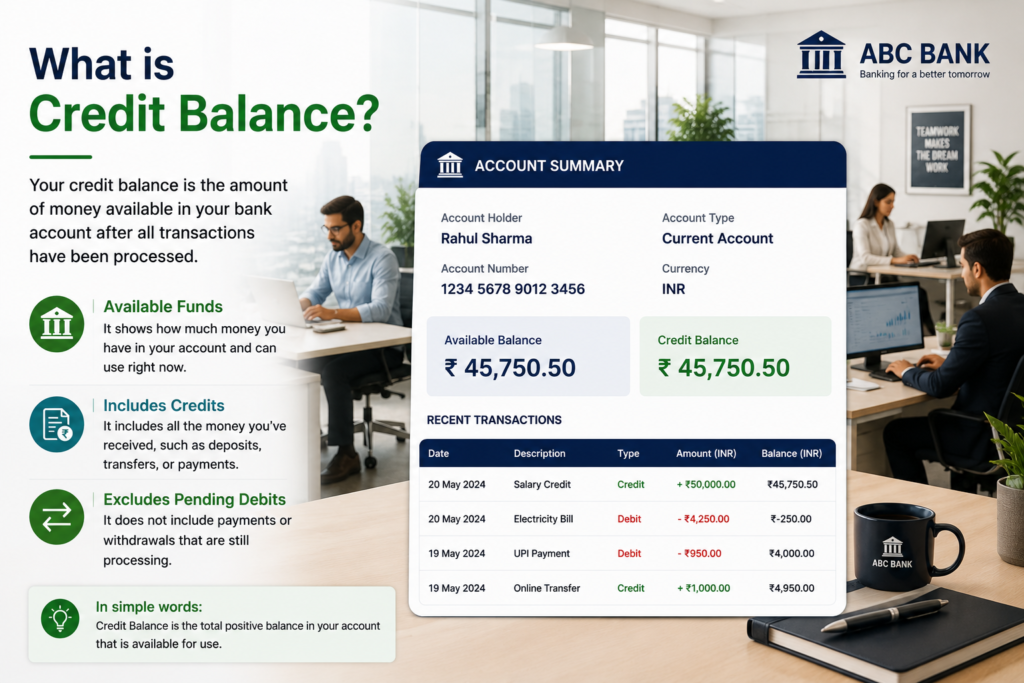
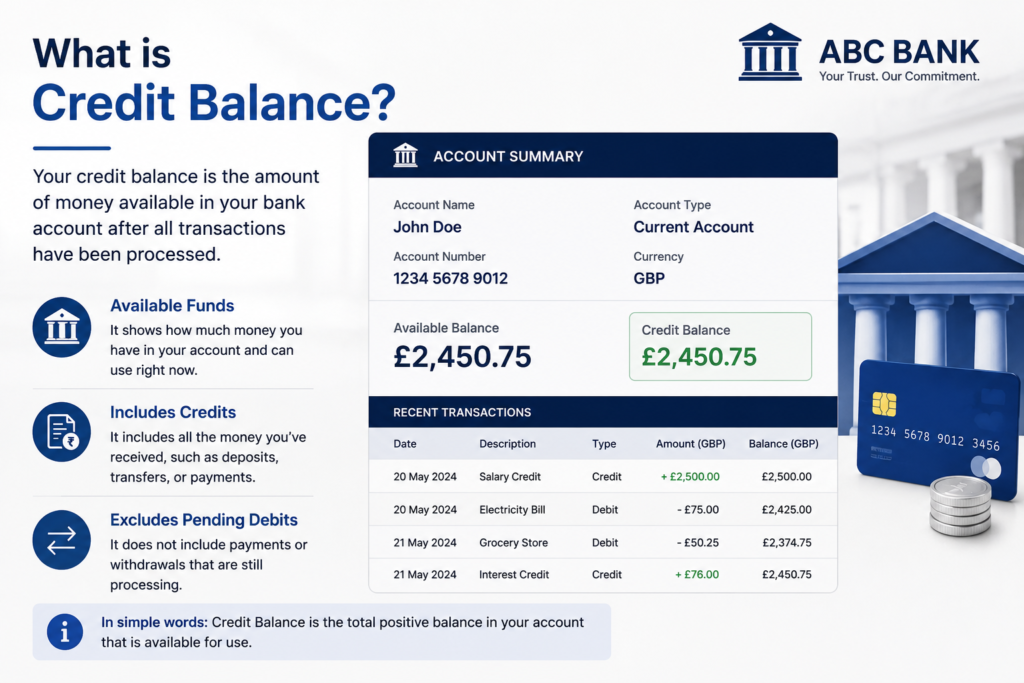
1. Bank Account: It’s Simply Your Available Money
On a checking or savings account, credit balance meaning is the least ambiguous of any context — arguably the cleanest starting point for anyone learning the term.
- Fact: A bank account credit balance represents funds the bank holds on your behalf, fully available for you to spend or withdraw
- Fact: This money belongs to you — the bank is not extending credit; it’s safeguarding your deposit
- Distinction: This is the direct opposite of an overdraft or loan balance, which reflects money you owe the bank, not money owed to you
Professional takeaway: A credit balance on a bank statement requires zero action. It’s simply confirmation your account is in healthy, positive standing.
2. Credit Card: The Company Owes You Money
This is the context that surprises people most, since credit cards are built around debt, not surplus.
- Fact: According to the Consumer Financial Protection Bureau, a credit balance on a billing statement is specifically “an amount that the credit card company owes you”
- Common causes: Accidental overpayment, a merchant refund posted after the balance already hit zero, or a promotional cashback credit
- Your options: Let the surplus automatically offset your next purchases, or contact your issuer directly to request a cash refund
Professional takeaway: A credit balance on a card statement is genuinely good news — but it’s inert money until you act on it.
3. It Sits Idle — And Doesn’t Earn You Interest
A detail most cardholders never learn until it costs them — and a key piece of credit balance meaning that’s easy to overlook.
- Fact: A credit card credit balance does not accrue interest while it remains on the account
- Financial reality: Leaving a large credit balance unused is functionally an interest-free loan to your card issuer
- Recommended action: Request a refund or apply the surplus toward upcoming purchases rather than letting it sit idle indefinitely
Professional takeaway: Treat an idle credit balance the same way you’d treat idle cash sitting in a zero-interest account — reclaim it.
4. Business Accounting: Context Determines Everything
In corporate ledgers, credit balance meaning splits by account category, and getting this wrong can misrepresent a company’s actual financial position — a distinction every finance professional should know cold.
| Account Type | Normal Balance | What a Credit Balance Signals |
|---|---|---|
| Liability | Credit | Amount owed to others (loans, payables) — expected |
| Equity | Credit | Owner’s stake in the business — expected |
| Revenue | Credit | Income earned — expected |
| Asset | Debit | Overpayment or posting error — investigate |
| Expense | Debit | Refund or overcharge correction — investigate |
Professional takeaway: A credit balance in a liability, equity, or revenue account is routine. The same balance in an asset or expense account is a red flag worth investigating immediately.
5. Unexpected Credit Balances Are Often Errors, Not Windfalls
For finance teams specifically, an unplanned credit balance is a diagnostic signal, not a bonus.
- Leading cause #1: Duplicate payments processed against the same invoice
- Leading cause #2: Misapplied credits or incorrect ledger postings
- Leading cause #3: A return or refund processed without a corresponding adjustment elsewhere
Professional takeaway: Reconcile any unplanned credit balance immediately. Left unresolved, these errors compound and distort financial reporting at scale.
6. Accounts Receivable vs. Accounts Payable: A Critical Distinction
This is the nuance that separates casual bookkeeping from professional-grade financial management.
- Accounts payable credit balance: Entirely normal — it reflects what your business currently owes its suppliers
- Accounts receivable credit balance: Atypical — it usually signals a customer overpayment or a credit issued without a matching invoice
- Why it matters: Misreading an AR credit balance as “extra revenue” rather than a liability to refund is a common and costly bookkeeping mistake
Professional takeaway: Any accounts receivable credit balance should be resolved — refunded, applied to a future invoice, or corrected — before it distorts your revenue reporting.

The Bottom Line
Understanding credit balance meaning comes down to one consistent accounting principle applied across four very different contexts:
- Bank account → Your available funds
- Credit card → A refund the issuer owes you
- Business liability/equity/revenue → Normal, expected balance
- Business asset/expense/AR → Investigate — likely an error or overpayment
Master this single framework, and you’ll never misread a “credit balance” line item again — on a personal statement or a corporate ledger. That’s the full practical value of understanding credit balance meaning in one sitting.
5. FAQs Section
1. What does credit balance mean on a bank statement? On a bank account, a credit balance simply means the funds shown are available to you — money the bank holds on your behalf that you can spend or withdraw.
2. What does a credit balance on a credit card mean? It means you’ve paid more than your outstanding balance, so the credit card company actually owes you money, often due to an overpayment, refund, or promotional credit.
3. Does a credit balance on a credit card earn interest? No. A credit balance typically sits without earning interest, so it’s usually better to request a refund or apply it toward future purchases rather than leaving it idle.
4. What does credit balance mean in accounting? In accounting, a credit balance is the amount on the right-hand side of a ledger account, normal for liability, equity, and revenue accounts, but potentially a sign of an error in asset or expense accounts.
5. Why would a business have an unexpected credit balance? Common causes include duplicate payments, misapplied credits, incorrect postings, or a return processed without a corresponding adjustment.
6. Is a credit balance always a good thing? Not necessarily. While it often represents money owed to you, an unexpected credit balance in certain business accounts can also indicate a processing error that needs correcting.