If you’ve landed here to define reconciliation finance, you’ve probably come across the term in an accounting textbook, a job description, or while trying to make sense of your own business records, and found the explanations either too vague or too technical. That’s genuinely common. Reconciliation is one of those concepts that sounds more complicated than it actually is once you see it applied to a real example.
Here’s the simplest way to think about it: reconciliation is the process of checking two sets of records against each other to confirm they match, and investigating and correcting any differences you find. That’s it at its core. Everything else is just detail about where and how it’s applied.
How to Define Reconciliation Finance Simply
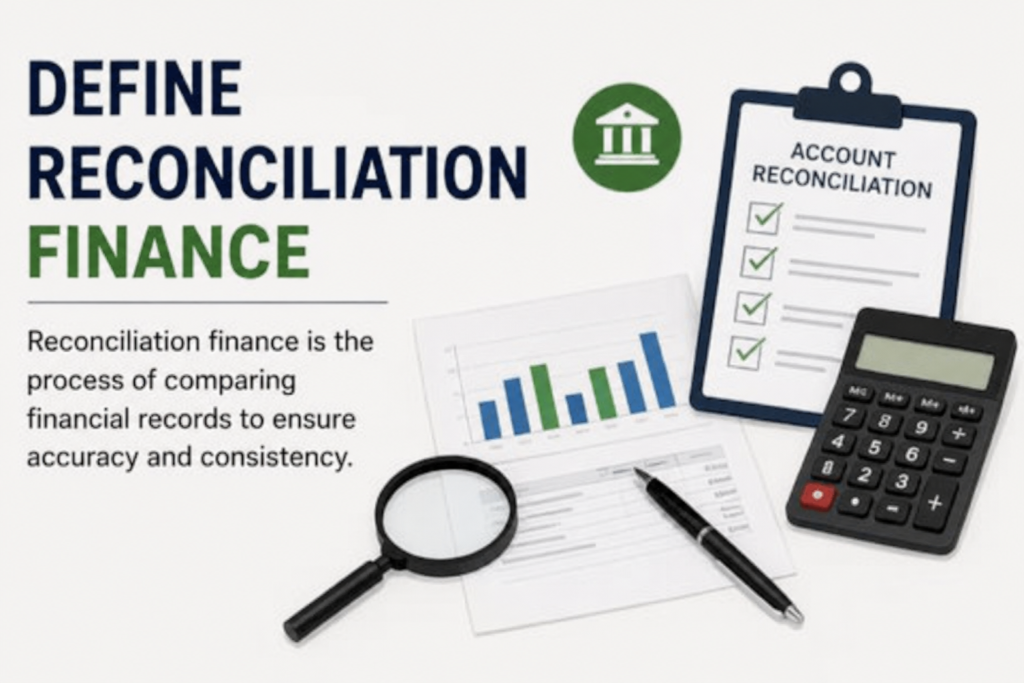
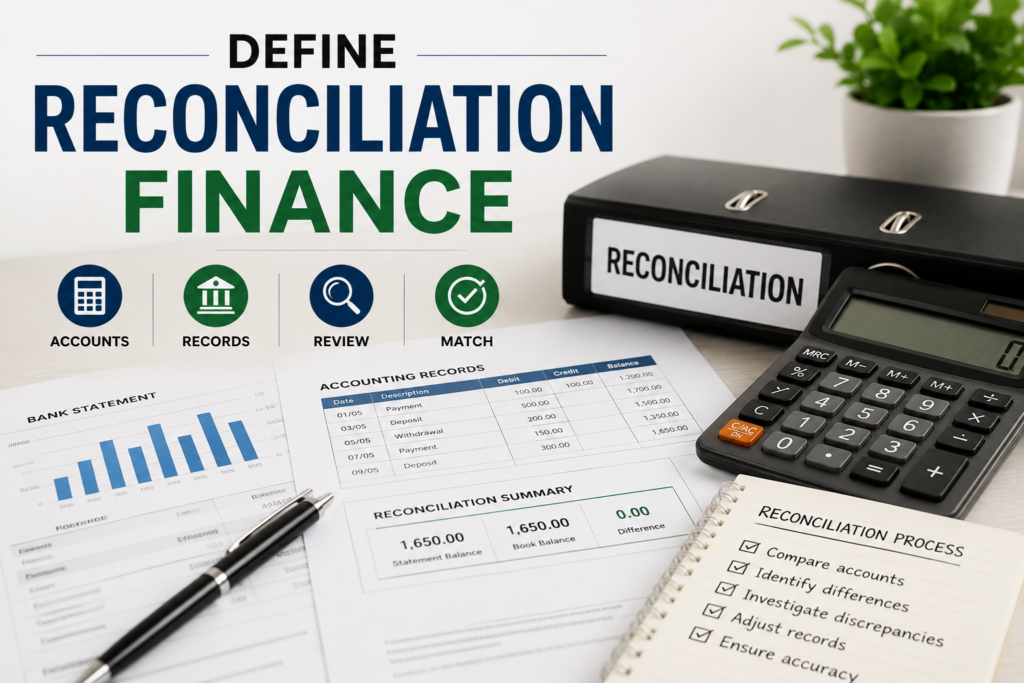
To define reconciliation finance in one sentence: it’s the process of comparing two independent records of financial transactions to confirm they agree, and identifying, explaining, and correcting any discrepancies between them.
Most commonly, this means comparing your own internal financial records against an external source, like a bank statement, to make sure every transaction has been recorded accurately and nothing has been missed, duplicated, or entered incorrectly.
Quick takeaway: If you remember nothing else, remember this: reconciliation isn’t about assuming your records are correct, it’s about proving it against an independent source.
Why Businesses Actually Need This Process
It’s worth understanding why reconciliation exists in the first place, since that context makes the process feel far less like pointless busywork.
- Catching errors early, before they compound into larger accounting problems
- Detecting fraud, since unexplained discrepancies are often the first sign something’s wrong
- Ensuring accurate financial reporting, since financial statements are only as reliable as the records behind them
- Supporting cash flow management, by confirming exactly what funds are actually available versus what’s recorded
Quick takeaway: Think of reconciliation as a regular health check for your financial records, not a one-time task you complete and forget about.
The Most Common Type: Bank Reconciliation
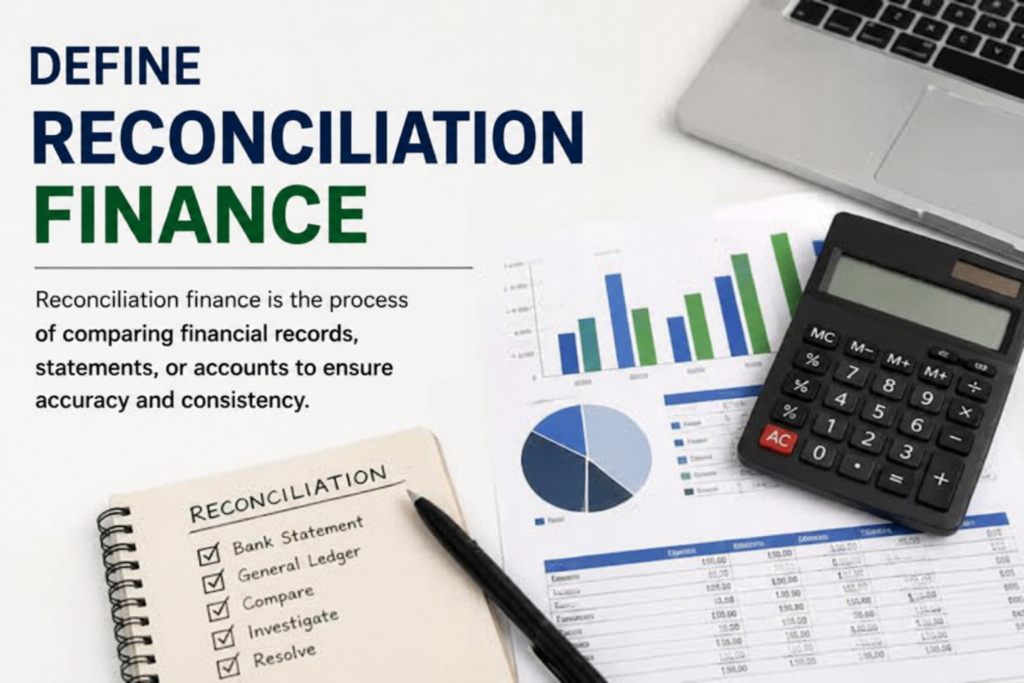
When people search to define reconciliation finance, they’re often specifically thinking of bank reconciliation, the most common and familiar version of this process.
Here’s how it typically works:
- Gather your internal records, such as your accounting software’s transaction log
- Obtain your bank statement for the same period
- Compare each transaction line by line, checking amounts, dates, and descriptions
- Identify discrepancies, such as outstanding cheques, bank fees not yet recorded, or timing differences
- Adjust your internal records to account for legitimate differences
- Investigate anything that remains unexplained, since this is where genuine errors or fraud tend to surface
Quick takeaway: Most discrepancies turn out to be simple timing differences, like a cheque that hasn’t cleared yet, rather than actual errors. Anyone trying to define reconciliation finance accurately should understand this distinction before assuming the worst about a mismatch.
Other Types of Reconciliation Worth Knowing
Bank reconciliation gets the most attention when people try to define reconciliation finance, but several other types matter just as much depending on the business.
Accounts Receivable Reconciliation
Comparing amounts customers owe you against your own sales ledger, ensuring invoices and payments received match up correctly.
Accounts Payable Reconciliation
Comparing what you owe suppliers against vendor statements, catching duplicate payments or missed invoices.
Intercompany Reconciliation
Used by larger organizations with multiple entities, ensuring transactions between related companies are recorded consistently on both sides.
Credit Card Reconciliation
Comparing credit card statements against recorded business expenses, particularly important for catching unauthorized charges quickly.
Quick takeaway: Any time two independent records are supposed to describe the same underlying activity, that’s a candidate for a reconciliation process, not just bank accounts specifically.
The Mistake That Causes Most Errors When You Define Reconciliation Finance Too Narrowly
Here’s something worth flagging directly: the single biggest source of reconciliation problems isn’t complicated accounting, it’s inconsistent timing.
A transaction recorded on one date in your internal system might clear on a completely different date on your bank statement. Treating this timing gap as an “error” rather than a normal, expected difference leads to unnecessary confusion and wasted investigation time.
Quick takeaway: Before assuming a discrepancy is a genuine error, check whether it’s simply a timing difference first. This single habit saves significant time during the reconciliation process.
How Often Should Reconciliation Happen?
The right frequency depends on transaction volume and business size, but a few general guidelines apply consistently.
- Monthly, at minimum, for most small to mid-sized businesses, typically aligned with monthly bank statements
- Weekly or daily, for businesses with high transaction volumes or tight cash flow management needs
- Immediately after major transactions, such as large payments or unusual account activity
Quick takeaway: Waiting too long between reconciliations makes errors harder to trace back to their original cause. If you’re still working out how to define reconciliation finance for your own business, frequency is often the practical difference between an easy monthly check and a stressful, overdue one.
How Technology Has Changed This Process
Modern accounting software has automated much of what used to be a fully manual, line-by-line comparison process.
- Automatic bank feeds, pulling transaction data directly into accounting software
- AI-assisted matching, automatically pairing likely corresponding transactions and flagging only genuine discrepancies for human review
- Real-time reconciliation, allowing businesses to check records continuously rather than only at month-end
Quick takeaway: Automation reduces manual effort significantly, but someone still needs to review flagged discrepancies personally. Understanding how to define reconciliation finance today means recognizing it’s no longer a fully hands-off process, even with modern software.
A Simple Worked Example
Let’s tie this together with a quick example that helps define reconciliation finance in practice. Imagine your internal accounting records show a closing balance of £10,450 for the month, while your bank statement shows £10,200.
- Identify the £250 difference
- Check for outstanding items, such as a cheque for £250 written near month-end that hasn’t cleared the bank yet
- Confirm this explains the gap fully
- Adjust your reconciliation statement to note the outstanding cheque, showing both figures are accurate once timing is accounted for
Quick takeaway: A reconciliation is considered complete once every difference between the two records is fully explained, not simply once the totals happen to match by chance.
5. FAQs
Q1: How do you define reconciliation finance in simple terms? It’s the process of comparing two independent financial records, such as your internal books and a bank statement, to confirm they match and to identify and correct any discrepancies between them.
Q2: What is the most common type of reconciliation? Bank reconciliation is the most common type, comparing a business’s internal transaction records against its bank statement to confirm accuracy and catch errors or fraud.
Q3: How often should a business perform reconciliation? Most small to mid-sized businesses reconcile monthly at minimum, though businesses with higher transaction volumes often benefit from weekly or even daily reconciliation.
Q4: What causes most reconciliation discrepancies? Timing differences are the most common cause, such as a cheque or payment that’s been recorded internally but hasn’t yet cleared through the bank.
Q5: Can reconciliation be fully automated? Modern software automates much of the matching process through bank feeds and AI-assisted matching, but discrepancies still require human review to confirm and resolve accurately.
Q6: Why does reconciliation matter for fraud prevention? Unexplained discrepancies between two independent records are often the first visible sign of fraudulent activity, making regular reconciliation an important early detection tool.
Final Thoughts
To define reconciliation finance clearly: it’s the disciplined process of comparing two independent financial records, identifying any differences, and confirming or correcting them until both sets of records tell the same accurate story. It’s not glamorous, but it’s one of the most important habits a business can maintain for accurate reporting, fraud prevention, and genuine financial control.
Whether you’re reconciling a single bank account or intercompany transactions across a large organization, the underlying principle stays exactly the same: trust, but verify, every single time.
For official guidance on financial record-keeping standards relevant to reconciliation practices, the UK Financial Reporting Council’s guidance is a reliable, authoritative reference point.