
Tesla Stock Price Prediction 2030: What Could TSLA Be Worth?
The Tesla stock price prediction 2030 is one of the more difficult long-term forecasts in the market because Tesla is no longer just an electric vehicle manufacturer. Its future valuation could depend on electric vehicles, energy storage, artificial intelligence, autonomous driving, robotaxis, software, and potentially robotics.
That makes a simple prediction risky. Tesla’s shares have historically moved sharply when investors change their expectations about future growth, even before those expectations show up in earnings.
As of August 28, 2026, Tesla shares were trading around the mid-$350 range, according to recent market data. The stock has also experienced a wide 52-week trading range, highlighting just how quickly sentiment around TSLA can change.
So, where could Tesla be by 2030?
Rather than claiming that TSLA will definitely reach one specific number, this article examines bull, base, and bear scenarios and the business conditions that could produce each outcome.
Investment disclaimer: This article is for educational purposes only. A long-term stock forecast is inherently uncertain and should not be treated as personalized investment advice.
Quick takeaway: Don’t judge a 2030 Tesla target from today’s share price alone. Revenue growth, margins, free cash flow, share count, and valuation will ultimately matter.
Tesla Stock Price Prediction 2030: The Starting Point
Before looking toward 2030, it helps to understand where Tesla stands today.
Tesla’s 2025 revenue was approximately $94.8 billion, down from about $97.7 billion in 2024. Automotive revenue declined, while energy generation and storage revenue increased substantially. According to Tesla’s 2025 annual report, automotive revenue was approximately $69.5 billion, while energy generation and storage revenue reached $12.8 billion.
This is an important detail for investors.
Tesla’s story is increasingly becoming broader than vehicle sales.
In 2025, Tesla delivered approximately 1.64 million vehicles and deployed 46.7 GWh of energy storage products.
The energy business could become particularly important over the next several years. Tesla says its energy-storage products use battery, power-electronics, software, and grid-management technologies, including platforms such as Powerhub and Autobidder.
At the same time, Tesla faces substantial competition in electric vehicles, pressure on margins, regulatory uncertainty, and questions about how quickly its newer businesses can become commercially meaningful.
Takeaway: Tesla enters the 2030 period with several potential growth engines, but investors need to separate proven revenue from future expectations.
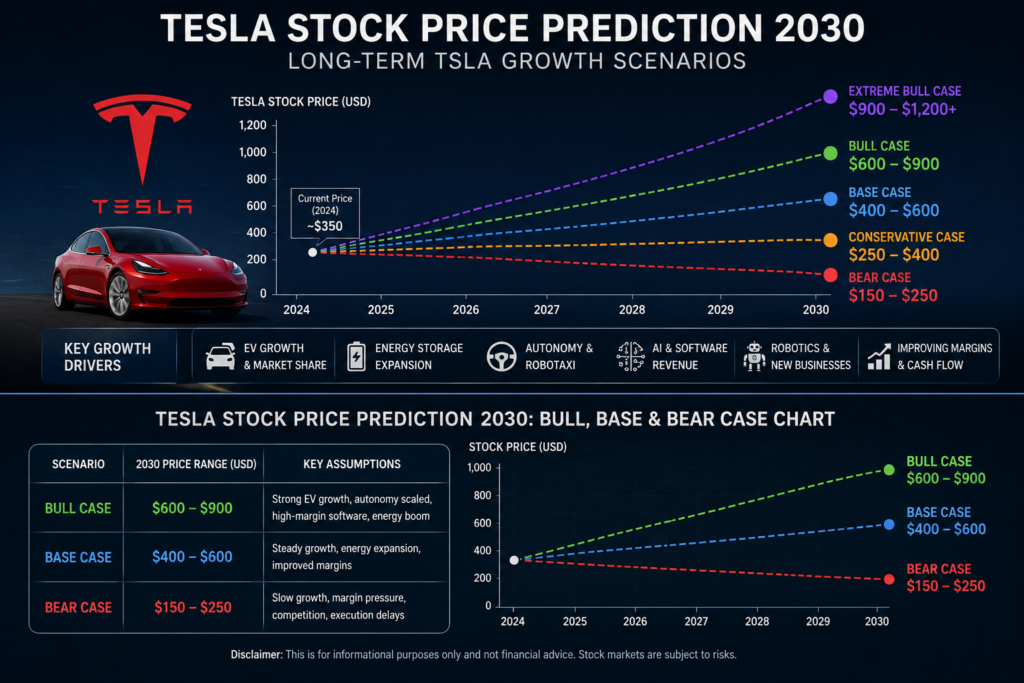
Tesla Stock Price Prediction 2030: 7 Scenarios
Instead of giving readers a single number, a scenario-based approach is more useful.
Here is a simplified framework:
| Scenario | Possible 2030 TSLA Range | General Business Outcome |
|---|---|---|
| Bear Case | $150–$250 | Slower EV growth and weak margins |
| Conservative Case | $250–$400 | Moderate growth with limited AI upside |
| Base Case | $400–$600 | Stronger vehicles and energy growth |
| Bull Case | $600–$900 | Successful autonomy and software expansion |
| Extreme Bull Case | $900–$1,200+ | Major robotaxi/AI/robotics success |
These are scenario ranges, not guaranteed targets.
A $1,000 share price, for example, would require far more than Tesla simply selling more cars. The company would likely need substantially higher earnings and/or free cash flow, combined with investors continuing to assign Tesla a premium valuation.
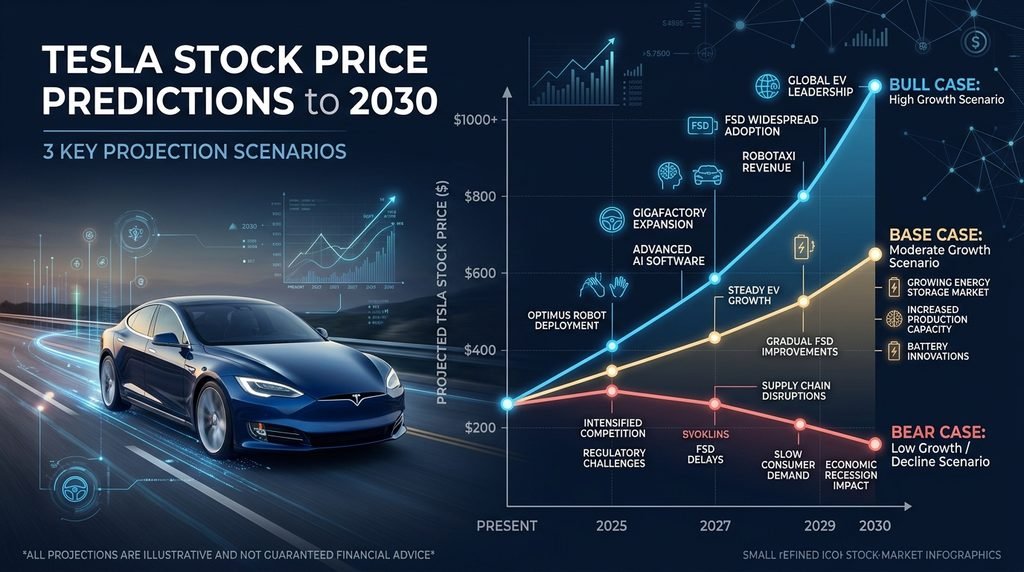
1. Bear Case: $150–$250
The bear case assumes Tesla struggles to maintain its historical growth rate.
Several things could contribute:
- EV competition becomes more aggressive.
- Vehicle prices remain under pressure.
- Automotive margins stay relatively low.
- New products take longer to reach mass production.
- Robotaxi adoption disappoints.
- AI and robotics investments generate limited near-term revenue.
- Investors assign Tesla a more conventional automotive valuation.
In this scenario, Tesla could remain a major EV company but fail to justify the technology-style valuation that investors have sometimes placed on the stock.
Takeaway: The biggest downside risk is not necessarily Tesla disappearing. It is Tesla becoming a slower-growing company while still carrying a very high valuation.
2. Conservative Case: $250–$400
This scenario assumes Tesla continues growing but at a more moderate pace.
Vehicle deliveries increase, energy storage expands, and Tesla maintains a meaningful technology advantage. However, autonomous driving and robotics contribute less revenue than the most optimistic investors expect.
This would leave Tesla looking like a combination of:
- EV manufacturer
- Energy-storage company
- Software business
- Charging and services platform
The valuation would still be higher than that of many traditional automakers, but the market would demand stronger financial evidence before assigning an extremely high multiple.
Takeaway: This is a useful scenario for investors who believe Tesla will remain successful without assuming every future technology becomes a huge commercial success.
3. Base Case: $400–$600
The base case assumes Tesla successfully improves its overall business mix through 2030.
Automotive sales remain the foundation, while energy storage becomes a much larger contributor. Software and autonomous-driving services generate additional recurring revenue.
This scenario does not require Tesla to dominate every emerging technology.
Instead, the company would need to execute reasonably well across several areas.
Tesla’s energy business is already showing why diversification matters. Energy generation and storage revenue increased from about $10.1 billion in 2024 to $12.8 billion in 2025.
If that business continues expanding while vehicle economics improve, Tesla could produce substantially more earnings and cash flow by 2030.
Takeaway: A middle-of-the-road Tesla forecast should focus on improving financial fundamentals, not just futuristic product announcements.
4. Bull Case: $600–$900
The bullish scenario becomes more interesting if Tesla’s autonomous-driving strategy works at scale.
Imagine Tesla generating meaningful recurring revenue from autonomous transportation, software subscriptions, fleet services, and related technology.
That could fundamentally change how the market values the company.
Instead of asking, “How many cars does Tesla sell?” investors might increasingly ask, “How much recurring profit can Tesla generate from each vehicle and autonomous service?”
That is a much bigger economic opportunity.
However, there is a major difference between demonstrating autonomous technology and operating a profitable autonomous transportation network at scale.
Takeaway: For the bull case to become realistic, investors should watch commercial deployment, utilization, regulatory approval, revenue, and margins—not just demonstrations.
5. Extreme Bull Case: $900–$1,200+
This is the scenario that attracts the most attention when discussing a long-term Tesla forecast.
For Tesla to reach this type of valuation by 2030, several ambitious developments would probably need to happen together.
Potential catalysts include:
- Large-scale autonomous vehicle operations.
- Strong growth in energy storage.
- Successful lower-cost vehicle platforms.
- High-margin software revenue.
- Significant AI-related commercial applications.
- Successful robotics commercialization.
- Strong free cash flow growth.
This scenario is possible, but it should not be treated as the default.
The higher the valuation becomes, the more execution investors are effectively paying for in advance.
Takeaway: A four-digit TSLA price would likely require Tesla to evolve into a much broader technology and infrastructure company rather than simply becoming a larger automaker.
What Could Drive Tesla Stock Toward 2030?
The most important part of any Tesla stock price prediction 2030 is identifying the variables that could actually change the company’s earnings power.
Electric Vehicle Growth
EV sales will remain important.
Tesla needs to defend its market position while expanding into new segments and price points. More affordable models could significantly increase its potential customer base.
However, higher volume alone does not guarantee higher stock prices.
If Tesla sells more vehicles but margins fall substantially, revenue growth may not translate into proportional earnings growth.
Energy Storage
Energy storage could become one of Tesla’s most important long-term businesses.
Tesla’s 2025 energy-storage deployments reached 46.7 GWh.
The broader opportunity includes grid storage, commercial batteries, residential energy systems, and software that manages energy assets.
This segment deserves attention because energy demand is increasing alongside data centers, electrification, and renewable power generation.
Takeaway: Track Tesla’s energy-storage deployments, revenue, gross margin, and production capacity rather than looking only at vehicle deliveries.
Autonomous Driving
Autonomy represents perhaps the largest upside variable in the Tesla valuation debate.
If Tesla can turn autonomous driving into a commercially scalable service, the company’s revenue model could become significantly more recurring.
But regulatory approval, safety, reliability, operating costs, and consumer adoption will determine whether the opportunity becomes financially meaningful.
Artificial Intelligence and Robotics
Tesla’s AI ambitions could create another valuation driver.
The market may assign a premium to Tesla if its AI infrastructure and robotics projects become commercially successful.
The challenge is timing.
Long-term potential does not automatically equal near-term earnings. Investors should distinguish between research, prototypes, pilot programs, and actual commercial revenue.
Takeaway: When evaluating AI-related Tesla claims, ask one simple question: Where is the measurable financial impact?
Tesla Valuation: Why the Price-to-Earnings Ratio Matters
A common mistake when making a Tesla stock price prediction 2030 is focusing entirely on revenue growth.
Valuation matters just as much.
Suppose Tesla earns $10 per share in 2030.
If investors value those earnings at 20 times earnings, the implied share value would be approximately $200.
At 40 times earnings, it would be $400.
At 60 times earnings, it would be $600.
The same company can therefore have very different stock prices depending on what investors are willing to pay for each dollar of earnings.
This is why long-term Tesla forecasting should consider:
- Earnings per share
- Free cash flow
- Operating margins
- Revenue growth
- Capital expenditure
- Share dilution
- Cash and debt
- Price-to-earnings ratio
- Price-to-sales ratio
Tesla’s own financial filings also warn that actual results can differ materially from estimates and assumptions.
Takeaway: Never calculate a 2030 Tesla target using revenue alone. Build the forecast from earnings or free cash flow and then apply a reasonable valuation multiple.
Tesla Stock Price Prediction 2030: What Could Go Wrong?
A professional forecast should always discuss the downside.
Tesla has several risks that could materially affect its long-term valuation.
Competition
Traditional automakers and Chinese EV manufacturers continue investing heavily in electric vehicles, batteries, software, and autonomous technology.
Tesla cannot assume its current market position will remain unchanged through 2030.
Margin Pressure
Price cuts can support vehicle demand but may hurt profitability.
For shareholders, a business selling millions of vehicles with weak margins may be less attractive than a smaller company producing strong free cash flow.
Regulatory Risk
Autonomous driving involves significant regulatory and safety considerations.
Delays in approvals or changes in rules could slow Tesla’s ability to commercialize autonomy.
Execution Risk
Tesla is pursuing several major projects simultaneously.
That creates opportunity, but it also creates execution risk. A delay in one major project may not matter much, but multiple delays could change investor expectations quickly.
Valuation Risk
This is perhaps the easiest risk to overlook.
Even if Tesla performs well operationally, the stock can fall if investors decide the valuation has become too high.
Takeaway: A great company is not automatically a great investment at every price.
How to Build Your Own Tesla Stock Forecast for 2030
Rather than copying a prediction from another website, investors can create a basic model themselves.
Step 1: Estimate Vehicle Deliveries
Start with a realistic estimate of Tesla’s annual vehicle deliveries in 2030.
Do not automatically assume explosive growth.
Step 2: Estimate Average Revenue per Vehicle
Multiply expected deliveries by estimated average revenue per vehicle.
Then add energy, services, software, and other businesses separately.
Step 3: Estimate Net Margin
Apply a conservative net margin to projected revenue.
This produces an approximate net income figure.
Step 4: Calculate Earnings Per Share
Divide projected net income by the expected number of diluted shares.
This is important because future share issuance can affect per-share value.
Step 5: Apply a Valuation Multiple
Finally, choose a P/E ratio based on Tesla’s expected growth and profitability.
For example:
2030 Share Price = 2030 EPS × P/E Multiple
This simple formula is not perfect, but it forces the forecast to connect business performance with valuation.
Takeaway: Build at least three models—bear, base, and bull. If your investment thesis only works under the bull case, the risk is probably higher than it first appears.
Tesla Stock Price Prediction 2030: What Investors Should Watch
Long-term investors do not need to check TSLA every hour.
Instead, focus on a small group of measurable indicators.
Key metrics to monitor
- Quarterly vehicle deliveries
- Automotive gross margin
- Total revenue growth
- Energy-storage deployments
- Energy revenue
- Operating income
- Free cash flow
- Capital expenditure
- Cash balance
- Diluted share count
- Autonomous-driving progress
- Software revenue
- Regulatory developments
Tesla publishes quarterly financial disclosures and investor materials through its Investor Relations website.
Takeaway: Use company filings and measurable operating data as your primary sources. News headlines can explain market movements, but financial statements help explain business performance.
Is Tesla a Good Long-Term Investment for 2030?
There is no universal answer.
For an investor who believes Tesla will remain primarily an EV manufacturer, the current valuation may look difficult to justify.
For someone who believes Tesla can successfully commercialize autonomous transportation, energy software, AI, and robotics, the long-term opportunity may look very different.
That difference explains why Tesla often creates such strong disagreement among investors.
The most sensible approach is to separate what Tesla is today from what investors believe it could become.
Tesla already has a large automotive and energy business. Its future valuation, however, may depend heavily on businesses that are still developing.
That creates both the opportunity and the risk.
Takeaway: Before buying TSLA for a 2030 thesis, write down exactly which business assumptions you are paying for and what evidence would prove your thesis wrong.
Tesla Stock Price Prediction 2030: Final Outlook
The most reasonable Tesla stock price prediction 2030 is not a single magic number.
A broad scenario range is more honest.
A weaker execution environment could leave TSLA around the $150–$250 range. A more moderate outcome could place the stock around $250–$400. If Tesla delivers stronger vehicle growth, expands energy storage, improves margins, and creates meaningful software revenue, a $400–$600 range becomes more plausible.
The most optimistic scenario—where autonomous transportation, AI, and robotics become substantial commercial businesses—could potentially support $600–$900 or even $900–$1,200+ valuations.
But those higher targets require significantly more execution.
Tesla’s 2025 financial results show both sides of the story: total revenue declined modestly, while energy generation and storage revenue grew strongly.
That is exactly why investors should avoid treating Tesla as either a simple car company or a guaranteed AI winner.
The better question is:
How much profit and free cash flow can Tesla realistically generate by 2030, and what valuation will the market assign to it?
That is the foundation of a useful long-term forecast.
Frequently Asked Questions
What is the Tesla stock price prediction 2030?
A reasonable scenario-based range could be roughly $250–$600, while highly bullish outcomes could reach $900 or more. However, these figures are not guaranteed forecasts. Tesla’s 2030 value will depend on vehicle growth, energy storage, margins, autonomy, AI, robotics, earnings, and the valuation multiple investors assign.
Can Tesla stock reach $1,000 by 2030?
Yes, it is mathematically possible, but reaching $1,000 would likely require substantial earnings growth and a high valuation multiple. Tesla would probably need meaningful commercial success beyond vehicle sales, particularly in autonomy, software, energy, AI, or robotics. Investors should therefore treat $1,000 as an aggressive bull-case scenario rather than a base-case expectation.
Is Tesla stock a good investment for 2030?
Tesla could be attractive for investors who believe its energy, autonomy, AI, and software businesses will become significant sources of profit. However, the stock also carries substantial valuation and execution risks. Investors should assess their own risk tolerance and compare Tesla’s expected returns with alternative investments.
What will affect the Tesla stock price prediction 2030 most?
The biggest factors are likely to include vehicle deliveries, automotive margins, energy-storage growth, autonomous-driving commercialization, software revenue, free cash flow, capital spending, competition, and Tesla’s valuation multiple. Among these, successful autonomy could have an especially large effect on the long-term valuation.
Could Tesla stock fall below $200 before 2030?
Yes. A significant slowdown in vehicle demand, sustained margin pressure, disappointing autonomous-driving progress, increased competition, or a major valuation reset could push TSLA substantially lower. A lower stock price would not necessarily mean Tesla’s business had failed; valuation and market sentiment can change faster than fundamentals.
How accurate is a Tesla stock price prediction 2030?
No 2030 stock forecast can be considered highly precise. Ten-year projections depend on many variables that cannot be known today. The best approach is to use multiple scenarios, update assumptions as Tesla reports new results, and focus on earnings and free cash flow rather than relying on a fixed price target.