If you have a lump sum that you will not need immediately, fixed rate bonds can be a straightforward way to earn predictable interest. You agree to leave your money with a bank or building society for a set period, and the provider fixes the interest rate for that term.
That certainty is the main attraction. You know the rate before committing, so falling savings rates will not change the return on your bond. The trade-off is flexibility. In most cases, you cannot simply withdraw your money whenever you want.
This guide explains how fixed rate bonds work, who they suit, what happens when a bond matures, how tax can affect your return, and what to check before putting your savings away.
Information in this article is general guidance, not personal financial advice. Rates, terms, tax rules and protection limits can change. Always check the current conditions with the provider and official sources before making a financial decision.
What Are Fixed Rate Bonds?
Fixed rate bonds are savings accounts that pay a predetermined interest rate for an agreed period. They are also commonly called fixed-term bonds or fixed-rate savings accounts.
The basic idea is simple. You deposit a lump sum, leave it untouched for the agreed term, and receive interest at the fixed rate.
Terms vary between providers. Six-month, one-year, two-year and three-year products are common, while some accounts run for four or five years. The exact options available depend on the provider and the market at the time you apply.
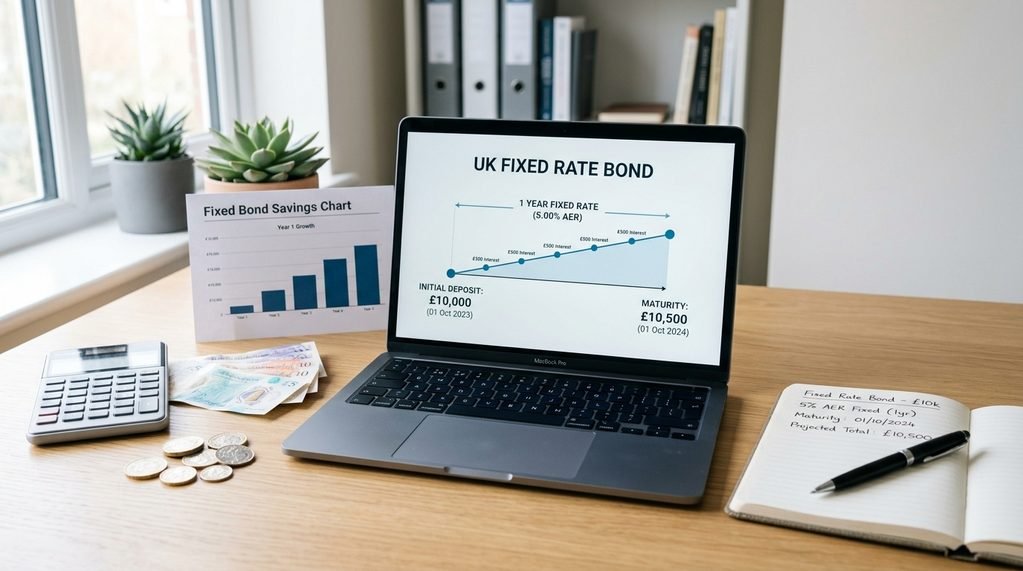
For example, imagine you place £10,000 into a one-year bond paying 4.5% interest. If the rate and terms remain as advertised, you would earn £450 over a year before any applicable tax.
That calculation looks attractive because there is no guessing involved. However, the headline rate is only one part of the decision.
MoneyHelper describes fixed-rate savings bonds as accounts that pay interest for a fixed period and notes that they can offer higher returns than some instant-access savings options.
Fixed rate bonds vs investment bonds
There is an important distinction here.
The word “bond” can cause confusion because a fixed-rate savings bond is different from an investment bond or corporate bond.
A bank fixed-rate savings bond is essentially a savings product. An investment bond can involve lending to a company or government and may carry different risks, pricing and access rules.
So, if you are searching for fixed rate bonds because you want a predictable savings return, make sure you are looking at deposit-based savings products rather than investment securities.
Actionable takeaway: Before comparing rates, check exactly what type of bond you are considering and whether it is a savings deposit covered by the relevant protection scheme.
How Fixed Rate Bonds Work
The process is generally easier than it sounds.
1. Choose a term
First, decide how long you can comfortably leave the money untouched.
A shorter bond may give you more flexibility because the money becomes available sooner. A longer bond can provide rate certainty for several years, but it also means you lose the opportunity to move the money if better savings rates appear later.
2. Deposit your money
Most fixed-term savings products require an initial lump-sum deposit.
Some providers have relatively low minimum deposits, while others may require thousands of pounds. Certain accounts also have maximum deposit limits.
Unlike a regular savings account, you often cannot keep adding money whenever you like.
3. Receive the fixed interest rate
Once your account is opened and funded, the agreed interest rate normally remains unchanged throughout the term.
This is where the product gets its name.
If the Bank of England or wider savings market causes other account rates to fall, your fixed rate does not normally change. The opposite is also true: if savings rates rise significantly, you are generally still locked into your original rate.
Current provider terms demonstrate how different fixed products can have different funding windows, payment arrangements and access rules, so reading the individual account conditions matters.
4. Wait until maturity
At the end of the agreed term, the bond reaches maturity.
You can normally take your original deposit plus the interest earned. Depending on the provider, you may be able to withdraw the money, move it elsewhere or reinvest it into another bond.
Actionable takeaway: Think about the maturity date before opening the account. A good interest rate is not helpful if the money becomes inaccessible when you actually need it.
Are Fixed Rate Bonds Right for You?
The most important question is not “What is the highest rate?”
It is:
Can I genuinely afford to leave this money alone for the entire term?
If the answer is yes, fixed rate bonds can make sense for part of your savings.
They may suit people who:
- Have a lump sum available.
- Already have accessible emergency savings.
- Want a predictable return.
- Do not need the money immediately.
- Prefer saving rather than taking investment risk.
- Want to lock in a rate before savings rates potentially fall.
They may be less suitable if you expect to need the money for an unexpected expense.
For example, suppose you have £15,000 in savings but only £2,000 available elsewhere for emergencies. Putting the entire £15,000 into a three-year fixed bond could leave you short of accessible cash.
A more sensible approach may be to keep an emergency fund in an easy-access account and consider fixing only the money you are confident you will not need.
The Co-operative Bank similarly suggests that fixed-rate bonds may suit people with lump sums who do not require access to their money during the fixed term.
A simple test
Before opening one, ask yourself:
- Could I cover an unexpected bill without using this money?
- Do I have enough accessible cash elsewhere?
- Am I comfortable with the full term?
- Would I still be happy with this rate if savings rates increased?
- Have I checked the early-access rules?
If you hesitate over the first two questions, flexibility may be more valuable than a slightly higher rate.
Actionable takeaway: Do not lock away emergency money simply because the fixed rate looks attractive.
The Main Benefits and Drawbacks
Like every savings product, fixed rate bonds have strengths and weaknesses.
Benefits of fixed rate bonds
Predictable returns
You know the interest rate when you open the account. That makes planning easier.
Protection from falling rates
If market savings rates fall after you open the bond, your agreed rate generally stays unchanged until maturity.
Potentially higher interest
Fixed accounts can sometimes pay more than easy-access accounts because you give up access to your money for the agreed period. However, this is not guaranteed, and rates vary between providers.
Useful for lump sums
If you receive money from a property sale, inheritance or another source and do not need it immediately, a fixed account can give that money a defined purpose.
Encourages disciplined saving
There is something useful about making your money harder to spend. If you know it cannot be easily withdrawn, you may be less tempted to dip into it.
Drawbacks to consider
Limited access
This is the big one.
Many fixed rate bonds do not allow withdrawals during the term. Others may permit access only under specific circumstances and may charge a penalty or reduce the interest you receive.
You could miss better rates
Imagine you fix your money for three years and savings rates rise considerably after six months. Your money remains at the original rate.
You usually cannot add money freely
Many products are designed for a single lump-sum deposit. If you are building savings every month, a regular saver may be more appropriate.
Inflation can reduce real returns
A fixed rate does not automatically mean your money is growing in real terms. If inflation remains higher than your interest rate, the purchasing power of your savings can still fall.
Tax may reduce your return
Interest from ordinary savings accounts can count as taxable savings income. The amount of tax you actually pay depends on your circumstances.
Actionable takeaway: Treat access, inflation and tax as seriously as the advertised interest rate.
How to Choose the Best Fixed Rate Bonds
There is no single “best” bond for everyone.
The best option is the one that fits your amount, timeframe and access needs.
1. Compare the AER
The Annual Equivalent Rate, or AER, helps you compare savings products on a consistent basis.
Do not automatically choose the account with the largest headline number. Check whether the rate is fixed for the whole term and whether any special conditions apply.
2. Check the minimum deposit
A bond offering an excellent rate is irrelevant if you cannot meet its minimum deposit.
Minimums can vary substantially between providers.
3. Check the maximum deposit
This matters particularly if you have a large amount of cash.
Some providers accept substantial deposits, but protection limits may apply even when the account itself allows you to deposit much more.
4. Understand early withdrawal rules
Never assume you can get your money back whenever you want.
Read the specific terms. One provider may prohibit early withdrawals completely, while another may allow them only in limited circumstances.
For example, TSB currently states that its fixed rate bonds do not allow early withdrawals or early closure.
5. Check how interest is paid
Interest may be paid annually, monthly or at maturity, depending on the product.
If you want income during the term, monthly interest could be useful. If your priority is building the final balance, another payment structure may suit you better.
6. Check the provider’s protection
Do not stop at the bank’s brand name.
Check the authorised institution behind the product and whether your deposits are protected by the Financial Services Compensation Scheme.
This becomes particularly important when you are spreading a large amount across several savings accounts.
7. Think about the maturity date
A one-year bond ending on a specific date may fit your plans perfectly. A five-year bond may not.
Before opening the account, put the maturity date in your calendar.
Actionable takeaway: Compare the full product, not just the interest rate. Term, access, deposit limits, protection and maturity arrangements all matter.
Tax, Interest and FSCS Protection
Tax is easy to overlook when comparing fixed rate bonds, especially when the advertised rate looks impressive.
In the UK, interest from ordinary savings accounts can count as savings income. However, many people have allowances that can reduce or eliminate the tax they owe.
According to GOV.UK, the Personal Savings Allowance can currently cover up to £1,000 of savings interest for basic-rate taxpayers and £500 for higher-rate taxpayers. Additional-rate taxpayers do not receive the Personal Savings Allowance.
Your wider income and tax position can affect how these rules apply.
What about Cash ISAs?
A Cash ISA is different because qualifying ISA interest is generally tax-free.
This means you should compare the after-tax return rather than simply looking at the highest gross rate.
For some savers, a slightly lower ISA rate may be more valuable than a higher taxable savings rate, particularly if they are likely to exceed their Personal Savings Allowance.
FSCS protection
Another key point is deposit protection.
Since 1 December 2025, FSCS deposit protection has been £120,000 per eligible person, per authorised firm. This applies to eligible deposits with UK-authorised banks, building societies and credit unions.
There is a catch worth understanding.
If several banking brands operate under the same banking licence, your money across those brands may count towards the same £120,000 limit.
For example, having £80,000 in one brand and £60,000 in another does not necessarily mean the full £140,000 is protected.
The underlying authorised institution matters.
FSCS also says qualifying temporary high balances of up to £1.4 million may receive protection for up to six months following certain major life events, such as selling a home or receiving an inheritance.
Actionable takeaway: If you have more than £120,000 in cash, check the banking licences behind your accounts rather than relying on different brand names.
What Happens When a Bond Matures?
Maturity is the point where many savers make an avoidable mistake.
You have spent one, two or three years earning interest. Then the bond ends. What happens next?
Usually, your provider will contact you before the maturity date and explain your options.
You may be able to:
- Withdraw the money.
- Move it to another savings account.
- Open another fixed-rate bond.
- Leave it in a maturity or easy-access account offered by the provider.
Do not automatically allow the money to roll into another fixed product.
Take a moment to compare the market again.
The savings landscape may have changed significantly since you opened the original bond. The best rate at the start of your term may no longer be competitive.
This is one of the simplest ways to improve your long-term savings strategy: review the market whenever a fixed account matures.
Some providers give customers a notice period before maturity, while the exact process varies by account.
Put maturity dates in your calendar
This sounds almost too simple, but it works.
Set a reminder several weeks before the bond matures. That gives you enough time to compare alternatives rather than making a rushed decision.
Actionable takeaway: Never assume reinvesting is automatically the best choice. Treat maturity as a fresh comparison point.
Smart Strategies for Using Fixed Rate Bonds
You do not have to put every pound into one bond.
A useful strategy can be to divide your savings according to when you might need them.
Build a savings ladder
Suppose you have £30,000.
Instead of locking all of it into one three-year bond, you might divide it between different terms, depending on the rates and products available.
For example:
- £10,000 in a one-year bond
- £10,000 in a two-year bond
- £10,000 in a three-year bond
When the first bond matures, you have access to part of your money. You can then decide whether to spend it, keep it accessible or reinvest it.
This approach can reduce the risk of having your entire savings pot locked away at one rate.
It also gives you regular opportunities to reassess the market.
Keep emergency savings separate
A fixed bond should not normally replace your emergency fund.
Keep enough readily accessible money to cover unexpected costs. The right amount depends on your circumstances, income stability and regular expenses.
Then consider fixing the surplus.
Consider rate expectations carefully
Nobody knows exactly where savings rates will go.
If rates are high and you value certainty, fixing can make sense. If rates are expected to rise sharply, locking into a long term could become less attractive.
You do not need to predict the market perfectly. Instead, focus on what you can control: how long you can leave the money untouched and how much flexibility you need.
Actionable takeaway: A mixture of accessible savings and fixed terms can be more practical than putting everything into one long-term bond.
Fixed Rate Bonds vs Other Savings Options
The right savings account depends heavily on access requirements.
| Savings option | Interest certainty | Access | Best suited to |
|---|---|---|---|
| Fixed rate bond | High | Limited | Money you will not need soon |
| Easy-access account | Variable | High | Emergency and short-term savings |
| Notice account | Usually variable | Medium | Savers who can plan withdrawals |
| Regular saver | Usually fixed/variable | Varies | Building savings monthly |
| Cash ISA | Depends on product | Varies | Tax-efficient cash savings |
Fixed rate bonds vs easy-access savings
Easy-access accounts give you more flexibility. You can generally withdraw money without the restrictions associated with fixed products.
However, the rate can change.
Fixed rate bonds offer certainty but sacrifice flexibility.
So the choice comes down to what matters more to you right now.
Fixed rate bonds vs Cash ISAs
Cash ISAs offer tax advantages because qualifying interest is tax-free.
However, rates can differ between ISAs and ordinary savings accounts. Therefore, compare the net benefit rather than assuming one category is always better.
Fixed rate bonds vs investing
This distinction is especially important.
Savings products generally aim to protect your deposited capital, subject to provider failure and applicable protection arrangements. Investments can rise and fall in value.
If you need the money within a short period, taking investment risk simply to chase a higher potential return may not be appropriate.
Actionable takeaway: Choose the account based on your goal, access needs and risk tolerance, not simply the highest advertised percentage.
Common Fixed Rate Bond Mistakes to Avoid
Even straightforward savings products can cause problems when the small print is ignored.
Mistake 1: Locking away emergency money
This is probably the most common error.
If you might need the cash unexpectedly, keep it accessible.
Mistake 2: Chasing the highest rate
A slightly higher rate is not necessarily better if it comes with an unsuitable term or restrictive conditions.
Mistake 3: Ignoring tax
Calculate how much interest you could receive across all your savings.
If you exceed your available tax allowances, the headline rate may not represent your actual return.
Mistake 4: Forgetting the FSCS limit
Large balances require extra care.
Check whether your accounts are held under separate authorised firms or the same banking licence.
Mistake 5: Automatically renewing
Do not let convenience make the decision for you.
Compare rates when your bond matures.
Mistake 6: Confusing AER with the amount you actually receive
AER helps you compare accounts, but your actual interest payment depends on the amount deposited, term and payment structure.
Mistake 7: Forgetting about inflation
A 4% return sounds positive. But if inflation is higher, your money may still lose purchasing power in real terms.
Actionable takeaway: Before opening a bond, write down the rate, term, maturity date, access rules, tax position and protection status. Five minutes of checking can prevent an expensive mistake.
A Simple Checklist Before Opening Fixed Rate Bonds
Use this checklist before committing your money:
- Interest rate: Is it genuinely competitive today?
- AER: Are you comparing products on the same basis?
- Term: Can you leave the money untouched?
- Minimum deposit: Do you meet the requirement?
- Maximum deposit: Can you place your intended amount?
- Early access: What happens if you need the money?
- Interest payments: Monthly, annually or at maturity?
- Tax: Could the interest exceed your available allowances?
- FSCS: Is the provider authorised and protected?
- Banking licence: Does another account you hold share the same licence?
- Maturity: What happens when the term ends?
- Inflation: Is the return likely to preserve purchasing power?
- Alternative accounts: Would an ISA or easy-access account be better?
A good savings decision does not need to be complicated. It just needs to fit your circumstances.
Final Thoughts on Fixed Rate Bonds
Fixed rate bonds can be useful when you have money available today and a clear reason for not needing it tomorrow.
Their biggest strength is certainty. You lock in a rate and can plan around the return. Their biggest weakness is the loss of flexibility.
That trade-off should drive your decision.
Do not choose a bond simply because it appears near the top of a comparison table. Look at the full terms, calculate the potential interest, consider your tax position and check the protection available for your deposit.
Most importantly, keep your emergency savings accessible.
Then, when you have surplus cash that you genuinely will not need for a defined period, a fixed-rate product may provide the certainty you are looking for.
Before applying, compare current products, check the provider’s official terms and review your options again when the bond approaches maturity. Rates and rules change, so today’s attractive account may not be tomorrow’s best choice.
Frequently Asked Questions About Fixed Rate Bonds
1. What are fixed rate bonds?
Fixed rate bonds are savings accounts that pay a set interest rate for an agreed term. You normally deposit a lump sum and leave it untouched until maturity. In return, you receive predictable interest. Access restrictions vary, so always check the provider’s specific withdrawal rules before opening an account.
2. Are fixed rate bonds safe?
Fixed rate savings bonds with eligible UK-authorised banks, building societies or credit unions can benefit from FSCS deposit protection. Since December 2025, eligible deposits are protected up to £120,000 per person, per authorised firm. However, protection does not mean every financial product or every amount is automatically covered.
3. Can I withdraw money from fixed rate bonds early?
Usually, access is restricted during the fixed term. Some providers do not allow withdrawals at all, while others may permit early access only under specific conditions or with a financial penalty. Check the exact account terms before depositing money, particularly if you may need the cash unexpectedly.
4. Do fixed rate bonds pay more than easy-access savings accounts?
Fixed rate bonds can offer higher interest because you agree to leave your money untouched for a set period. However, this is not guaranteed. Easy-access rates can sometimes be competitive, especially when providers are trying to attract new savers. Compare current AERs, terms and access conditions before choosing.
5. Do I pay tax on interest from fixed rate bonds?
Interest from ordinary fixed rate savings bonds can count as taxable savings income. Your Personal Savings Allowance may allow some interest to be received without additional tax, depending on your income tax band. ISA savings have different tax treatment. Check current HMRC guidance for your circumstances.
6. What happens when fixed rate bonds mature?
When a fixed rate bond matures, you normally regain access to your original deposit plus the interest earned, subject to the account’s terms. Your provider may offer reinvestment options. Do not automatically renew. Compare current rates and decide whether another fixed bond, an easy-access account or another savings option is more suitable.
FAQ Schema-Ready Content
Question: What are fixed rate bonds?
Answer: Fixed rate bonds are savings accounts that pay a set interest rate for an agreed term. You normally deposit a lump sum and leave it untouched until maturity. In return, you receive predictable interest. Access restrictions vary, so always check the provider’s specific withdrawal rules before opening an account.
Question: Are fixed rate bonds safe?
Answer: Fixed rate savings bonds with eligible UK-authorised banks, building societies or credit unions can benefit from FSCS deposit protection. Since December 2025, eligible deposits are protected up to £120,000 per person, per authorised firm. However, protection does not mean every financial product or every amount is automatically covered.
Question: Can I withdraw money from fixed rate bonds early?
Answer: Usually, access is restricted during the fixed term. Some providers do not allow withdrawals at all, while others may permit early access only under specific conditions or with a financial penalty. Check the exact account terms before depositing money, particularly if you may need the cash unexpectedly.
Question: Do fixed rate bonds pay more than easy-access savings accounts?
Answer: Fixed rate bonds can offer higher interest because you agree to leave your money untouched for a set period. However, this is not guaranteed. Easy-access rates can sometimes be competitive, especially when providers are trying to attract new savers. Compare current AERs, terms and access conditions before choosing.
Question: Do I pay tax on interest from fixed rate bonds?
Answer: Interest from ordinary fixed rate savings bonds can count as taxable savings income. Your Personal Savings Allowance may allow some interest to be received without additional tax, depending on your income tax band. ISA savings have different tax treatment. Check current HMRC guidance for your circumstances.
Question: What happens when fixed rate bonds mature?
Answer: When a fixed rate bond matures, you normally regain access to your original deposit plus the interest earned, subject to the account’s terms. Your provider may offer reinvestment options. Do not automatically renew. Compare current rates and decide whether another fixed bond, an easy-access account or another savings option is more suitable.