

What Is a BACS Payment?
A BACS payment is an electronic bank transfer used mainly in the UK to send money directly from one bank account to another. It is widely used by businesses for salaries, supplier invoices, subscriptions, refunds, and regular payments.
Unlike a card transaction, a BACS transfer does not normally require the recipient to provide card details. Instead, payments are sent using banking information such as the account number and sort code.
For businesses, that simplicity can be a major advantage. Once payment details and instructions are set up correctly, recurring payments can be processed with relatively little manual work.
The term “BACS” comes from Bankers’ Automated Clearing Services, the UK payment system that processes these transactions.
So, how does it actually work, and when should you use it?
Let’s break it down.
Quick takeaway: BACS is particularly useful for planned UK payments where speed is less important than predictable processing and straightforward bank-to-bank transfers.
How Does a BACS Payment Work?
A typical BACS payment passes through several stages before the money reaches the recipient’s account.
The process is designed around scheduled clearing rather than instant transfers. This is one of the biggest differences between BACS and faster UK payment methods.
1. Payment instructions are submitted
The sender provides the required payment details, including the recipient’s:
- Full name
- Sort code
- Account number
- Payment amount
- Payment date or collection instructions
For business payments, this information may be submitted through banking software, accounting software, or a payment service provider.
2. The payment enters the BACS processing cycle
The payment instruction is submitted into the BACS system. It then moves through the standard clearing cycle.
This means the payment is not generally completed immediately after the instruction is submitted.
3. The recipient’s bank receives the payment
Once processing is complete, the recipient’s bank receives the funds and credits them to the relevant account.
For many standard BACS payments, the familiar timeframe is three working days: processing on the first day, clearing on the second, and crediting the recipient on the third.
4. The payment appears in the account
The recipient can then see the funds in their bank account and use them as normal.
The exact experience can vary depending on the bank, payment type, and circumstances, so businesses should always allow sufficient time rather than relying on a payment arriving at the last possible moment.
Practical tip: If a payment must arrive by a particular date, submit it early and check your bank’s cut-off times. A weekend or UK bank holiday can affect the schedule.
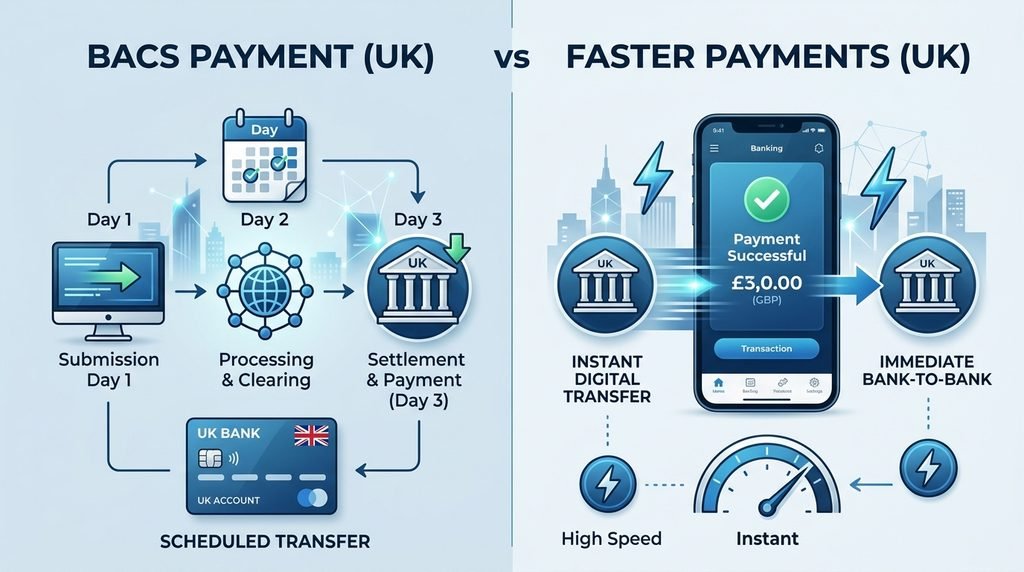
BACS Payment vs Faster Payments
One of the most common questions is whether a BACS payment is the same as a Faster Payment.
It isn’t.
Both methods can move money between UK bank accounts, but they are designed for different purposes.
| Feature | BACS | Faster Payments |
|---|---|---|
| Typical use | Regular and planned payments | Everyday bank transfers |
| Processing | Usually three working days | Usually much faster |
| Scheduling | Well suited to scheduled payments | Often near real-time |
| Common business use | Payroll and Direct Debits | Urgent supplier or customer payments |
| Availability | Based on BACS processing cycles | Subject to bank and payment limits |
Faster Payments can be more appropriate when the recipient needs money quickly. BACS, on the other hand, remains useful when businesses need predictable, scheduled processing.
There is also CHAPS, which is generally used for high-value or time-critical payments and operates differently from BACS.
The right choice depends on the situation rather than simply choosing whichever method sounds fastest.
Quick takeaway: Use BACS for planned, scheduled transactions and consider Faster Payments when speed is the priority.
What Are BACS Payments Used For?
BACS is deeply integrated into everyday UK business activity.
You may not always notice when a BACS payment is being used because much of the process happens electronically in the background.
Payroll
Employers commonly use BACS to pay employees’ salaries.
Payroll teams can prepare payments in advance, making it easier to manage regular monthly or weekly salary runs.
Supplier payments
Businesses can use BACS to pay suppliers according to agreed invoice terms.
For example, a company with 30-day payment terms may schedule supplier payments without manually initiating every transfer on the payment date.
Direct Debits
BACS is also associated with Direct Debit processing.
This allows organisations to collect recurring payments when customers have given the appropriate authorisation.
Examples include:
- Utility bills
- Insurance premiums
- Membership fees
- Subscriptions
- Loan repayments
The Direct Debit process has its own rules and protections, so it should not be confused with a simple bank transfer.
Refunds and regular business payments
Companies may also use BACS for refunds, pensions, expenses, and other recurring transactions.
For organisations making hundreds or thousands of payments, automation can significantly reduce repetitive administrative work.
Practical tip: If your business makes regular payments, document the payment schedule and approval process. This reduces the chance of missed deadlines or incorrect account details.
How Long Does a BACS Payment Take?
A standard BACS payment is commonly associated with a three-working-day processing cycle.
For example, if a payment is submitted on a Monday within the relevant processing deadline, it may reach the recipient on Wednesday.
However, this should not be treated as a guarantee for every situation.
Bank holidays, weekends, submission times, incorrect payment information, and specific banking arrangements can affect when funds become available.
Why weekends matter
BACS processing is based on working days rather than simply counting calendar days.
If you submit a payment before a weekend, the recipient may not receive it until the relevant processing cycle has completed.
Why bank holidays matter
UK bank holidays can also affect payment schedules.
This is especially important for payroll departments. If payday falls around a bank holiday, businesses often need to arrange their payment instructions earlier.
Check the bank cut-off time
There is another detail that is easy to overlook: the time your bank requires payment instructions to be submitted.
Missing a daily cut-off could push the payment into the next processing cycle.
Practical tip: For important payments, work backwards from the required arrival date rather than submitting the payment on the assumption that it will arrive automatically.
Are BACS Payments Safe?
A BACS payment can be a secure way to move money, but security still depends heavily on how payment information is collected, checked, and authorised.
The biggest practical risk for businesses is often not the payment network itself. It is sending money to the wrong account because incorrect or fraudulent bank details were provided.
This is why payment controls matter.
Good security practices include:
- Verify new supplier bank details independently.
- Confirm changes to existing payment details.
- Restrict access to payment systems.
- Use strong passwords and multi-factor authentication where available.
- Keep payment approval records.
- Avoid relying solely on information contained in an unexpected email.
- Recheck large or unusual payments before authorising them.
Imagine receiving an email from a supplier saying its bank account has changed. The email looks genuine, the invoice looks normal, and everything seems fine.
Sending the payment immediately could be a costly mistake.
A safer approach is to verify the change using a trusted contact method already held on file.
For broader UK payment and financial guidance:
Quick takeaway: Treat bank-detail changes as high-risk events and verify them independently before sending money.
What Information Is Needed for a BACS Payment?
The exact information required depends on the type of BACS transaction and the organisation processing it.
For a standard account-to-account payment, common details include:
- Recipient’s name
- Sort code
- Account number
- Amount
- Payment reference
- Requested payment date
Businesses may also need additional information for payroll or bulk payment files.
For Direct Debits, the process is different because the organisation needs an appropriate customer mandate and must follow the applicable Direct Debit rules.
Why accurate details matter
A single incorrect digit can cause a payment to fail, be delayed, or potentially reach an unintended account.
That’s why many finance teams use approval workflows, supplier verification procedures, and accounting software integrations.
For larger organisations, automated validation can also reduce manual data-entry errors.
Practical tip: Never assume that bank details are correct simply because they appeared on an invoice you’ve received before. Keep verified supplier information in a controlled system.
BACS Payment Costs: Are They Free?
Whether a BACS payment costs money depends on the bank, business account, payment provider, and type of service being used.
Some banking packages include certain BACS transactions within their fees, while others may charge per payment or according to a pricing structure.
For businesses making large payment volumes, the cost can be more complex than a simple per-transfer fee.
You may need to consider:
- Monthly account fees
- Per-payment charges
- Bulk payment charges
- Payroll processing costs
- Payment service provider fees
- Software or integration costs
A business that sends five payments per month has very different requirements from a company processing several thousand payments.
Don’t compare only the transaction fee
Suppose one provider charges a small fee per payment but requires expensive software or additional services. Another provider may have a higher transaction cost but include useful payment and accounting features.
The cheapest individual transaction isn’t necessarily the cheapest overall solution.
Practical tip: Calculate your estimated annual payment volume before comparing BACS pricing. Look at the total cost rather than focusing on one headline fee.
Common BACS Payment Mistakes to Avoid
BACS is straightforward once the process is understood, but businesses can still make avoidable mistakes.
1. Leaving payments until the last minute
Because BACS works through scheduled processing cycles, it isn’t ideal for emergencies.
If a supplier needs payment today, another payment method may be more appropriate.
2. Ignoring bank holidays
A payment schedule that works during an ordinary week may not work around a UK bank holiday.
Finance teams should check the calendar when planning payroll and other critical payments.
3. Entering incorrect bank details
Incorrect sort codes or account numbers can create unnecessary problems.
Always check payment details before submitting a transaction.
4. Failing to verify changed details
Fraudsters may attempt to impersonate suppliers and request changes to bank information.
Independent verification is one of the simplest ways to reduce this risk.
5. Assuming every bank transfer is BACS
UK bank transfers can use different payment systems.
Calling every transfer a BACS payment can create confusion when discussing processing times, fees, or transaction requirements.
6. Not keeping payment records
Businesses should maintain appropriate records of payments and approvals.
Good documentation makes reconciliation easier and can help investigate problems later.
Quick takeaway: Most BACS-related problems are preventable with accurate information, proper scheduling, and a clear approval process.
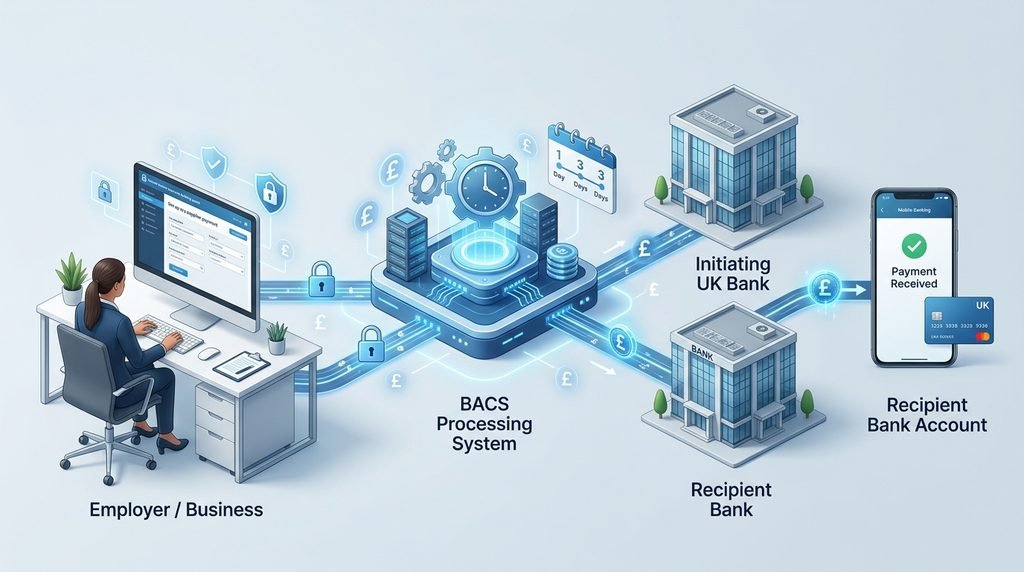
How Businesses Can Manage BACS Payments More Efficiently
The best BACS process is usually the one that removes unnecessary manual work without removing important controls.
A simple workflow can look like this:
- Collect payment information from an approved source.
- Verify new or changed bank details.
- Enter or import the payment data.
- Check amounts and payment dates.
- Use a second-person approval process for appropriate transactions.
- Submit payments before the relevant cut-off.
- Reconcile completed transactions with accounting records.
- Investigate failed or unexpected payments promptly.
Automation can make this process much easier.
For example, payroll software can prepare employee payments while accounting systems can help businesses manage supplier invoices and payment records.
That said, automation should not mean “set it and forget it.” Human oversight remains important, particularly when payment details change or transaction amounts are unusually high.
A simple BACS checklist
Before submitting an important payment, ask:
- Is the recipient correct?
- Have the bank details been verified?
- Is the amount correct?
- Is the payment date appropriate?
- Have approval requirements been met?
- Have weekends and bank holidays been considered?
- Is there enough money in the account?
- Has the payment reference been entered correctly?
It takes only a few minutes, but this kind of checklist can prevent expensive mistakes.
Practical tip: Build the checklist into your normal finance process instead of using it only when something goes wrong.
Is BACS Payment Right for Your Business?
For many UK businesses, BACS remains a practical option because it works particularly well for regular and predictable payments.
It can be a good fit if your organisation:
- Runs regular payroll
- Pays suppliers on scheduled terms
- Collects recurring payments
- Processes large volumes of transactions
- Does not require immediate settlement
- Wants a structured payment process
However, it may not be the best choice for every situation.
If you need to send money urgently, a faster payment method may be more suitable. If you’re dealing with a particularly high-value transaction, you may also need to consider other payment systems.
The key is to match the payment method to the business requirement.
A finance team shouldn’t choose BACS simply because it is familiar. It should choose it because the timing, cost, controls, and payment requirements make sense.
Quick takeaway: BACS is strongest when payments are planned, repeatable, and scheduled. For urgent transactions, consider whether another UK payment method is more appropriate.
FAQs About BACS Payment
What is a BACS payment?
A BACS payment is an electronic UK bank payment processed through the BACS system. It is commonly used for salaries, supplier payments, recurring transactions, and Direct Debits. Standard BACS processing is generally associated with a three-working-day cycle, although actual timing can depend on submission deadlines and other circumstances.
How long does a BACS payment take?
A standard BACS payment typically follows a three-working-day processing cycle. The exact arrival date depends on when the payment instruction is submitted, bank processing deadlines, weekends, and UK bank holidays. Businesses should therefore allow enough time for the payment to complete rather than relying on same-day delivery.
Is a BACS payment the same as a bank transfer?
Not exactly. A BACS payment is one type of electronic bank payment processed through the BACS system. UK banks also use other payment methods, including Faster Payments and CHAPS. These systems have different processing speeds, use cases, and characteristics.
Can a BACS payment be cancelled?
Whether a BACS payment can be cancelled depends on its stage in the payment process and the bank or service provider involved. Once a payment has been processed, recovering funds can be more difficult. Businesses should contact their bank promptly if they identify an error.
Are BACS payments safe?
BACS payments use established UK banking infrastructure, but businesses still need strong security controls. Incorrect account details, compromised systems, and payment fraud can create risks. Verifying bank-detail changes and using appropriate approval procedures are important safeguards.
Can individuals make a BACS payment?
BACS is most commonly associated with business and organisational payments, including payroll and Direct Debits. Individuals can make UK bank transfers through their bank, but the payment method used may be different. If speed is important, Faster Payments may be more appropriate.
Final Thoughts
BACS remains an important part of the UK’s payment infrastructure, particularly for organisations that handle regular, scheduled transactions.
Its main strength isn’t speed. It’s structure.
Businesses can plan payments, automate recurring processes, manage payroll, and pay suppliers without relying on manual transfers every time. But that convenience works best when payment details are accurate and internal controls are strong.
If you’re deciding whether BACS is right for a particular transaction, start with three questions: How quickly does the money need to arrive? How often will the payment be made? And what level of payment control does the business require?






1 thought on “BACS Payment: 7 Powerful Benefits and Best Practices”