What Is a Sort Code Checker?
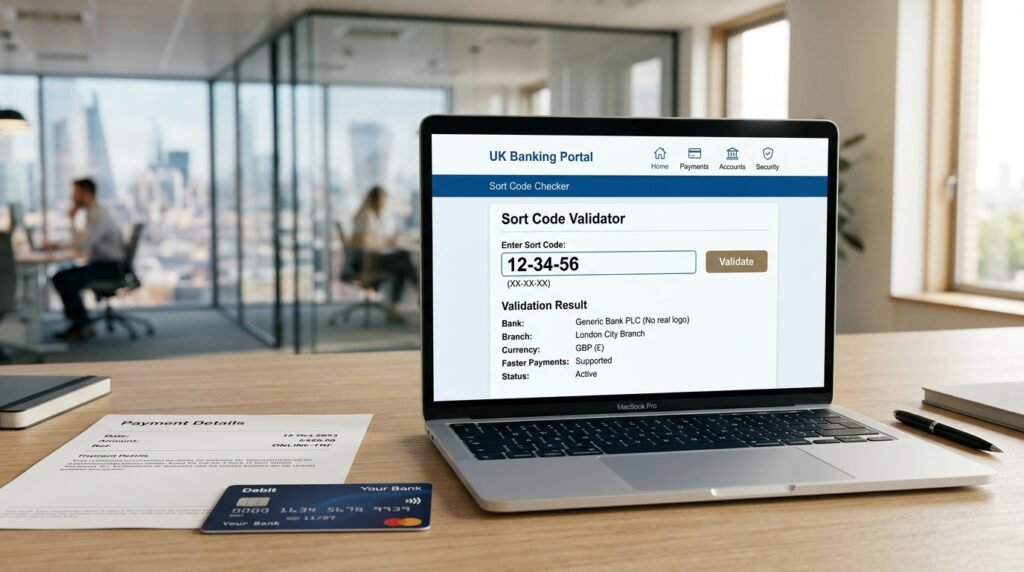
A sort code checker is a useful tool for identifying and validating a UK bank or building society sort code. A sort code is normally a six-digit number, often displayed in the format 12-34-56, and is used alongside an account number to route payments to the correct financial institution.
If you are making a bank transfer, setting up a Direct Debit, receiving your salary, or checking payment details, getting these numbers right matters. One small mistake can result in a failed payment or, in some circumstances, money being sent to the wrong account.
In practice, a sort code checker can help you answer simple but important questions:
- Which bank or financial institution uses a particular sort code?
- Is the sort code recognised?
- Which branch or office is associated with it?
- Does the code support particular UK payment systems?
- Are the details worth checking before making a payment?
Pay.UK manages the rules and processes surrounding UK sort codes and maintains industry reference data used across UK payment systems. Its Extended Industry Sort Code Directory (EISCD) contains information about payment service providers and their registered sort codes.
Quick takeaway: Use a sort code checker as a verification step, not as a substitute for confirming payment details directly with the recipient or their bank.
How Does a Sort Code Checker Work?
A sort code checker generally compares the six-digit code you enter against a database of banking information.
For example, imagine you are given:
Sort code: 20-45-67
Account number: 12345678
The checker may use the sort code to identify the relevant bank or payment service provider and provide information about the associated banking office.
However, there is an important distinction here. A valid sort code does not necessarily prove that a particular account exists or that the recipient’s account details are correct.
That’s why checking a sort code should be viewed as one part of the payment verification process.
What Information Can a Sort Code Checker Show?
Depending on the service being used, you may see information such as:
- Bank or payment service provider name
- Branch or office name
- Sort code
- Bank identifier
- Location or address
- Payment systems supported
- BIC information in some cases
The official EISCD contains information including sort codes, BICs, branch titles, clearing participation, postal addresses and telephone numbers.
This is particularly useful for businesses that process a large number of payments and need reliable banking reference data.
Quick takeaway: A checker is most useful for identifying the institution associated with a sort code. Do not assume it verifies the ownership of an individual bank account.

7 Powerful Ways to Use a Sort Code Checker
A sort code checker can be helpful in several everyday situations. Here are seven practical uses.
1. Identify the Bank
The most obvious use is finding the bank or payment service provider associated with a six-digit sort code.
This can be useful when a supplier, customer, employer, or business partner gives you payment information and you want to understand which institution the code belongs to.
For example, if you receive bank details without a clearly stated bank name, checking the sort code can provide an additional point of reference.
2. Check a Sort Code Before a Bank Transfer
Before sending a significant payment, take a moment to check the sort code.
This is especially sensible when:
- You are paying a new supplier.
- You are transferring money to a business for the first time.
- You are paying an invoice with recently changed bank details.
- You are sending a large amount.
- Someone has provided payment details by email.
A checker can help identify obvious inconsistencies. For example, if someone says an account belongs to one financial institution but the sort code is associated with another, stop and verify the details before proceeding.
3. Help Set Up Direct Debits
UK Direct Debits generally require the customer’s account number and sort code. MoneyHelper explains that these details are normally requested when setting up a Direct Debit.
A sort code checker can therefore be useful when reviewing banking information before completing a payment instruction.
That said, the checker does not replace the Direct Debit process or your bank’s own verification procedures.
4. Investigate an Unexpected Sort Code
Sometimes a sort code appears on a bank statement, invoice, payment instruction, or financial document without much explanation.
Checking it can help you identify the associated institution and understand where the payment information points.
This is particularly useful for businesses that deal with multiple suppliers and customers.
5. Check Banking Information for Payroll
Businesses often handle hundreds or thousands of employee payment records.
A basic sort code validation process can help identify incorrectly formatted or unrecognised banking information before payroll is submitted.
It is not a guarantee that every payment will succeed, but it can reduce avoidable data-entry errors.
6. Support Business Payment Processing
For organisations processing Bacs, Faster Payments, or other UK payment transactions, accurate reference data is particularly important.
Pay.UK states that its EISCD is used for checking account details in electronic payments and helping reduce returned payments and correction work.
This is where a sort code checker becomes more than a consumer convenience. Accurate banking reference data can become part of a company’s payment-control process.
7. Compare Payment Details Before Sending Money
One of the simplest uses is also one of the most valuable: compare the details you were given with what you expected.
For example:
- Check the recipient’s name.
- Check the sort code.
- Check the account number.
- Check the payment reference.
- Confirm unusual changes directly with the recipient.
Quick takeaway: A sort code checker works best as an early warning system. Use it to spot inconsistencies before you authorise a payment.
Sort Code Checker vs Bank Account Verification
These two ideas are often confused.
A sort code checker primarily identifies or validates information associated with a sort code. Account verification is a broader process that may check whether the account details correspond with the intended recipient.
The distinction matters because a perfectly valid sort code can still be paired with an incorrect account number.
What a Sort Code Check Can Tell You
A checker may help establish:
- Whether the format looks valid
- Which bank or payment service provider is associated with the code
- Which banking office is registered
- Whether relevant payment-system information exists
What It May Not Tell You
It may not confirm:
- The account holder’s identity
- Whether the account is currently active
- Whether the account has sufficient funds
- Whether the account number belongs with the sort code
- Whether a payment will definitely be successful
Modern UK payment services can provide additional account-name checking. Pay.UK explains that Confirmation of Payee can check the account name, sort code and account number against the details held by the receiving account provider.
This makes recipient verification an important additional safeguard.
Quick takeaway: A valid sort code is useful evidence, but it is not proof that the complete bank account details belong to the person or company you intend to pay.

How to Check a Sort Code Correctly
If you have been given a UK sort code and want to check it, the process is straightforward.
Step 1: Find the Six-Digit Code
Look at the bank statement, online banking screen, cheque, invoice, or payment information provided by the recipient.
A UK sort code normally contains six digits.
It may be written as:
12-34-56
or:
123456
Both formats represent the same six-digit sequence.
Step 2: Enter the Code Carefully
If you are using a sort code checker, enter all six digits.
Avoid accidentally entering an account number, card number, or reference number instead.
Step 3: Review the Result
Check the institution name and other available information.
If the result does not match what you were told, do not immediately assume the checker is wrong. Banking arrangements can be more complicated than a simple bank-to-branch relationship.
Step 4: Confirm the Complete Payment Details
Compare the result with:
- Recipient name
- Account number
- Sort code
- Bank name
- Invoice or payment reference
For larger payments, contact the recipient through a trusted channel if any detail has recently changed.
Step 5: Follow Your Bank’s Verification Process
Your bank may perform additional checks when you create a payment.
If it displays a warning, close match, or other verification message, read it carefully rather than ignoring it.
Quick takeaway: Never rely on one database or one check when sending a large or unusual payment.
Why Accurate Sort Codes Matter for UK Payments
Sort codes are an important part of the UK’s payment infrastructure.
Pay.UK explains that sort codes are used to route and settle payments through systems including Bacs, Faster Payments and the Image Clearing System.
That means a six-digit code is doing more than identifying a familiar high-street bank branch.
It forms part of the routing information that helps payment systems determine where funds should go.
Bacs Payments
Bacs is widely used for business payments, salaries and Direct Debits.
Incorrect banking information can lead to payment failures or additional administrative work.
Faster Payments
Faster Payments allows qualifying UK payments to move electronically between participating institutions, often within a short period.
Because transactions can move quickly, checking details before pressing the final payment button is sensible.
Direct Debits
Direct Debits use account information to collect payments from a bank account. MoneyHelper notes that customers generally provide their account number and sort code when setting one up.
Quick takeaway: Sort codes are part of the UK’s payment-routing infrastructure, so accuracy matters across several everyday payment methods.
Common Sort Code Mistakes to Avoid
Even experienced users can make simple banking-data mistakes. The problem is that they are often easy to prevent.
Entering Five or Seven Digits
A standard UK sort code contains six digits.
If you have fewer or more digits, check the original information again.
Confusing a Sort Code With an Account Number
An account number is usually separate from the sort code.
Do not copy the first six digits of an account number simply because you need a sort code.
Assuming the Bank Name Is Enough
Two payment details may look similar while serving different purposes.
Always check the actual sort code rather than relying only on a bank name written on an invoice.
Trusting Recently Changed Payment Details Without Verification
This is particularly important for businesses.
If a supplier suddenly tells you that its bank details have changed, verify the change using an established contact method. Do not rely solely on the email or message containing the new details.
Treating a Valid Sort Code as Proof of Ownership
This is perhaps the biggest misunderstanding.
A sort code can identify a payment service provider, but that does not automatically establish who owns the account.
Quick takeaway: The safest payment habit is simple: verify the full set of details, especially when the amount is large or the recipient’s bank information has changed.
Is a Sort Code Checker Safe to Use?
Generally, checking a sort code is a low-risk activity because the sort code itself is not the same as a password, PIN, card security code, or online banking credential.
However, you should still be careful about the website you use.
A trustworthy checker should not ask you for unnecessary sensitive information.
Never Enter These Details Into an Untrusted Checker
Avoid entering:
- Online banking passwords
- PINs
- Card security codes
- One-time authentication codes
- Full card details
- Security answers
A legitimate banking reference lookup should not need your online banking login.
For businesses, it is also sensible to use authoritative or reputable banking reference-data providers rather than relying on an unknown website with unclear data sources.
Pay.UK’s EISCD is the industry’s central database containing information about UK payment service providers and sort codes connected to relevant clearing systems.
Quick takeaway: If a website asks for more sensitive information than necessary just to check a sort code, leave the site and use a more reputable source.
Final Checks Before Sending a UK Bank Payment
Before sending money, especially to a new recipient, use this quick process.
- Check the recipient’s name.
- Check the six-digit sort code.
- Check the account number.
- Review the bank’s verification message.
- Confirm unexpected changes independently.
- Double-check the payment amount.
- Make sure the reference is correct.
- Keep evidence of the payment and the details you verified.
A sort code checker can support the process, but the final responsibility for confirming payment information should not be placed on a single online tool.
This is particularly important because banking databases can change, payment arrangements can be complex, and some financial institutions operate through indirect or sponsored arrangements. Pay.UK notes that not every payment service provider relationship is necessarily represented in the same straightforward way within its reference directories.
Practical tip: For routine payments, build verification into your normal workflow. For high-value payments, treat verification as a separate control rather than a quick final glance.
Frequently Asked Questions
What is a sort code checker?
A sort code checker is a tool used to look up information associated with a UK six-digit sort code. It can typically help identify the bank or payment service provider connected with the code. However, it does not necessarily confirm that a particular account belongs to a specific person or business.
Can a sort code checker confirm a bank account?
Not necessarily. A sort code checker can identify information associated with the sort code, but it may not verify the account holder or confirm that the account number is valid. Additional services, such as bank-provided recipient verification, may perform broader checks.
Is a sort code always six digits?
Yes, a standard UK sort code consists of six digits. It is commonly displayed in two groups of three, such as 12-34-56, although some systems display it without hyphens as 123456. If you receive a different format, check the original banking information before using it.
Can I use a sort code checker before making a bank transfer?
Yes. Checking the sort code before a transfer can help you identify the associated financial institution and spot obvious inconsistencies. However, you should also verify the recipient name, account number and any bank verification messages before authorising the payment.
Is a sort code the same as an account number?
No. A sort code and account number are separate pieces of banking information. The sort code generally contains six digits and helps route payments to the relevant institution, while the account number identifies the individual account within that banking arrangement.
Why does a sort code checker show a different bank?
There can be legitimate reasons for an unexpected result, including banking restructures, payment-service-provider arrangements, or sponsored and indirect access arrangements. If the result conflicts with the payment information you received, verify the details with the bank or recipient before sending money.