
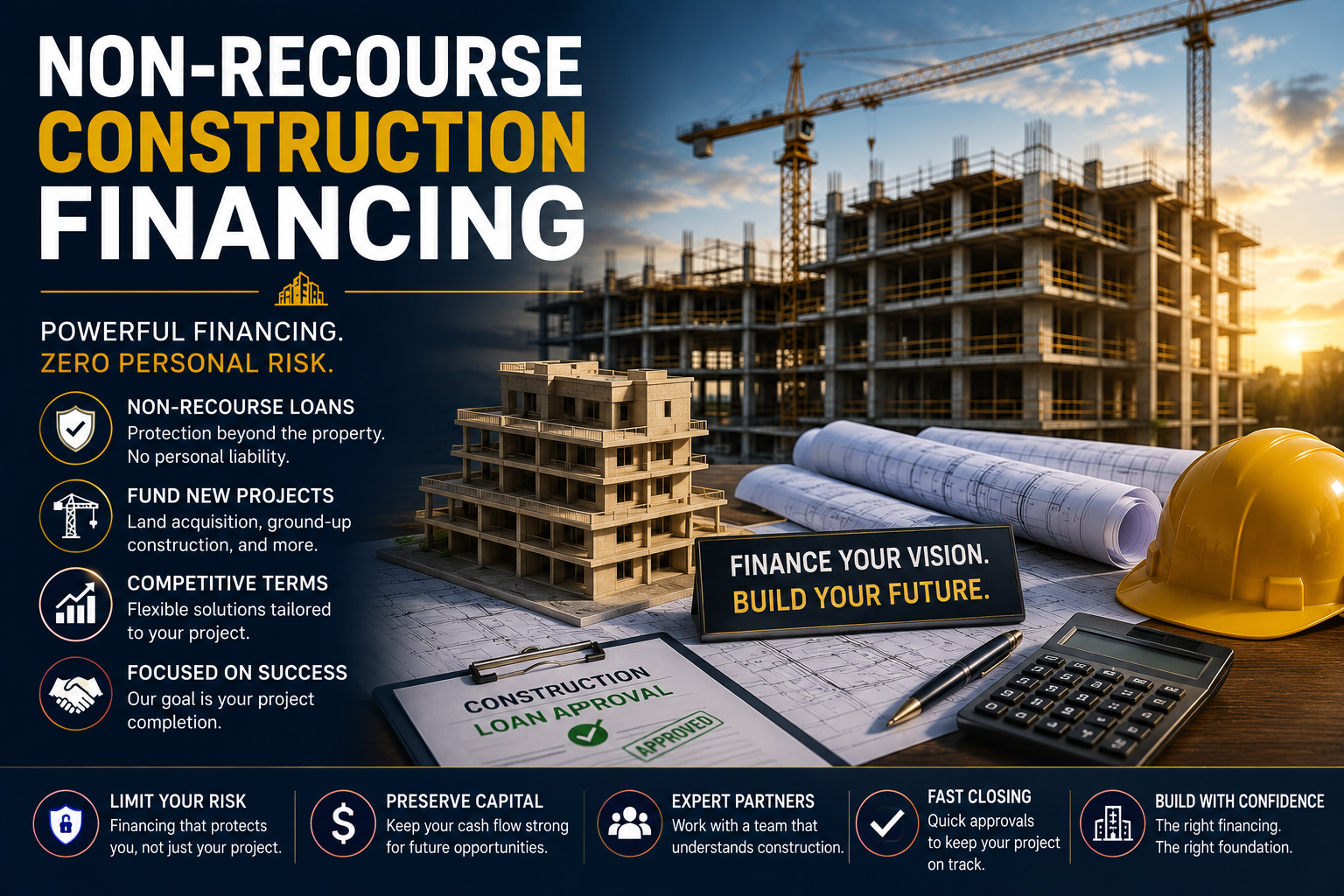
Developers taking on large-scale building projects face a critical early decision: how much personal risk are they willing to put on the line? Non-recourse construction financing offers one answer. It’s a loan structure built around the project itself rather than the borrower’s personal balance sheet, and it’s become a go-to option for sponsors handling significant commercial and multifamily developments.
Below are the six things developers most need to understand before pursuing this type of financing.
1. It Limits Liability to the Project, Not the Borrower
At its core, non-recourse construction financing means the lender’s only claim in the event of default is the collateral itself — typically the property under construction. If the project runs into trouble and repayment becomes impossible, the lender can seize the asset, but the borrower’s personal bank accounts, other real estate holdings, and unrelated business assets stay untouched. This stands in contrast to a recourse loan, where a lender can pursue a borrower’s personal assets and income if the property’s value doesn’t cover the outstanding debt.
That separation of project risk from personal wealth is the entire appeal of the structure. It lets developers pursue ambitious or capital-intensive projects without staking their personal financial future on a single deal.
2. Most Construction Loans Are Actually Recourse
It’s worth setting expectations early: the majority of bank, bridge, and construction loans in the market are structured as recourse loans. Non-recourse options are more commonly associated with agency and government-backed programs, such as Fannie Mae, Freddie Mac, and HUD/FHA multifamily financing, along with CMBS loans. Banks generally default to recourse structures because federal regulation effectively pushes them that way outside of very low leverage deals.
That means finding a lender willing to offer a fully non-recourse construction loan often requires looking beyond a traditional community bank and toward specialized lenders or federally insured programs like HUD’s 221(d)(4) construction-to-permanent loan.
3. Qualification Standards Are Stricter
Because the lender is absorbing more of the downside risk, underwriting for non-recourse construction loans tends to be more rigorous than for recourse financing. Lenders will look closely at:
- The developer’s track record and experience completing similar projects
- The project’s location and evidence of market demand, including pre-leasing where applicable
- The borrower’s equity contribution, since a meaningful stake in the deal reassures lenders that the sponsor is committed
- Overall project feasibility, including budget, timeline, and contractor experience
A first-time developer with a speculative project in a soft market will have a much harder time securing non-recourse terms than an experienced sponsor with strong pre-leasing in a proven submarket.
4. “Bad Boy” Carve-Outs Still Apply
Non-recourse doesn’t mean zero personal exposure under any circumstance. Nearly all non-recourse construction loans include carve-out provisions — often called “bad boy” carve-outs — that convert the loan to full recourse if the borrower engages in fraud, intentionally misrepresents financial information, or improperly declares bankruptcy on the project entity. Many lenders also require a completion guarantee, since an unfinished construction project is one of the riskiest outcomes for a non-recourse lender to absorb.
Reading these carve-out terms carefully matters, since standards for what counts as a violation vary from lender to lender.
5. Terms and Costs Differ From Recourse Loans
Because lenders take on more risk, non-recourse construction loans often carry higher interest rates or lower loan-to-value and loan-to-cost ratios compared with recourse alternatives. Loan structures commonly include:
- Interest-only payments during the construction phase, often followed by a balloon payment or a conversion to permanent financing once the project stabilizes
- Draw schedules that release funds in stages as construction milestones are met, usually tied to inspections and documentation
- Burn-off provisions in some hybrid deals, where a loan starts as recourse and converts to non-recourse once the property hits a defined occupancy or debt service coverage threshold
Programs like HUD’s 221(d)(4) stand out for offering fully non-recourse terms with no personal guarantees, even during the construction and stabilization periods, though the underwriting and approval timeline is typically longer than a conventional bank loan.
6. It’s Best Suited to Certain Project Types
Non-recourse construction financing tends to work best for income-producing properties where a lender can reasonably underwrite future cash flow — think stabilized multifamily communities, office buildings, and retail centers with a clear path to occupancy. It’s also popular in partnership and syndication structures, since it avoids the awkward question of which investor should be personally on the hook if the deal goes south. For smaller, speculative, or first-time development projects, recourse financing often remains the more accessible, if riskier, path.
Weighing the Trade-Off
Non-recourse construction financing isn’t free protection — it’s a trade of speed and cost for a firmer boundary around personal liability. For seasoned developers working on substantial, well-positioned projects, that trade-off is often worth the stricter underwriting and longer approval process. For smaller or first-time projects, a recourse loan may still be the more realistic starting point, with an eye toward non-recourse or agency financing once the portfolio and track record grow.
As with any financing decision, terms vary significantly by lender and project type, so working with an experienced commercial finance advisor before committing to a structure is worth the time.
Frequently Asked Questions
What is non-recourse construction financing? It’s a loan for a building project where the lender’s only claim in a default is the property itself. The borrower’s personal assets, bank accounts, and other holdings are not at risk.
Is non-recourse construction financing hard to get? Yes, relative to recourse loans. Lenders apply stricter underwriting, since they can’t fall back on the borrower’s personal assets if the project fails. Strong developer track records, meaningful equity contributions, and solid pre-leasing all help.
Who typically offers non-recourse construction loans? Specialized commercial lenders and government-backed programs are the most common sources, particularly HUD/FHA multifamily financing (like the 221(d)(4) program), along with some Fannie Mae, Freddie Mac, and CMBS-related structures. Most conventional banks default to recourse lending instead.
Are interest rates higher on non-recourse construction loans? Often, yes. Because the lender is taking on more risk without a personal guarantee, non-recourse loans can carry higher rates or lower loan-to-value and loan-to-cost ratios than comparable recourse financing.
Does non-recourse mean the borrower has zero personal liability? Not entirely. Most non-recourse loans include “bad boy” carve-outs, which convert the loan to full recourse if the borrower commits fraud, misrepresents financial information, or improperly declares bankruptcy on the project entity.
What types of projects qualify for non-recourse construction financing? Income-producing properties with a clear path to stabilized occupancy tend to qualify most easily — think multifamily communities, office buildings, and retail centers. Smaller or speculative projects often have an easier time with recourse financing instead.
This article is for general informational purposes and isn’t a substitute for advice from a licensed financial or legal professional. Loan terms, qualification standards, and available programs change over time, so confirm current details directly with a lender before making financing decisions.