Ever wondered why customers keep choosing one brand over another, even when the products look almost identical? Honestly, the answer isn’t just about price or quality — it’s hidden in something called a value proposition. If you’re still not entirely sure what a value proposition actually is and why it matters so much for your business, you’re in the right place.
I remember when I first started my own small business, the biggest mistake I made was this — I knew my product inside out, but I couldn’t clearly explain why a customer should pick me over someone else. The day I finally nailed down my value proposition, that’s when I noticed a real shift in both sales and customer trust.
A Simple Definition of Value Proposition
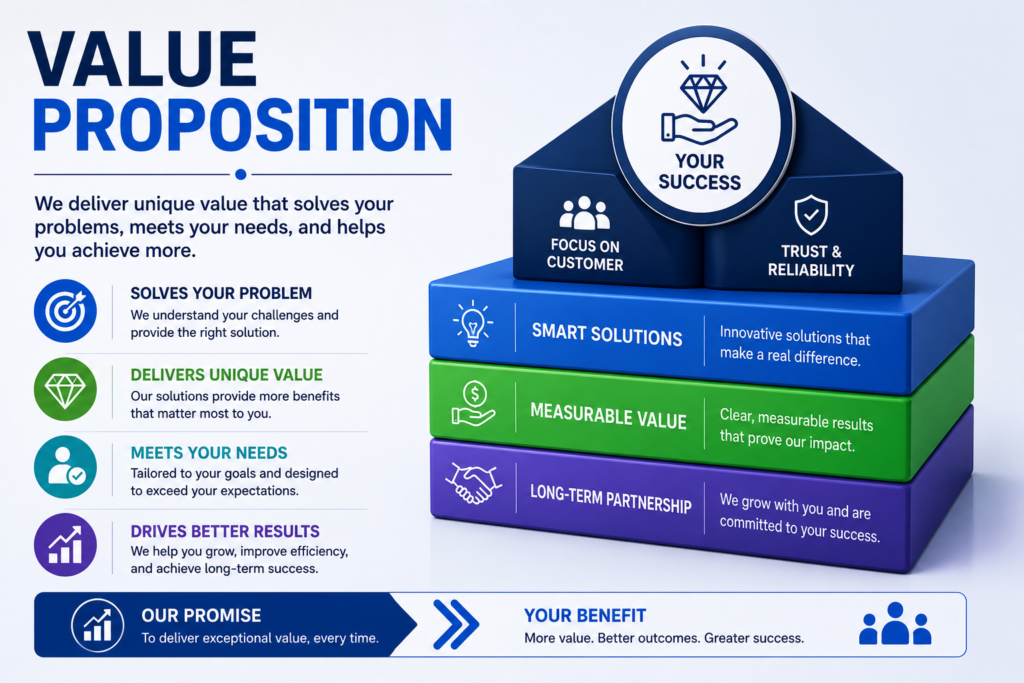
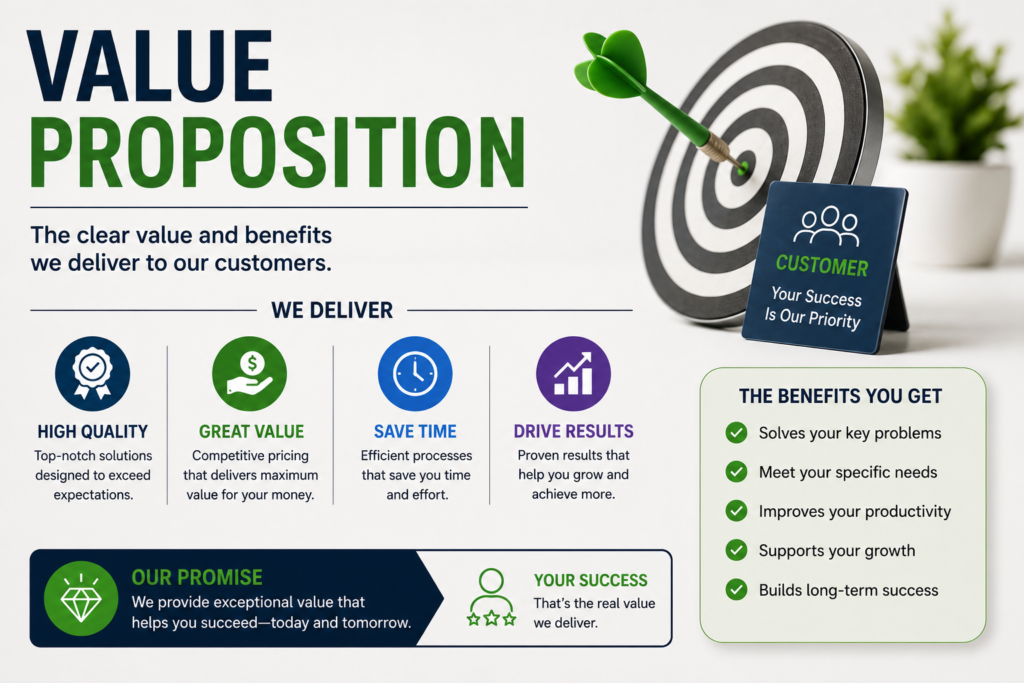
A value proposition is a clear statement that tells customers exactly what specific benefit your product or service offers, and why it’s different from everything else out there. It’s not just a catchy tagline — it’s basically a promise your entire business makes to its customers.
What’s more, a value proposition isn’t only a marketing team’s job. It’s actually the core of your business strategy, showing up everywhere from product development to how you treat customers on a support call.
Why Does a Value Proposition Matter So Much?
Let’s be real — in today’s competitive market, customers are drowning in choices. Nearly every category has dozens of brands selling more or less the same thing. In a situation like that, if you can’t quickly explain how your product makes someone’s life better, they’ll simply move on to a competitor.
A strong value proposition gives you:
- Instant clarity for customers on why your product is right for them
- Sharper, more focused marketing messaging
- Easier conversations for your sales team
- Stronger brand loyalty and trust over time
- A real point of difference from competitors
5 Key Elements Every Value Proposition Needs
So now comes the real question — how do you actually build one? Here are the five elements every solid value proposition should include.
1. A Clear Understanding of Your Target Audience
The first and most important piece is knowing exactly who you’re building this for. If you try to sell “to everyone,” you end up being convincing to no one.
For example, if you’re running a skincare brand, deciding whether you’re targeting teenagers or working professionals matters a lot — because their needs are completely different.
2. The Problem You’re Actually Solving
Every great value proposition starts with a real problem. Customers don’t buy from you just because your product is “good” — they buy because it solves something that’s genuinely bothering them.
Ask yourself: “What’s the daily frustration my customer deals with that my product can actually fix?” The more specific your answer, the stronger your value proposition naturally becomes.
3. Your Unique Benefit (Differentiation)
Beyond that, you also need to explain how your solution stands apart from the rest. You don’t need to reinvent the wheel — sometimes even a small, specific angle is enough to make you stand out.
Some common differentiation angles include:
- Speed — like “delivered within 24 hours”
- Price — like “the most affordable option in the market”
- Quality — like “premium materials, lifetime warranty”
- Convenience — like “order in just one click”
- Personalization — like “customized to your exact needs”
4. Proof or Credibility (The Trust Factor)
Just making a claim isn’t enough — you need to back it up so customers actually believe you. This is where reviews, case studies, testimonials, or certifications come into play.
If you’re saying “our product is the most durable,” you need some kind of proof to support that — whether it’s a customer review, a before-and-after result, or a lab certification. This is exactly what builds both authority and trust.
5. Simple, Clear Language
A great value proposition is never buried in complicated jargon. It should be simple enough that anyone can understand what you’re offering within five seconds.
If it takes paragraphs to explain your value proposition, it’s probably not working. The best ones are usually just a line or two — clear, direct, and easy to remember.
How to Write a Value Proposition (Practical Framework)
If you want to write your own, here’s a simple formula you can use:
“We help [target audience] solve [problem] through [unique solution], so they get [key benefit].”
For example: “We help busy professionals solve the problem of eating healthy through fresh, ready-to-eat meals, saving them time while improving their health.”
This framework is simple but incredibly effective — because it brings together your audience, the problem, your solution, and the benefit, all in one place.
Common Mistakes Businesses Make
From my own experience — and honestly, mistakes I’ve made myself — here are a few things to watch out for:
- Treating the value proposition as just a slogan, when it should shape your entire brand strategy
- Listing too many features instead of clearly stating the benefit
- Using vague, generic language like “best quality” or “affordable prices” without any real proof
- Not having a clearly defined target audience
- Writing it once and forgetting about it — it should evolve as your business grows
Conclusion
So if you’re trying to understand what a value proposition really is, here’s the simple truth — it’s the reason a customer believes you’re the best choice for them. It brings together a clear understanding of your audience, a real problem, a unique point of difference, credibility, and simple language — all five elements working together.
Here’s the honest part — businesses that take the time to clearly define their value proposition don’t just attract more customers, they also build brand loyalty that lasts. If you haven’t nailed yours down yet, now is exactly the right time to start.