
Have you ever made a decision quickly, only to realize later that you didn’t actually think it through? Honestly, most of us have. We live in a world full of information, opinions, and noise, and without strong critical thinking skills, it’s easy to get pulled in the wrong direction. That’s exactly why critical thinking exercises matter — they train your brain to slow down, question assumptions, and reach better conclusions.
I still remember when I first started practicing these exercises myself. At first, it felt unnatural, almost like forcing my brain to work differently. But within a few weeks, I noticed I was catching my own biases faster and making decisions I actually felt confident about. That’s the real power of consistent practice.
What Is Critical Thinking, Really?
Critical thinking is the ability to analyze information objectively, question assumptions, and form a judgment based on evidence rather than emotion or habit. It’s not about being negative or doubting everything — it’s about thinking clearly before you act or believe something.
The good news is, just like a muscle, critical thinking can be trained. And that’s where structured exercises come in.
Why Critical Thinking Exercises Matter
Let’s be honest — in daily life, we’re bombarded with opinions, headlines, and quick judgments. Without practicing critical thinking, it becomes easy to accept things at face value or make decisions based purely on emotion.
Regularly practicing critical thinking exercises helps you:
- Spot logical fallacies and weak arguments faster
- Make better personal and professional decisions
- Avoid being manipulated by misinformation
- Improve problem-solving at work and in daily life
- Communicate your reasoning more clearly to others
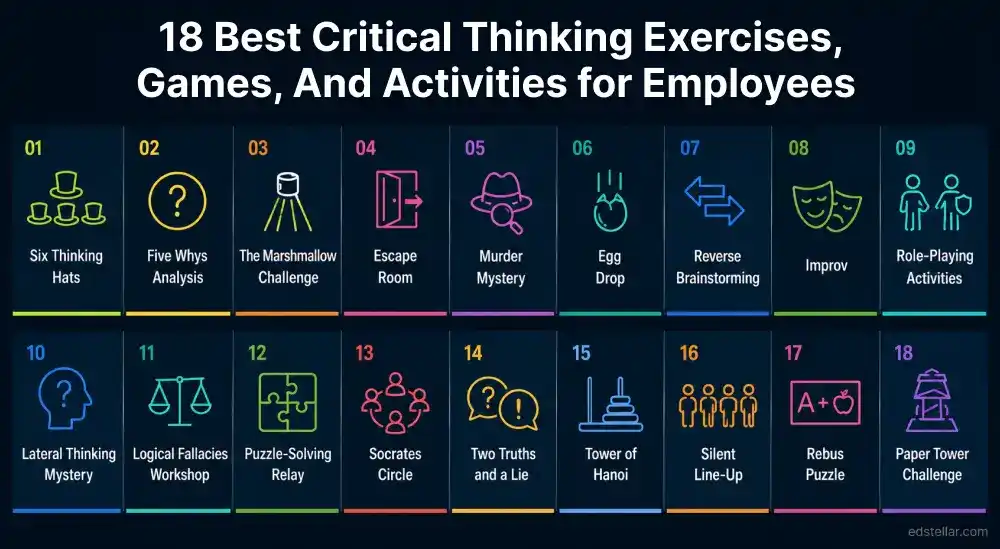
18 Practical Critical Thinking Exercises You Can Start Today
Here’s where it gets interesting. Below are exercises you can genuinely use, whether you’re a student, a professional, or just someone who wants to think more clearly.
1. The Five Whys Technique
Whenever you face a problem, ask “why” five times in a row to dig into the root cause instead of stopping at the surface-level symptom. This exercise is widely used in business problem-solving, but it works just as well for personal decisions.
2. Play Devil’s Advocate
Pick any opinion you strongly believe in, and then intentionally argue the opposite side as convincingly as you can. This forces you to understand other perspectives instead of just defending your own.
3. Analyze News Headlines
Take any news headline and ask yourself: What facts support this? What’s missing? Is there an emotional trigger being used here? This builds media literacy, which is a huge part of modern critical thinking.
4. Solve Logic Puzzles Regularly
Puzzles that require deduction — like Sudoku, logic grid puzzles, or riddles — train your brain to follow structured reasoning steps rather than jumping to conclusions.
5. Identify Assumptions in a Statement
Take any common belief, such as “hard work always leads to success,” and list every underlying assumption hidden inside that statement. This helps you separate fact from unquestioned belief.
6. Practice the “Steelman” Method
Unlike a strawman argument, a steelman means presenting the strongest possible version of an opposing view before you respond to it. It’s harder, but it dramatically improves the quality of your reasoning.
7. Debate With Yourself on Paper
Pick a topic, write down arguments for one side, then physically switch and write arguments for the other side. Seeing both perspectives on paper makes biases much easier to spot.
8. Fact-Check Before You Share
Before sharing any article, post, or claim online, pause and verify it from at least one credible source. This small habit alone builds strong analytical discipline over time.
9. Reverse Brainstorming
Instead of asking “how do I solve this problem,” ask “how could I make this problem worse?” Reversing the question often reveals blind spots you wouldn’t normally notice.
10. The “So What?” Test
After forming any conclusion, ask yourself “so what?” repeatedly to test whether your reasoning actually leads somewhere meaningful, or if it’s just surface-level thinking.
11. Compare Two Conflicting Sources
Find two articles or reports that disagree on the same topic, then break down where exactly the disagreement comes from — is it different data, different interpretation, or bias?
12. Practice Socratic Questioning
Use open-ended questions like “What evidence supports this?” or “What would change my mind about this?” This method, rooted in classical philosophy, remains one of the most effective critical thinking tools.
13. Identify Cognitive Biases in Daily Decisions
At the end of each day, review one decision you made and ask if any bias — like confirmation bias or anchoring — influenced it. Awareness alone significantly reduces the impact of these biases over time.
14. Case Study Analysis
Pick a real business or historical case, then analyze what decisions were made, what alternatives existed, and what you would have done differently. This builds practical, applied reasoning skills.
15. Group Discussion With Structured Roles
In a group setting, assign roles like “questioner,” “summarizer,” and “skeptic” during a discussion. This structured approach naturally improves collective critical thinking.
How Often Should You Practice These Exercises?
There’s no strict rule here, but consistency matters far more than intensity. Even spending 10–15 minutes a day on one exercise can lead to noticeable improvement within a month. The key is to treat it like a habit, not a one-time activity.
Common Mistakes People Make While Practicing Critical Thinking
From experience, here are a few pitfalls worth avoiding:
- Confusing critical thinking with simply being skeptical or negative about everything
- Practicing exercises passively without actually questioning your own conclusions
- Avoiding uncomfortable perspectives instead of engaging with them
- Expecting instant results instead of building the skill gradually
- Relying only on puzzles while ignoring real-life application
Conclusion
At the end of the day, critical thinking isn’t something you’re simply born with — it’s a skill built through consistent, deliberate practice. These 15 critical thinking exercises give you a solid starting point, whether your goal is better decision-making at work, sharper analysis of information, or simply understanding the world a little more clearly.
The truth is, the people who think more clearly aren’t necessarily smarter — they’ve just trained themselves to pause, question, and reason before jumping to conclusions. Start with even one exercise from this list today, and you’ll likely notice the difference sooner than you expect.