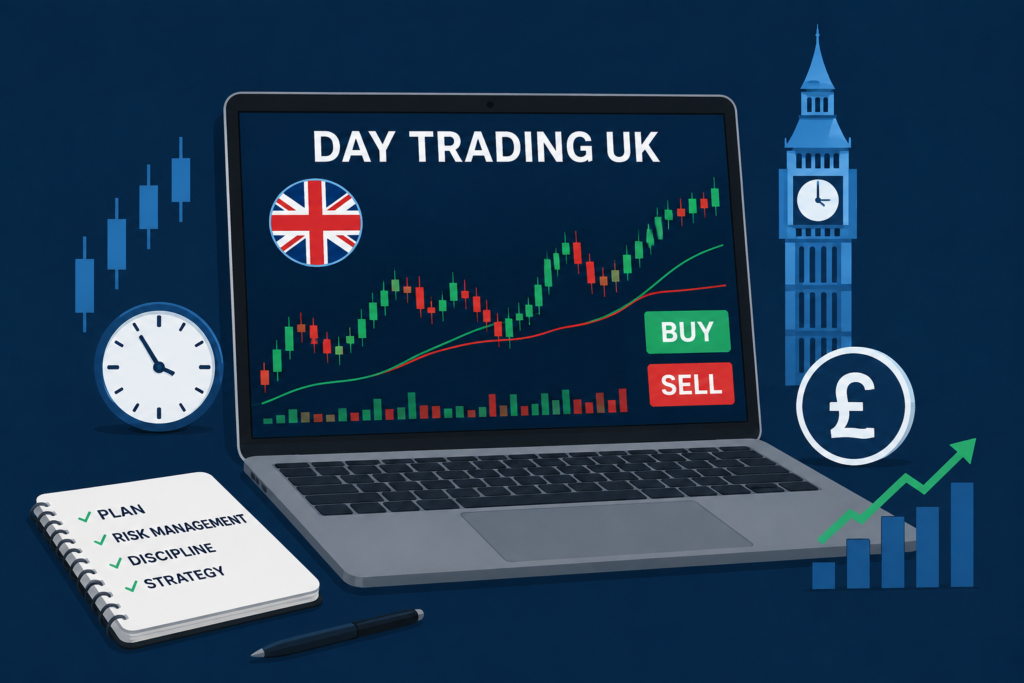
Day trading UK is completely legal, and unlike the United States, there’s no pattern day trader rule limiting how many trades you can place in a day. That said, “legal” and “straightforward” aren’t quite the same thing. The part that trips up most new UK traders isn’t the trading itself, it’s the tax treatment, which changes significantly depending on exactly what instrument you’re trading.
Here’s the thing most day trading UK guides get wrong: they treat tax as an afterthought, a single paragraph near the bottom. In reality, the instrument you choose, spread betting, CFDs, or actual shares, can mean the difference between a completely tax-free profit and a taxable one. Let’s walk through what actually matters.
Is Day Trading Legal in the UK?
Yes, day trading UK is fully legal and regulated by the Financial Conduct Authority (FCA). To trade legally and safely, you simply need to use an FCA-regulated broker, ideally one offering segregated client funds and negative balance protection.
A few basics worth knowing upfront:
- There’s no restriction on how many trades you can place in a single day
- No minimum account balance is legally required, though brokers set their own minimums
- You don’t need any special license or certification to trade as an individual
Quick takeaway: Always confirm your broker is FCA-regulated before depositing any funds. This single check protects you far more than any trading strategy ever will.

The Three Ways UK Traders Are Taxed, and Why It Matters
This is genuinely the most important section for anyone serious about day trading UK, and it’s the part most guides oversimplify. HMRC’s tax treatment depends heavily on which instrument you use.
Spread Betting: Tax-Free for Most Traders
Profits from spread betting are tax-free for the vast majority of UK residents. There’s no capital gains tax and no stamp duty, because spread betting is legally classified as gambling rather than investing.
The trade-off: because profits aren’t subject to capital gains tax, you also can’t offset spread betting losses against gains made elsewhere in your portfolio.
CFDs: Capital Gains Tax Applies
Contracts for Difference (CFDs) are treated differently. Profits above your annual Capital Gains Tax allowance, currently £3,000 for the 2026/27 tax year, are taxed at 18% for basic-rate taxpayers or 24% for higher-rate taxpayers. Unlike spread betting, CFD losses can be used to offset other capital gains in the same tax year, or carried forward to future years.
Buying and Selling Actual Shares
If you day trade real shares rather than derivatives, the same Capital Gains Tax rules apply as CFDs. The key difference: share purchases attract Stamp Duty Reserve Tax (SDRT) of 0.5% on UK-listed shares. US shares and most ETFs are exempt from this UK stamp duty.
Quick takeaway: If tax efficiency matters to your strategy, spread betting is generally the most tax-friendly starting point for UK day traders, but you lose the ability to offset losses, which matters if you expect a rough first year.
When HMRC Classifies You as a “Professional” Trader
Here’s a detail that catches a lot of active day traders off guard. If HMRC determines your trading constitutes a business rather than personal investing, your profits get taxed as income instead of capital gains, and you may also owe National Insurance contributions.
HMRC uses what’s known as the “badges of trade” test, which considers factors including:
- How frequently you trade
- How organised and systematic your approach is
- Whether you’re trading as your primary source of income
- How long you typically hold positions
This distinction was cemented in the landmark case Marson v Morton, which established that repeated buying and selling with short holding periods tends to indicate trading as a business, not passive investing.
Quick takeaway: If day trading UK is becoming your main source of income, it’s worth speaking to a tax advisor early. Getting reclassified as a professional trader after the fact can mean an unexpected and significant tax bill.

Getting Started: A Realistic Step-by-Step Approach
That said, tax planning only matters once you actually have a working strategy. Here’s a grounded, realistic way to approach day trading UK as a beginner.
- Pick your wrapper first — spread betting, CFDs, or shares, based on your tax priorities and risk appetite
- Choose one or two markets only — something like the FTSE and gold, or the Nasdaq and GBP/USD, and ignore everything else for a few months
- Open a demo account and track 20 to 30 trades using a single, defined strategy
- Move to small live size only once you have evidence your approach actually works
- Review monthly, not daily — focus on risk management first, profit second
Quick takeaway: Resist the urge to trade multiple markets and strategies at once when starting out. Depth in one or two markets beats shallow exposure across many.
Risk Management Basics for UK Day Traders
Regardless of which instrument you choose, a few risk management principles apply consistently across day trading UK strategies.
- Fix your risk per trade as a set percentage of your account, not a random position size
- Always use a stop loss, placed at a logical technical level rather than an arbitrary distance
- Avoid over-leveraging, especially with spread betting and CFDs, where leverage can amplify losses just as quickly as gains
- Keep a trading journal, logging entries, exits, and reasoning for every trade
Quick takeaway: Most new day traders in the UK lose money not because of a bad strategy, but because of inconsistent risk management applied to an otherwise reasonable strategy.
Common Mistakes New Day Traders Make in the UK
A handful of mistakes come up repeatedly among people just starting with day trading UK.
- Underestimating tax obligations, particularly with CFDs and share trading
- Trading too many markets at once, diluting focus and pattern recognition
- Ignoring the professional trader classification risk when trading very frequently
- Skipping a demo phase entirely, jumping straight into live trading with real capital
- Chasing losses by increasing position size after a losing trade
Quick takeaway: Most of these mistakes are avoidable simply by slowing down. Treat your first three to six months as a structured learning period rather than a race to profitability.
Choosing an FCA-Regulated Broker

Since regulation is central to trading safely in the UK, it’s worth knowing what to actually check before opening an account.
- Confirm FCA authorisation directly on the FCA’s Financial Services Register
- Check whether client funds are held in segregated accounts, separate from the broker’s own funds
- Confirm negative balance protection is offered, which prevents you from losing more than your deposited funds
- Compare spreads and commissions across your intended markets specifically, not just headline account fees
Quick takeaway: A slightly higher spread from a well-regulated, reputable broker is usually a better trade-off than the cheapest possible fees from a less established one.
5. FAQs
Q1: Is day trading legal in the UK? Yes, day trading UK is fully legal and regulated by the Financial Conduct Authority. There’s no restriction on trade frequency, unlike the US pattern day trader rule, as long as you use an FCA-regulated broker.
Q2: Do I pay tax on day trading profits in the UK? It depends on the instrument. Spread betting profits are generally tax-free, while CFD and share trading profits above the £3,000 annual allowance are subject to Capital Gains Tax at 18% or 24%.
Q3: What’s the best tax wrapper for day trading UK? Spread betting is typically the most tax-efficient starting point since profits are tax-free, though losses can’t be offset elsewhere. CFDs allow loss offsetting but are taxed above your annual CGT allowance.
Q4: Can HMRC classify a day trader as a professional? Yes, HMRC uses a “badges of trade” test based on frequency, organisation, and intent. If classified as a professional trader, profits are taxed as income rather than capital gains.
Q5: How much money do I need to start day trading in the UK? There’s no legal minimum, and with spread betting or CFD leverage, meaningful positions can be opened with a few hundred pounds. Broker minimums vary, so check individual platforms directly.
Q6: Is stamp duty charged on day trading UK share purchases? Yes, buying UK-listed shares attracts Stamp Duty Reserve Tax of 0.5% per purchase. CFDs and spread betting are exempt from stamp duty since no underlying share ownership changes hands.
Final Thoughts
Day trading UK is legal, well-regulated, and genuinely accessible compared to markets like the US. But the real complexity isn’t in placing trades, it’s in understanding how your chosen instrument affects your tax position, and recognising when HMRC might classify your activity as a professional trade rather than personal investing.
Start small, choose your wrapper deliberately, and don’t let tax planning become an afterthought. It’s one of the few parts of day trading UK you have full control over from day one.
For official, up-to-date guidance on capital gains tax and trading classification, HMRC’s own guidance pages remain the most reliable source to confirm your specific situation.