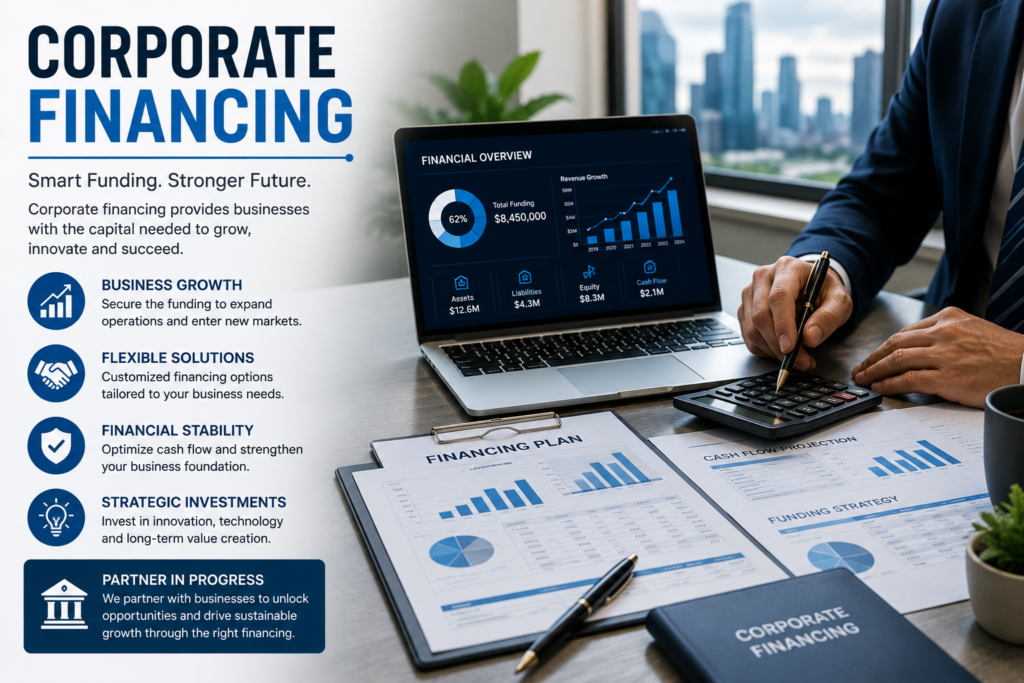

Corporate financing is the process businesses use to raise the money they need to operate, grow, and invest in new opportunities. If you’re a business owner, finance professional, or simply researching how companies fund their operations, this guide breaks down the key concepts in simple, easy-to-understand language.
Whether you’re exploring options for your own business or just want a clearer picture of how larger companies manage their finances, understanding the basics of corporate financing can help you make more informed decisions.
What Is Corporate Financing?
Corporate financing refers to the various methods a business uses to raise capital, whether for day-to-day operations, expansion, acquisitions, or new projects. This can involve borrowing money, issuing shares, or using a company’s own retained profits, depending on its size, goals, and financial position.
Main Types of Corporate Financing
1. Debt Financing
This involves borrowing money that must be repaid over time, usually with interest. Common examples include bank loans, corporate bonds, and lines of credit, all of which allow a business to access funds without giving up ownership.
2. Equity Financing
Rather than borrowing, this method involves raising money by selling shares in the company. Investors who purchase shares become part-owners, sharing in the company’s future profits, but also its risks.
3. Retained Earnings
Many established companies fund growth using their own profits, reinvesting money back into the business instead of relying on external funding sources.
4. Hybrid Instruments
Some businesses use financial tools that combine features of both debt and equity, such as convertible bonds, which can later be converted into company shares.
Why Corporate Financing Matters
1. Supporting Growth and Expansion
Access to capital allows businesses to invest in new products, enter new markets, or scale operations faster than they could using cash flow alone.
2. Managing Cash Flow
Even profitable companies sometimes need short-term funding to cover gaps between expenses and incoming revenue, particularly during periods of rapid growth.
3. Funding Acquisitions
Larger businesses often rely on external funding to acquire other companies, helping them grow more quickly than through organic expansion alone.
4. Managing Risk
Choosing the right mix of debt and equity can help a business balance financial risk while still pursuing growth opportunities.
How Businesses Decide Which Option to Use
Choosing the right approach to raising capital often depends on several factors:
- Cost of Capital – Comparing interest rates on debt versus the potential dilution of ownership through equity.
- Company Size and Stage – Startups may rely more on equity investment, while established firms often have easier access to debt markets.
- Risk Tolerance – Taking on debt increases financial obligations, while issuing equity shares ownership and control.
- Market Conditions – Interest rates and investor sentiment can influence which funding route is more accessible or affordable at a given time.
Common Sources of Business Funding in the UK
- Bank Loans – Traditional funding through high street or specialist business lenders.
- Venture Capital and Private Equity – Investment from firms in exchange for equity, often used by high-growth startups.
- Government-Backed Schemes – Various UK government initiatives support small business funding and growth.
- Corporate Bonds – Larger companies may issue bonds to raise money directly from investors.
- Crowdfunding Platforms – A growing option for smaller businesses seeking capital from a wide pool of individual investors.
For official guidance on business funding options available in the UK, resources like the UK Government’s business finance support directory provide details on schemes and lenders relevant to different business types.
Risks and Considerations
1. Over-Reliance on Debt
Taking on too much debt can strain cash flow, particularly if revenue slows or interest rates rise unexpectedly.
2. Dilution of Ownership
Raising money through equity means giving up a portion of ownership and control, which can affect long-term decision-making.
3. Market Volatility
Economic downturns can make it harder to raise capital through either debt or equity markets, particularly for smaller businesses.
4. Repayment Obligations
Unlike equity, borrowed funds must be repaid regardless of how well the business performs, which can create financial pressure during difficult periods.
Corporate Financing vs. Personal Business Funding
It’s worth distinguishing this from how sole traders or very small businesses might fund operations, often relying more heavily on personal savings, credit cards, or small business loans rather than formal capital markets. According to general guidance from Investopedia, larger structured funding methods typically become more relevant as a business scales and requires more significant capital investment.
Getting Professional Guidance
Deciding how to fund a business, whether through debt, equity, or a combination of both, is a significant decision that can affect a company’s future. Speaking with a licensed financial advisor or corporate finance specialist can help business owners choose the right approach as part of a broader financial strategy.
Frequently Asked Questions
Q1: What is the difference between debt and equity financing?
Debt involves borrowing money that must be repaid with interest, while equity involves raising money by selling shares in the business.
Q2: Is corporate financing only relevant for large companies?
No, businesses of all sizes use various funding methods, though the specific options available often depend on company size and stage.
Q3: What are common sources of corporate funding in the UK?
Common sources include bank loans, venture capital, government-backed schemes, corporate bonds, and crowdfunding platforms.
Q4: What risks come with taking on business debt?
Risks include cash flow strain, repayment obligations regardless of performance, and increased financial pressure during economic downturns.
Q5: Why might a business choose equity over debt?
Equity avoids repayment obligations and interest costs, though it means giving up a portion of ownership and potential control.
Final Thoughts
Corporate financing plays a central role in how businesses grow, manage cash flow, and pursue new opportunities. Whether through debt, equity, retained earnings, or a combination of methods, choosing the right funding approach depends on a company’s size, goals, and risk tolerance.
Before deciding on a funding strategy, it’s worth carefully weighing the costs, risks, and long-term implications of each option, ideally with guidance from a qualified financial professional.