
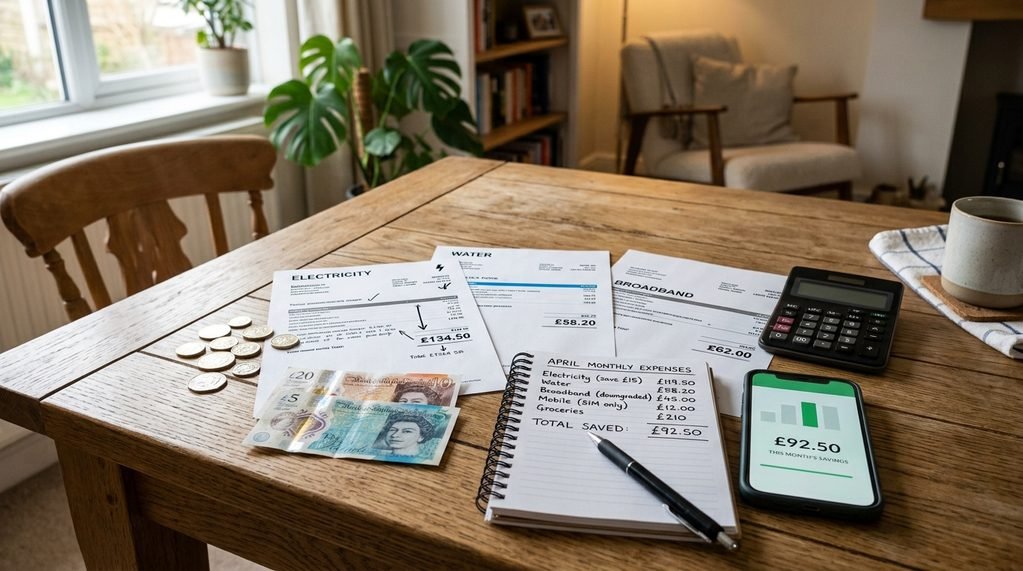
Saving money doesn’t have to mean giving up everything you enjoy. In many cases, the biggest improvements come from reviewing the costs you already have, finding better-value financial products and making sure the money you save doesn’t simply disappear into other spending.
If you’re looking for a money saving expert approach, start with the areas that can make the biggest difference: household bills, subscriptions, food, insurance, borrowing and savings.
This guide takes you through a practical way to reduce your monthly costs, build a financial cushion and make better use of the money you keep.
Important: Money-saving opportunities vary from person to person. Check the terms, eligibility requirements and current rates before switching a financial product or making a financial decision.
What Does a Money Saving Expert Actually Do?
A money-saving expert helps consumers make better decisions about their finances. That can include finding ways to reduce household bills, comparing financial products, managing debt, building savings and avoiding unnecessary costs.
The term is also strongly associated with Money Saving Expert, the consumer finance website founded by Martin Lewis. If you’re searching for the phrase because you’re looking for that type of practical money guidance, the principles are fairly straightforward: understand your spending, challenge unnecessary costs and make informed financial decisions.
But saving money isn’t simply about finding the cheapest possible option.
A good deal should also provide the right level of service, access, protection and flexibility for your circumstances.
For example, saving £10 a month on an insurance policy isn’t necessarily worthwhile if the cheaper policy removes cover you actually need.
The better question is:
“Am I getting good value for the money I’m spending?”
Start by Finding Your Biggest Money Leaks
Before cancelling subscriptions or trying to spend less on groceries, look at your overall finances.
Check your bank and credit card statements from the last two or three months and group your spending into categories such as:
- Housing
- Council tax
- Energy
- Broadband and mobile
- Insurance
- Groceries
- Transport
- Debt repayments
- Subscriptions
- Eating out
- Entertainment
- Other discretionary spending
Don’t rely on memory. Small recurring payments are easy to forget when they’re automatically taken from your account.
Focus on recurring costs first
Suppose you discover that you spend:
- £12 on unused subscriptions
- £15 more than necessary on your mobile plan
- £20 more on broadband than a suitable alternative
- £30 on takeaway food you could reduce
That’s £77 a month, or £924 a year, before considering any other changes.
The point isn’t that every household can save £924. It’s that recurring expenses deserve attention because a small monthly reduction continues working for you throughout the year.
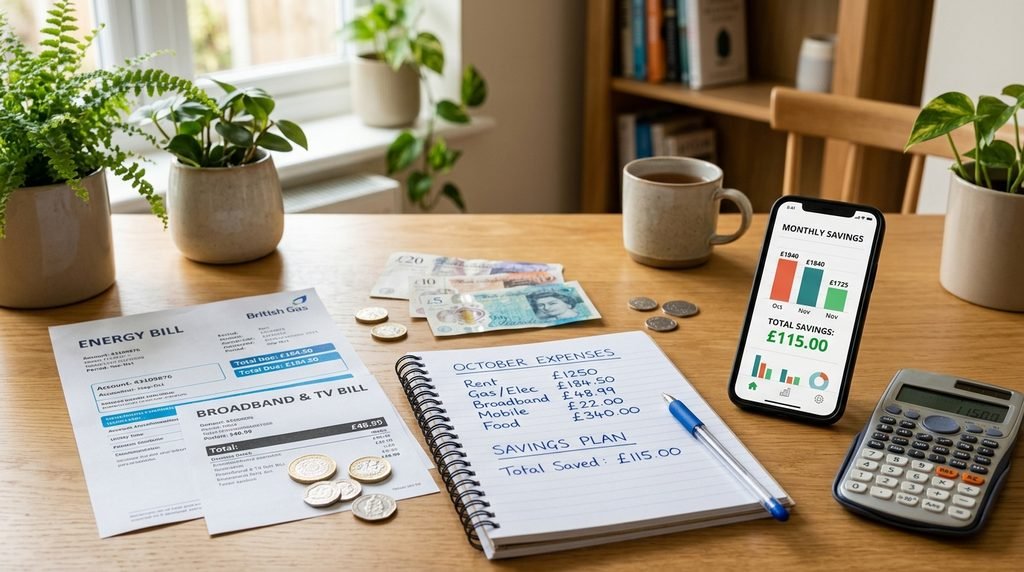
How to Cut Your Monthly Household Bills
Once you’ve identified your largest regular expenses, review them one at a time.
Review your broadband and mobile contract
Check:
- When your contract ends
- Your current monthly cost
- Whether you still need the same package
- Whether you’re paying for features you rarely use
- What competing deals are available
If you’re outside your contract period, compare alternatives before automatically renewing.
Don’t compare price alone. Check speed, coverage, contract length, installation costs and other important terms.
Review your insurance
Car, home and other insurance policies are worth checking before renewal.
Compare the total cost and level of cover rather than simply choosing the cheapest quote.
Pay attention to:
- Excess
- Cover limits
- Exclusions
- Optional extras
- Cancellation terms
A slightly cheaper policy isn’t necessarily better value if it leaves you inadequately covered.
Check your energy costs
Look at your current tariff and energy usage rather than assuming your bill is simply fixed.
Simple efficiency measures can help reduce consumption, while comparing available tariffs may help if a more suitable option is available.
Because energy pricing changes over time, use current information when making a switching decision.
Audit your subscriptions
Go through your direct debits and recurring card payments.
Look for:
- Streaming services
- Music subscriptions
- Apps
- Gym memberships
- Cloud storage
- Software
- Gaming services
- Memberships
Ask yourself one question:
“Would I sign up for this today?”
If the answer is no, consider cancelling it.
Save Money on Food Without Eating Poorly
Food is one of the easiest areas to overspend because several small decisions add up.
You don’t need an extreme grocery budget. Instead, make your shopping more deliberate.
Try:
- Planning several meals before shopping
- Making a shopping list
- Checking your cupboards and freezer first
- Comparing branded and own-brand products
- Buying larger quantities only when you’ll actually use them
- Using supermarket loyalty schemes where they offer genuine value
- Freezing suitable food before it goes to waste
- Preparing meals at home more often
A simple example
Imagine your household spends £500 a month on groceries and occasional takeaways.
If meal planning and fewer impulse purchases reduce that by £40 a month, the annual difference would be:
£40 × 12 = £480
You haven’t eliminated takeaways or changed your entire lifestyle. You’ve simply made the spending more intentional.
That’s generally easier to maintain than an unrealistic “spend nothing” challenge.
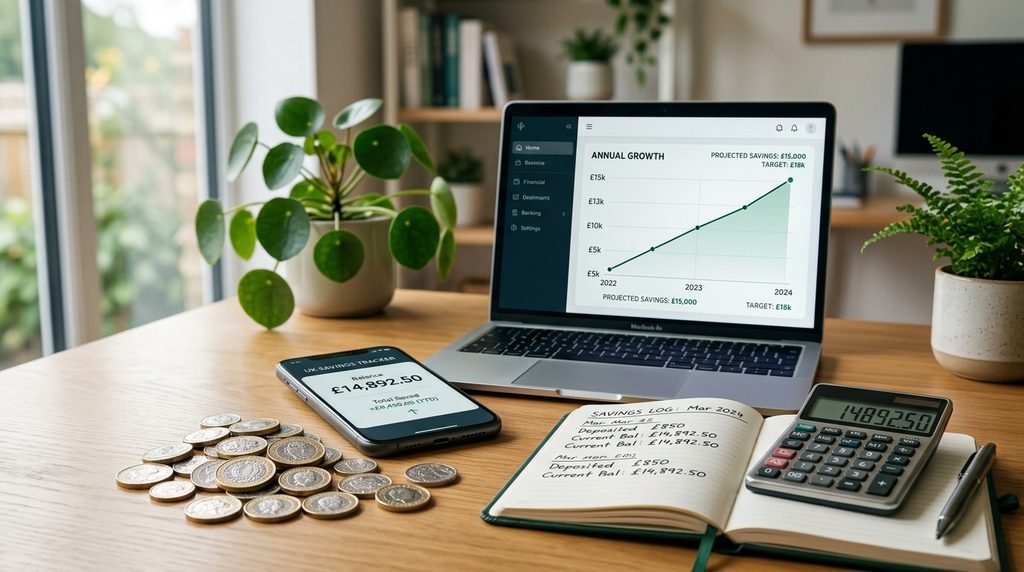
Check Your Bank Account and Banking Costs
Your current account can affect your finances in ways that are easy to overlook.
Review whether you’re paying:
- Monthly account fees
- Overdraft charges
- Unnecessary transaction fees
- Fees for services you don’t use
You should also check whether your bank offers benefits that you actually value.
If another current account appears more suitable, compare the full features before switching.
Don’t move your banking solely because another provider offers a temporary incentive. Consider the account’s ongoing fees, service, features and eligibility requirements.
Should You Save Money or Pay Off Debt First?
This is where money-saving advice becomes more personal.
If you have expensive borrowing, particularly high-interest credit card debt or an overdraft, paying down that debt may be a priority.
For example, imagine you have £3,000 of high-interest credit card debt while keeping £3,000 in a low-interest savings account.
The interest you’re paying on the debt could be substantially higher than the interest you’re earning on the savings.
However, using every penny of your savings to repay debt can leave you without cash for an unexpected bill.
A more balanced approach may be to:
- Keep an appropriate emergency buffer.
- Prioritise expensive debt.
- Avoid adding new high-cost borrowing.
- Continue building savings as your debt position improves.
The right approach depends on your interest rates, income, emergency savings and personal circumstances.
If debt is becoming difficult to manage, consider getting free debt guidance rather than simply taking out another loan to cover repayments.
Build an Emergency Fund
An emergency fund gives you somewhere to turn when an unexpected expense arrives.
It could cover things such as:
- A major car repair
- A broken appliance
- An urgent home expense
- A temporary income gap
- An unexpected essential bill
You don’t need to build a huge emergency fund overnight.
Suppose your first target is £1,000.
Saving:
- £50 a month gets you there in 20 months
- £100 a month gets you there in 10 months
- £200 a month gets you there in 5 months
Once you’ve reached your initial target, you can decide whether a larger emergency fund makes sense based on your essential monthly expenses and income stability.
Keep emergency savings somewhere you can access them when needed rather than exposing them to unnecessary investment risk.
Use Sinking Funds for Predictable Expenses
Some expenses aren’t emergencies. They’re simply expensive and infrequent.
Christmas, annual insurance, car servicing and holidays are good examples.
A sinking fund spreads these costs across the year.
For example, if you expect your annual car-related costs to total £1,200, putting aside £100 a month means the money is ready when those expenses arrive.
You could create separate savings pots for:
- Car expenses
- Christmas
- Holidays
- Home repairs
- Annual insurance
- School or family costs
This can reduce the temptation to use a credit card when a predictable bill arrives.
How to Choose the Right Savings Account
Once you’ve freed up extra cash, check whether your current savings account is still suitable.
Compare more than the headline interest rate.
Look at:
- AER
- Easy access or withdrawal restrictions
- Fixed-term conditions
- Minimum deposits
- Maximum balances
- Bonus periods
- Eligibility requirements
- Whether the account suits your savings goal
Easy-access savings
These accounts can be useful for emergency funds or money you may need relatively soon.
The main advantage is accessibility, although the rate may differ from accounts that restrict withdrawals.
Fixed-rate savings
These can suit money you know you won’t need for a particular period.
Check what happens if you need to withdraw the money early, as restrictions or penalties may apply.
Regular saver accounts
Regular savers can be useful if you want to deposit a set amount each month.
However, they often have maximum monthly deposits and other conditions, so compare the complete terms.
Cash ISAs
Cash ISAs can be useful for eligible savers who want to hold cash while benefiting from the ISA tax treatment.
The ISA rules and allowances can change, so check the latest GOV.UK information before making decisions based on current allowances.
The important point is that the highest rate isn’t automatically the best account. The right choice depends on when you need the money and how much flexibility you require.
Don’t Ignore Savings Protection
When comparing savings accounts, don’t look at interest rates alone.
Eligible deposits with authorised banks, building societies and credit unions may be protected by the Financial Services Compensation Scheme (FSCS) up to the applicable limit.
The protection applies per eligible person, per authorised firm, rather than simply per banking brand.
This distinction matters because different brands can sometimes operate under the same banking authorisation.
If you hold a large amount of cash, check the latest FSCS guidance and whether your accounts share an authorisation before assuming each brand has a separate protection limit.
Check Whether You’re Missing Financial Support
Reducing spending isn’t the only way to improve your finances.
Depending on your circumstances, you may be able to reduce your costs or increase your available income through:
- Benefits
- Council tax discounts
- Tax allowances
- Workplace benefits
- Pension contributions
- Government support schemes
- Other assistance you may qualify for
Don’t rely on a social media post or an old article to determine eligibility.
Rules can change, and eligibility often depends on several factors. Use official government sources to check what applies to you.
Save First, Then Think About Investing
Once your short-term finances are under control, you can start thinking about longer-term goals.
Saving and investing serve different purposes.
Savings are generally appropriate for money you may need in the short term, such as an emergency fund or a planned expense.
Investing is generally more suitable for longer-term goals, but investments can rise and fall in value. You could get back less than you originally invested.
For example, money you expect to use for a house deposit next year probably shouldn’t be exposed to unnecessary stock-market risk.
On the other hand, someone investing for a goal many years away has more time to ride out market fluctuations.
A Stocks & Shares ISA can be one tax-efficient option for eligible long-term investors, but it still carries investment risk.
The key principle is simple:
Match the financial product to the goal, time frame and level of risk you can accept.
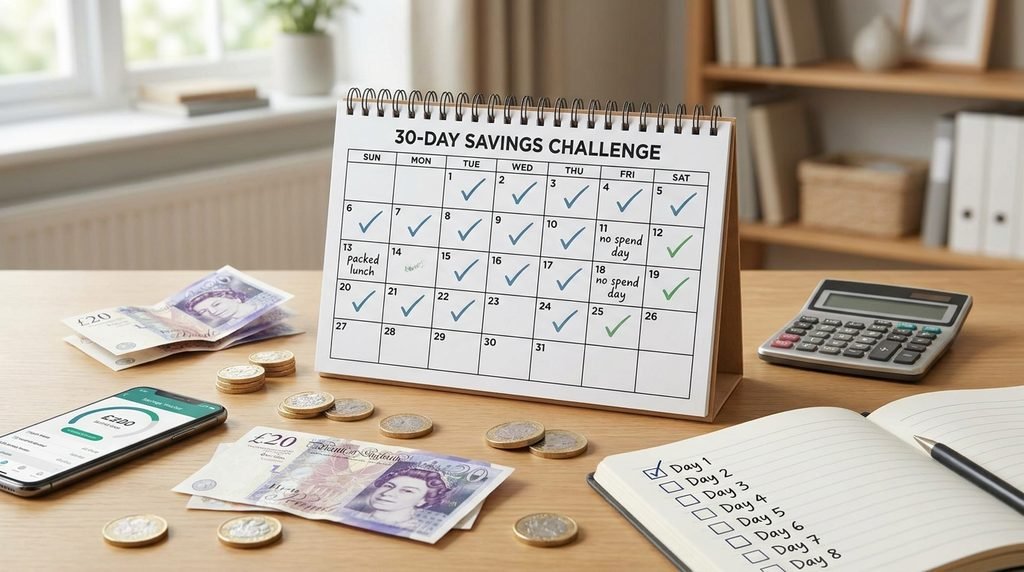
A 30-Day Money-Saving Challenge
If you’re not sure where to start, use this four-week plan.
Week 1: Find the leaks
Review your recent spending.
Write down:
- Essential bills
- Debt payments
- Subscriptions
- Food spending
- Transport
- Entertainment
- Other discretionary spending
Circle anything you no longer need or anything that looks unusually expensive.
Week 2: Review recurring bills
Focus on:
- Broadband
- Mobile
- Insurance
- Energy
- Subscriptions
- Banking fees
Check renewal dates and compare suitable alternatives.
Week 3: Control flexible spending
Set realistic limits for:
- Takeaways
- Eating out
- Shopping
- Entertainment
- Food
- Transport
Don’t aim for perfection.
If you normally spend £200 a month on eating out and reduce it to £140, you’ve created £60 of breathing room without removing the category entirely.
Week 4: Give the money a purpose
Add up the changes you’ve made.
Suppose you’ve freed up:
- £20 from subscriptions
- £15 from your phone/broadband
- £30 from food
- £35 from discretionary spending
That’s £100 a month.
Automating that £100 into a suitable savings account means you could put aside £1,200 over a year, before interest.
The important part is to move the money before you accidentally spend it.
How Much Money Can You Realistically Save?
There is no universal number.
Someone living alone in a rented flat has very different expenses from a family with children and a mortgage.
Instead of setting an arbitrary target, calculate your own potential saving.
For example:
| Area | Example monthly saving |
|---|---|
| Unused subscriptions | £15 |
| Broadband/mobile | £15 |
| Food | £30 |
| Takeaways/eating out | £40 |
| Other discretionary spending | £25 |
| Total | £125 |
A £125 monthly reduction would equal £1,500 over a year.
That’s an illustration, not a guaranteed saving. Your figure could be £20, £200 or somewhere in between.
The useful number is the one you can achieve consistently.
Money-Saving Mistakes to Avoid
Choosing the cheapest option every time
The cheapest product isn’t automatically the best value.
Look at quality, protection, flexibility and the total cost.
Forgetting about promotional rates
A savings account or financial service may offer a bonus or introductory rate that doesn’t last forever.
Set a reminder to review the account before the promotional period ends.
Buying something because it’s discounted
A discount is not a saving if you didn’t need the product.
Spending £40 on something reduced from £60 still means £40 has left your bank account.
Cutting everything enjoyable
An extreme budget can be difficult to maintain.
A realistic plan might reduce restaurant spending rather than banning it completely.
Ignoring expensive debt
Focusing exclusively on savings while expensive borrowing continues to accumulate interest can undermine your progress.
Look at both sides of your balance sheet.
Investing your emergency money
Investments can fall in value at exactly the wrong time.
Keep money needed for short-term emergencies in an appropriate accessible form.
Never reviewing old financial products
Your current account, savings account, insurance policy or broadband package may have been good value when you chose it.
That doesn’t mean it remains competitive forever.
Frequently Asked Questions
What is a money saving expert?
A money saving expert is someone who provides practical guidance to help people reduce unnecessary spending, cut bills, manage debt, build savings and make informed financial decisions. The phrase is also strongly associated with the MoneySavingExpert brand founded by Martin Lewis.
What is the fastest way to save money?
Start with recurring expenses rather than only cutting small daily purchases. Review subscriptions, insurance, broadband, mobile, energy, food and other regular costs to identify the largest realistic savings.
How can I save £500 quickly?
Set a specific target and identify several areas where you can reduce costs. Combining bill reductions with lower discretionary spending can make the target more achievable than relying on one large cut.
Should I save money or pay off debt?
It depends on the cost of your debt and your emergency savings. High-interest debt can be expensive, but keeping some accessible cash can help prevent an unexpected expense from forcing you to borrow again.
How much should I keep in emergency savings?
There isn’t one amount that works for everyone. Start with an achievable target and consider building it around your essential monthly expenses, income stability and personal circumstances.
Is a Cash ISA better than a savings account?
Not automatically. A Cash ISA can provide tax advantages for eligible savers, while ordinary savings accounts may offer different rates or access conditions. Compare the current terms and consider your tax position and financial goals.
How can I reduce my household bills?
Review recurring expenses such as energy, broadband, mobile, insurance and subscriptions. Compare alternatives when appropriate and check whether you’re paying for services or features you no longer need.
Is saving better than investing?
Neither is universally better. Savings are generally designed for short-term needs, while investing is usually intended for longer-term goals and involves the risk of losing money.
Your Money-Saving Checklist
Before you finish, work through this list:
- Review your recent bank statements
- Cancel subscriptions you don’t use
- Check your broadband and mobile contract
- Review insurance before renewal
- Check your energy costs
- Review food and takeaway spending
- Check current-account fees
- Review expensive debts
- Build an emergency fund
- Create sinking funds for predictable annual costs
- Compare your savings account
- Check applicable savings protection
- Look for benefits and financial support you may qualify for
- Automate your monthly savings
- Review your finances every few months
Final Thoughts
The best money-saving strategy isn’t about becoming obsessed with every £1 you spend.
It’s about making the big decisions well.
Review the bills that leave your account every month. Cancel costs you no longer value. Compare financial products when your circumstances change. Deal with expensive debt sensibly. Build an emergency fund and make sure your savings are working towards a clear goal.
Once you’ve created that extra breathing room, don’t let it disappear into your normal spending.
Track it, save it and give it a purpose.
That is what turns a collection of money-saving tips into a sustainable personal finance strategy.






1 thought on “Money Saving Expert: Practical Ways to Save Money in the UK in 2026”