

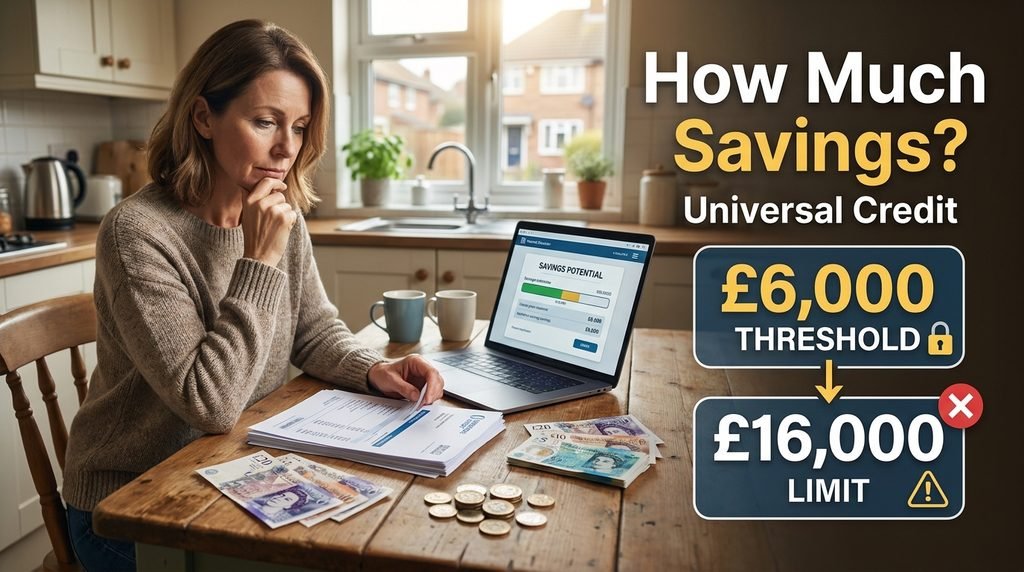
If you receive Universal Credit, you can usually have up to £16,000 in savings and still qualify, but your savings can start reducing your payment once they go above £6,000.
The key Universal Credit savings limits in 2026 are:
- Under £6,000: your savings normally do not affect your Universal Credit payment.
- £6,000 to £16,000: your payment can be reduced through a tariff income calculation.
- Over £16,000: you will usually no longer qualify for Universal Credit, although there are some important exceptions.
The tricky part is knowing exactly what counts as savings. Bank accounts are only one piece of the picture. ISAs, Premium Bonds, investments, property and money held on behalf of someone else can all raise questions about your capital.
This guide explains how much savings you can have on Universal Credit in 2026, how the £6,000 and £16,000 limits work, how the deduction is calculated, and what happens if your savings change.
Universal Credit Savings Limits in 2026
Universal Credit uses the term capital rather than simply savings. Your capital can include money in bank accounts, investments and certain other assets.
There are three important levels to understand.
Under £6,000
If your total capital is below £6,000, it normally has no effect on your Universal Credit payment.
For example, having £2,000, £4,500 or £5,999 in savings would not normally result in a tariff income deduction.
Between £6,000 and £16,000
This is where the calculation changes.
Once your capital goes above £6,000, Universal Credit treats part of it as producing income. This is called tariff income.
For every £250, or part of £250, above £6,000, £4.35 a month is normally treated as income and deducted when working out your Universal Credit.
For example, if you have £8,000:
- Total capital: £8,000
- Amount ignored: £6,000
- Amount above the threshold: £2,000
- £2,000 ÷ £250 = 8
- 8 × £4.35 = £34.80
So your Universal Credit calculation would include £34.80 of tariff income.
More than £16,000
If your total capital is more than £16,000, you will normally not be entitled to Universal Credit.
There are specific rules and transitional protections that can affect some people, particularly those who have moved to Universal Credit because of managed migration from another benefit. So if you are close to the limit, it is worth checking your individual circumstances rather than relying on the £16,000 figure alone.

How Is Universal Credit Savings Calculated?
The calculation is relatively straightforward once you know your total capital.
Imagine you have £11,500 in savings.
The first £6,000 is ignored.
That leaves:
£11,500 − £6,000 = £5,500
Now divide £5,500 by £250:
£5,500 ÷ £250 = 22
Then multiply 22 by £4.35:
22 × £4.35 = £95.70
Your tariff income would therefore be £95.70 a month.
If your Universal Credit entitlement before the tariff income deduction was £450, for example, the calculation would leave you with £354.30, assuming there were no other deductions or changes affecting your award.
Universal Credit Savings Calculation Examples
| Total savings | Amount above £6,000 | Monthly tariff income |
|---|---|---|
| £6,000 | £0 | £0 |
| £6,500 | £500 | £8.70 |
| £7,000 | £1,000 | £17.40 |
| £8,000 | £2,000 | £34.80 |
| £10,000 | £4,000 | £69.60 |
| £12,000 | £6,000 | £104.40 |
| £14,000 | £8,000 | £139.20 |
| £15,999 | £9,999 | £173.91 |
| £16,000 | £10,000 | £174.00 |
The calculation is based on the amount above £6,000, with each £250 (or part of £250) producing £4.35 of tariff income.
What Counts as Savings for Universal Credit?
Universal Credit looks at your total capital, rather than simply checking the balance of one savings account.
Depending on your circumstances, capital can include:
- Money in current accounts
- Savings accounts
- Cash
- Credit Union savings
- ISAs
- Premium Bonds
- Stocks and shares
- Certain investments
- Money held in other accounts that legally belongs to you
- Property you own that is not your main home
- Certain lump sums and payments
This is why someone with relatively little sitting in a traditional savings account can still have capital above £6,000 once their other assets are included.
What Usually Does Not Count?
Some things are normally disregarded when Universal Credit assesses your capital.
These can include:
- The home you normally live in
- Ordinary personal possessions
- Certain pension funds that have not been accessed
- Some capital specifically disregarded under benefit rules
- Certain children’s savings and accounts, where the money genuinely belongs to the child
The exact treatment can depend on how an asset is owned and your circumstances.
Does Your Partner’s Savings Count for Universal Credit?
Yes.
If you are claiming Universal Credit as a couple, your combined capital is generally taken into account.
For example, imagine:
- You have £4,000 in savings
- Your partner has £5,000
- Combined capital = £9,000
The assessment is generally based on the household’s £9,000 rather than treating each person’s savings separately.
This is an important point for couples because looking only at your own bank balance could give you the wrong answer.
Do ISAs and Premium Bonds Count as Savings?
They can.
Putting money into an ISA does not automatically remove it from a Universal Credit capital assessment. Similarly, Premium Bonds can generally count as capital.
So moving £8,000 from an ordinary savings account into an ISA does not necessarily mean that the £8,000 stops being relevant.
The important question is usually what the asset is and whether it is included under the Universal Credit capital rules, rather than simply which type of account holds the money.
Do Pensions Count as Savings for Universal Credit?
Pension rules are different from ordinary savings.
A pension pot that you have not accessed will generally not be treated in the same way as money sitting in your bank account.
However, once you start accessing pension funds, the money you receive can potentially affect your Universal Credit assessment depending on how it is taken and used.
Because pension withdrawals can be complicated, it is sensible to check the effect on your Universal Credit before taking a large amount from a pension.
What Happens If You Receive an Inheritance?
An inheritance can affect Universal Credit because it may increase your capital.
For example, suppose you have £5,000 in savings and receive an inheritance of £7,000.
Your total capital could become:
£5,000 + £7,000 = £12,000
That would put you above the £6,000 threshold, meaning tariff income could affect your Universal Credit calculation.
If an inheritance takes your capital above £16,000, your entitlement could normally stop unless a specific exception or protection applies.
The important point is that receiving money as an inheritance does not make it automatically exempt from the capital rules.
What If Your Savings Temporarily Go Over £16,000?
If your capital goes above £16,000, you should not simply assume that it will be ignored because the increase is temporary.
A one-off payment, inheritance, compensation payment or other lump sum can change your capital position.
You should report relevant changes to the DWP and keep records showing:
- How much you received
- When you received it
- Where the money was held
- What you spent it on
- Your account balances
Keeping clear records can make it much easier to explain your circumstances if the DWP asks questions about a change in capital.
The Migration Notice Exception
There is an important exception for some people who move to Universal Credit through managed migration.
If you were receiving tax credits and received a Migration Notice telling you to move to Universal Credit, special transitional rules can apply.
In certain circumstances, people with capital above £16,000 can receive Universal Credit for a limited period under transitional protection. This protection can last for up to 12 assessment periods, subject to the relevant conditions.
This is different from choosing to move to Universal Credit voluntarily.
If you have received a Migration Notice and have savings above £16,000, do not assume that the normal rule applies without checking your circumstances.
Can You Spend Your Savings to Get Under £16,000?
You can obviously use your money for genuine living costs and legitimate expenses. However, deliberately giving away or spending capital simply to qualify for Universal Credit can create problems.
This is known as deprivation of capital.
The DWP can look at why you spent or transferred your money. If it decides that you deliberately reduced your capital to obtain or increase benefits, it can potentially treat you as still possessing that money when assessing your entitlement.
That does not mean ordinary spending is prohibited.
For example, using savings to:
- Pay household bills
- Pay off genuine debts
- Replace a broken essential appliance
- Buy necessary household items
- Cover normal living expenses
- Pay for essential repairs
is very different from deliberately giving away a large amount of money shortly before making a claim.
The key issue can be why the money was spent, rather than simply the fact that your balance went down.
Can Paying Off Debt Reduce Your Savings?
Paying a genuine debt can reduce the amount of money you hold.
For example, if you have £9,000 in savings and owe £2,000 on a credit card, using £2,000 to clear the debt would leave £7,000 in savings.
However, benefit rules can be complicated where large transactions are made specifically around a Universal Credit claim. If you are considering a significant financial decision because you are close to the capital limit, getting independent benefits advice before acting is sensible.
Savings Held for Children
Money belonging to a child is not automatically treated as the parent’s capital.
For example, a genuine Junior ISA held in a child’s name is generally treated differently from money sitting in the parent’s personal bank account.
The important issue is who legally owns the money.
If you have £5,000 in your own account and simply describe it as “my child’s savings”, that does not necessarily mean the DWP will exclude it.
If the money genuinely belongs to the child and is held appropriately in the child’s name, the treatment can be different.
Self-Employed Claimants and Business Money
Self-employed people can face additional complications when Universal Credit assesses capital.
For example, you might have money set aside for:
- Business expenses
- Stock
- Equipment
- Tax
- Other genuine business requirements
Business assets and money used for a business are not necessarily treated in exactly the same way as personal savings.
However, simply labelling personal savings as “business money” does not automatically make them exempt.
If you are self-employed and have a significant amount of money in your business account, it is worth getting specific advice about how your capital should be assessed.
What Should You Do If Your Savings Change?
You should keep track of your capital rather than waiting until your Universal Credit payment changes unexpectedly.
Changes worth paying attention to can include:
- Receiving an inheritance
- Receiving a large compensation payment
- Selling property
- Receiving a substantial gift
- Moving money between accounts
- Your savings rising above £6,000
- Your savings approaching £16,000
- A change in ownership of an asset
If you are unsure whether a particular change needs to be reported, checking with the DWP or an independent benefits adviser is safer than making assumptions.
What If You Think Universal Credit Has Calculated Your Savings Incorrectly?
If you believe the DWP has made an incorrect decision about your capital, you can ask for a mandatory reconsideration.
This is the formal process for asking the DWP to look at its decision again.
Before requesting one, check the figures carefully. Gather evidence such as:
- Bank statements
- Savings account statements
- Investment statements
- Evidence relating to an inheritance
- Documents showing ownership of an asset
- Details of relevant payments
If the issue is complicated, organisations such as Citizens Advice or other independent benefits advisers may be able to help you understand the decision and your options.
Universal Credit Savings vs Other Benefits
The £6,000 and £16,000 rules should not be assumed to apply to every benefit.
Different benefits have different eligibility rules.
| Benefit | Do savings normally affect it? |
|---|---|
| Universal Credit | Yes, under capital rules |
| Personal Independence Payment (PIP) | No |
| Attendance Allowance | No |
| Carer’s Allowance | Not through a capital limit in the same way as Universal Credit |
| Housing Benefit | Capital rules can apply, with different rules depending on circumstances |
This distinction matters because receiving one benefit without a savings limit does not necessarily mean you can have unlimited capital while receiving a means-tested benefit such as Universal Credit.
Frequently Asked Questions
How much savings can you have on Universal Credit?
You can generally have up to £16,000 in capital and still potentially qualify for Universal Credit. Savings below £6,000 normally do not affect your payment, while capital between £6,000 and £16,000 can reduce your payment through tariff income.
Can I claim Universal Credit with £5,000 in savings?
Generally, yes. If your total capital is £5,000 and there are no other relevant assets taking you above the threshold, your savings would normally have no effect on your Universal Credit payment.
Can I claim Universal Credit with £10,000 in savings?
Potentially, yes. The first £6,000 is normally ignored, while the remaining £4,000 produces £69.60 of tariff income under the standard calculation.
Does £6,000 savings affect Universal Credit?
Savings below £6,000 normally do not affect Universal Credit. Once your capital goes above £6,000, tariff income can start reducing your payment.
Can I claim Universal Credit with £20,000 in savings?
Usually not. If your capital is above £16,000, you will normally not qualify for Universal Credit, although specific transitional protections and exceptions can apply in some circumstances.
Does my partner’s savings count?
Yes. If you claim Universal Credit as a couple, your combined capital is generally assessed.
Do ISAs count as savings for Universal Credit?
Generally, yes. Money held in an ISA can count as capital when Universal Credit assesses your savings.
Do Premium Bonds count as savings?
Premium Bonds can count as capital for Universal Credit purposes.
Does an inheritance affect Universal Credit?
It can. An inheritance can increase your capital and may reduce or end your Universal Credit depending on your total capital and circumstances.
Can I spend my savings before claiming Universal Credit?
You can use savings for genuine expenses, but deliberately giving away or spending money to reduce your capital simply to qualify for benefits can be treated as deprivation of capital.
Do pension savings count?
Unaccessed pension funds are generally treated differently from ordinary accessible savings. Once pension funds are accessed, the effect can depend on how and when you receive the money.
Final Thoughts
So, how much savings can you have on Universal Credit in 2026?
The simple answer is:
- Under £6,000: normally no effect on your Universal Credit.
- £6,000 to £16,000: your payment can be reduced through tariff income.
- Over £16,000: you will usually not qualify, subject to specific exceptions and transitional protections.
The important thing is not to look only at the balance of your savings account. Universal Credit can assess a wider range of capital, including investments, ISAs, Premium Bonds and certain property.
If you are close to either threshold, have recently received a large payment, or are unsure whether an asset should be included, check your position carefully before making financial decisions.
This article is for general information and is not personal benefits or financial advice. Universal Credit rules can change and individual circumstances matter. For the most up-to-date information, check GOV.UK or seek independent guidance from organisations such as Citizens Advice.