Ask most beginner options traders what “intrinsic value” means, and you’ll usually get a vague answer involving the word “profit.” That’s not wrong exactly, but it misses the actual mechanics behind one of the most foundational concepts in options trading. Understanding the intrinsic value of stock options properly changes how you evaluate every single trade you consider, whether you’re buying calls, puts, or writing covered options against a stock you already own.
Here’s the thing: this concept genuinely isn’t complicated once it clicks, but a lot of educational content either oversimplifies it into a single formula without context, or buries it in jargon that makes it harder than it needs to be. Let’s fix that.
What Does This Term Actually Mean?
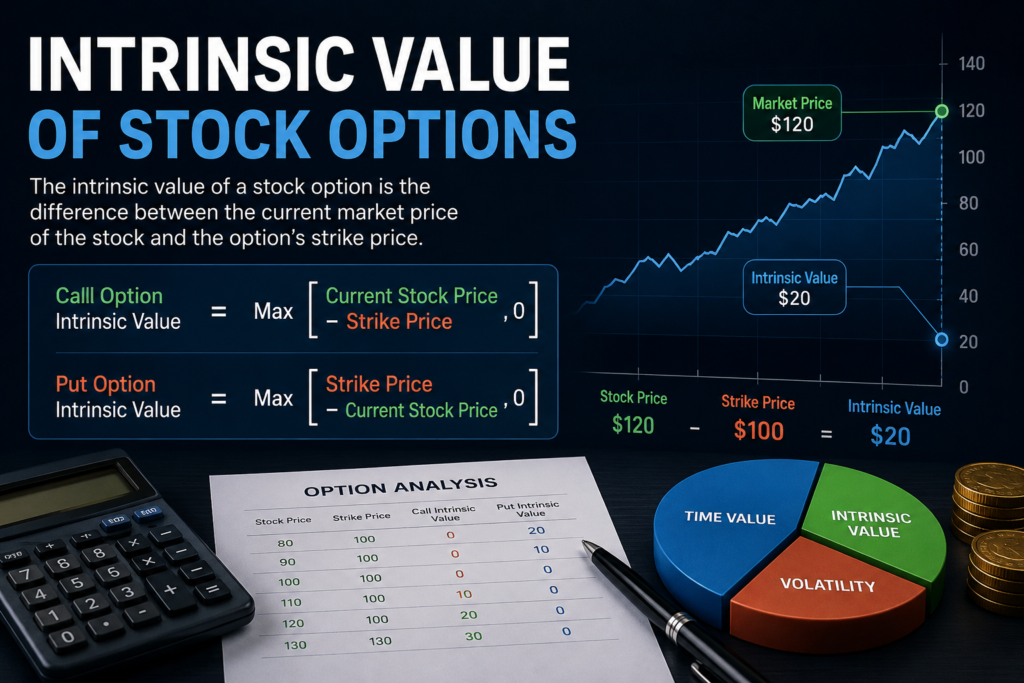
At its core, intrinsic value is the amount of real, tangible profit an option would generate if you exercised it right now, based purely on the current price of the underlying stock. It has nothing to do with time remaining, volatility, or market sentiment. It’s a pure, mechanical calculation.
Here’s the simplest way to think about it: this figure answers one question, “If I exercised this option this instant, how much money would I make before any fees?”
Quick takeaway: If an option has none of this built-in value, that doesn’t mean it’s worthless, it just means exercising it right now wouldn’t generate a profit. It might still hold value for other reasons, which we’ll get to shortly.
The Formulas That Actually Matter

Calculating the intrinsic value of stock options depends on whether you’re looking at a call option or a put option. The mechanics are mirror images of each other.
Call Options
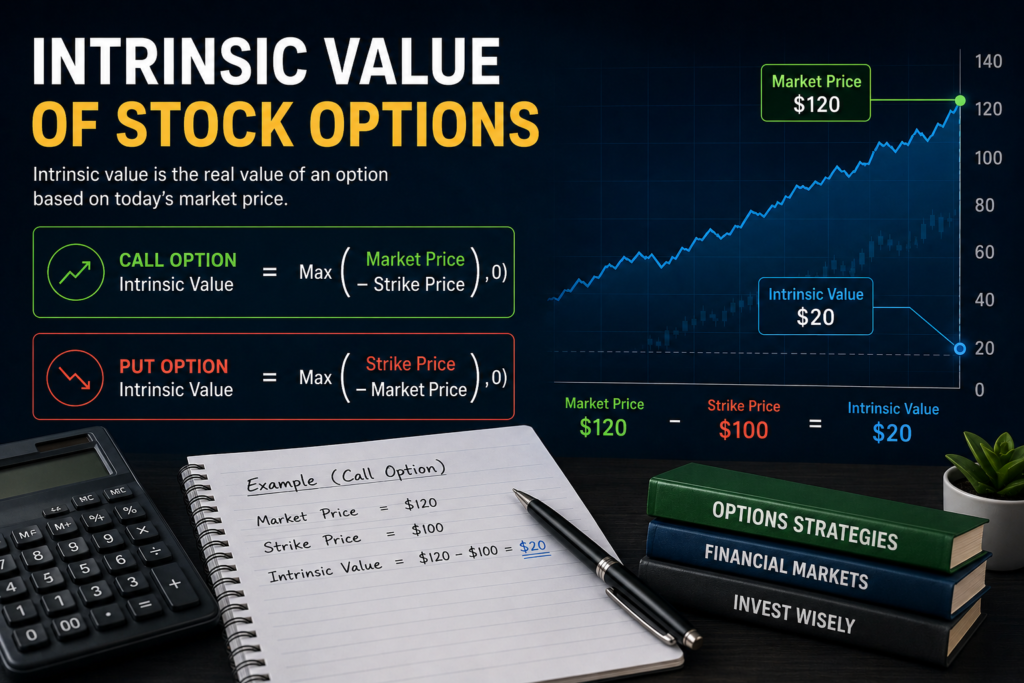
Intrinsic Value = Current Stock Price − Strike Price (If this number is negative, the result is simply zero, it can never go below that.)
Put Options
Intrinsic Value = Strike Price − Current Stock Price (Again, if this number is negative, the result is zero.)
Example, Call Option: If a stock trades at $55 and your call option has a $50 strike price, this built-in value is $5 per share, or $500 for a standard 100-share contract.
Example, Put Option: If a stock trades at $40 and your put option has a $45 strike price, the figure is $5 per share, or $500 per contract.
[Add internal link here: how options contracts work for beginners]
Quick takeaway: This number can never be negative. If the math produces a negative result, the actual figure is simply zero, not a loss amount.
In the Money, At the Money, and Out of the Money
Understanding this concept naturally leads to three terms you’ll see constantly in options trading, since they all describe the same underlying relationship from different angles.
- In the money (ITM): The option has a positive amount of this built-in value, meaning exercising it right now would be profitable
- At the money (ATM): The stock price and strike price are equal or nearly equal, meaning this figure sits at or near zero
- Out of the money (OTM): The option carries none of this value, since exercising it right now would not be profitable
Quick takeaway: Only options that are in the money carry any real, exercisable value at all. Every out-of-the-money option, by definition, has no intrinsic value, regardless of how much time remains until expiration.
The Concept Most Beginners Get Wrong
Here’s the mistake that trips up a lot of new traders: assuming an option’s total market price and its intrinsic value are the same thing. They’re not, and confusing the two leads directly to overpaying for options without realizing it.
An option’s actual market price is made up of two separate components:
- Intrinsic value — the real, exercisable profit available right now
- Extrinsic value (also called time value) — the additional amount the market is willing to pay based on time remaining until expiration, volatility, and other factors
An option trading at $8, with $5 of real, exercisable value, has $3 of extrinsic value baked into the price. That $3 has nothing to do with current profitability, it reflects the market’s expectation that the option could become more valuable before it expires.
Quick takeaway: Before buying any option, separate its price into these two components mentally. This single habit prevents a huge share of beginner mistakes, particularly overpaying for options with a lot of time value but little real, current profitability.
Why Extrinsic Value Fades Over Time
This is where a related concept, time decay (often referred to by its Greek letter symbol, theta), becomes relevant. Extrinsic value naturally shrinks as an option approaches its expiration date, since there’s progressively less time for the underlying stock to move favorably.
A few practical implications:
- Extrinsic value typically decays fastest in the final 30 to 45 days before expiration
- The exercisable portion, by contrast, doesn’t decay at all, it simply reflects the stock’s current price relative to the strike price
- On the expiration date itself, an option’s price equals this exercisable amount exactly, since no time remains for extrinsic value to exist
Quick takeaway: If you’re holding an option primarily for its extrinsic value, understand that this portion of the price is actively working against you every single day that passes.
How This Number Affects Your Trading Decisions
Understanding the intrinsic value of stock options practically changes a few specific decisions options traders make regularly.
When Deciding Whether to Exercise Early
Exercising an American-style option only makes mechanical sense from a pure value standpoint if there’s meaningful intrinsic value and limited remaining time value, since exercising forfeits any remaining time premium.
When Evaluating Whether an Option Is Overpriced
Comparing an option’s total price against its exercisable value tells you exactly how much you’re paying for time and volatility, information that helps you judge whether that premium is reasonable given the time remaining.
When Managing Risk on Covered Positions
For covered call writers, understanding this figure helps clarify exactly how much of the premium received is “real” profit versus time-based compensation that will erode regardless of stock movement.
Quick takeaway: Before any options trade, calculate this figure first, then look at the total price. The gap between the two tells you how much you’re paying purely for time and uncertainty.

A Worked Example, Start to Finish
Let’s walk through a complete example to tie this together.
Imagine a stock trading at $120. You’re looking at a call option with a $110 strike price, currently priced at $14.
- Calculate the exercisable value: $120 − $110 = $10
- Calculate extrinsic value: $14 (total price) − $10 (exercisable value) = $4
- Interpretation: You’re paying $10 for real, currently exercisable value, and an additional $4 for time and volatility expectations
If the stock stays flat and expiration approaches, that $4 of extrinsic value will shrink toward zero, even if the stock price doesn’t move at all.
Quick takeaway: Running this same three-step calculation before every options trade takes less than a minute and gives you a genuinely clearer picture of what you’re actually paying for.
5. FAQs
Q1: What is the intrinsic value of stock options? It’s the real, exercisable profit an option would generate if exercised immediately, based purely on the current stock price relative to the strike price. It excludes time value and market expectations entirely.
Q2: Can the intrinsic value of a stock option be negative? No. If the calculation produces a negative number, the actual result is simply zero. It has a hard floor and can never go below that point.
Q3: What’s the difference between intrinsic value and extrinsic value? One is the current, exercisable profit based on stock price versus strike price. Extrinsic value is the additional amount the market adds based on time remaining and expected volatility before expiration.
Q4: Does the intrinsic value of stock options change as expiration approaches? It doesn’t decay with time on its own, it only changes if the underlying stock price moves. Extrinsic value, however, does shrink steadily as expiration approaches.
Q5: How do I know if an option is in the money? A call option is in the money when the stock price exceeds the strike price. A put option is in the money when the strike price exceeds the stock price. Both cases mean the option carries a positive amount of this value.
Q6: Why does an option’s price include more than just this exercisable amount? Because options also carry extrinsic value, reflecting the market’s expectation that the stock could move favorably before expiration. This time-based premium exists alongside, but separately from, the intrinsic value of stock options.
Final Thoughts
The intrinsic value of stock options is a simple, mechanical concept once you separate it clearly from extrinsic value and total market price. It answers one specific question: how much real, exercisable profit exists right now, based purely on where the stock trades relative to the strike price. Everything else in an option’s price, the time value, the volatility premium, is a separate component entirely.
Get comfortable running this calculation on every option you consider trading. It’s a small habit that meaningfully improves how clearly you understand what you’re actually paying for.
For deeper, official educational material on how options pricing works, the Options Clearing Corporation’s investor education resources are a reliable, non-commercial starting point.