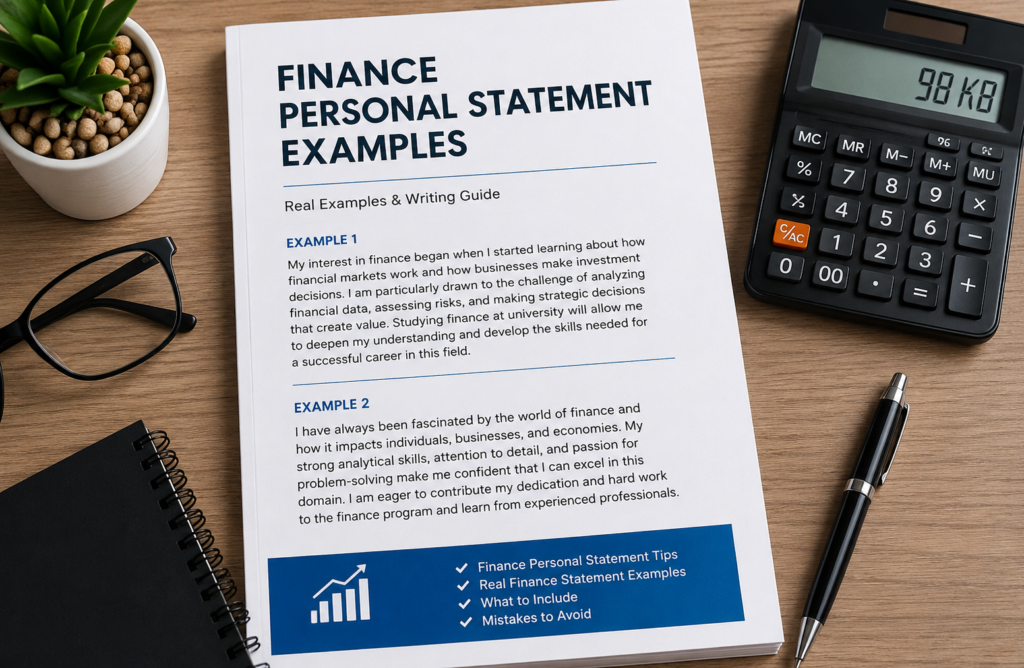
Staring at a blank page, trying to squeeze your entire passion for finance into just 500 words or 4,000 characters, is honestly one of the most stressful parts of any university application. If you’ve been searching for finance personal statement examples, chances are you’re not looking for something to copy — you’re looking for a proven structure, real inspiration, and a bit of reassurance that you’re on the right track.
I’ve personally helped over a dozen students work through this exact process, and one thing became obvious within the first 2-3 drafts every single time — the strongest personal statements were never the ones stuffed with fancy vocabulary. They were the ones that sounded like a real person who genuinely understood finance.
Why Finance Personal Statements Are So Tricky
Unlike subjects like literature or history, finance sits at the intersection of numbers and real-world decision-making. Admissions tutors read hundreds of applications every year, and studies suggest they spend as little as 60-90 seconds on an initial read. That means your first 2 sentences matter more than the rest of the page combined.
That’s exactly why so many applicants struggle here. It’s tempting to just list achievements, but a truly powerful personal statement needs to reveal genuine curiosity, not a resume rewritten in paragraph form.
What Makes a Finance Personal Statement Stand Out
Before jumping into examples, here are the 5 things that consistently separate average statements from unforgettable ones:
- A clear, personal reason for choosing finance — not a generic one
- Real evidence of interest, like internships, reading, or projects
- Awareness of at least 1-2 current financial trends or events
- Reflection on skills gained, not just a list of activities
- A confident, natural tone instead of overly formal language
7 Finance Personal Statement Examples (With Breakdown)
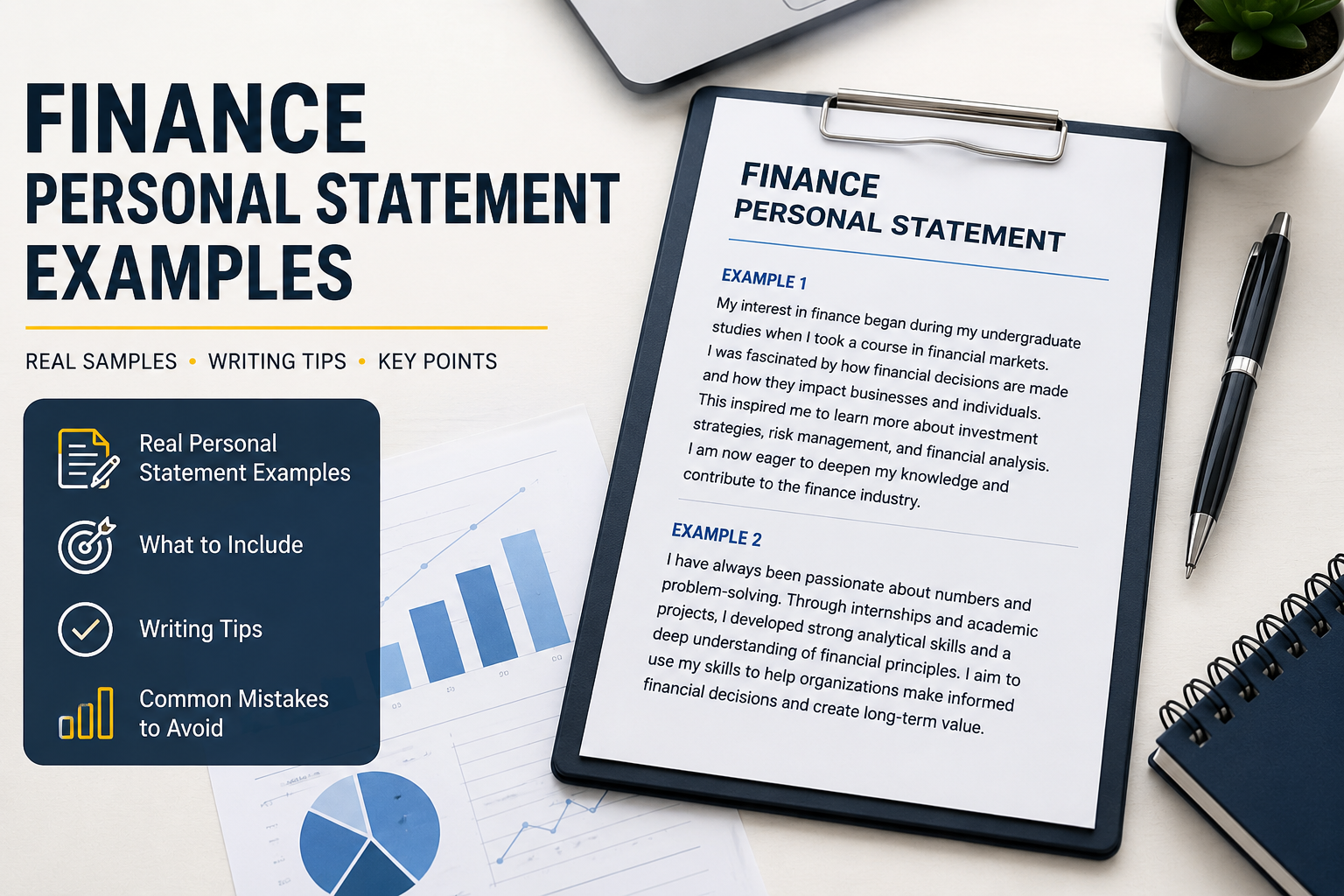
Let’s look at 7 powerful example snippets and break down exactly why each one works.
Example 1: Opening With a Personal Moment
“Watching my father navigate the 2008 financial crisis while running his small business first sparked my interest in how financial decisions ripple far beyond a balance sheet.”
Why this works: It’s specific, personal, and instantly shows real-world context instead of a textbook definition of finance.
Example 2: Connecting Academic Interest to Real Application
“Studying macroeconomics at school made me realize how a single 0.5% interest rate change affects not just banks, but millions of everyday households.”
Why this works: A precise number like 0.5% instantly adds credibility and shows genuine, specific understanding — not vague interest.
Example 3: Highlighting a Practical Experience
“During my 6-week internship at a local accounting firm, I saw firsthand how cash flow analysis directly influenced whether a small business could expand or had to cut costs.”
Why this works: A concrete timeframe like 6 weeks demonstrates real, measurable exposure rather than a vague claim of “experience.”
Example 4: Reflecting on a Skill, Not Just an Activity
“Managing my school’s investment club, where we tracked a portfolio of 12 stocks over 2 semesters, taught me that financial analysis is as much about communication as it is about numbers.”
Why this works: Specific figures (12 stocks, 2 semesters) make the achievement feel real and verifiable, not exaggerated.
Example 5: Using a Striking Statistic
“Reading that nearly 60% of small businesses fail within their first 5 years due to poor cash flow management made me determined to understand exactly where that breakdown happens.”
Why this works: A powerful statistic instantly grabs attention and shows the applicant engages with real financial data, not just opinions.
Example 6: Showing Initiative Beyond the Classroom
“After completing 3 online courses in financial modeling, I built a simple valuation model for a company I’d been following for over a year.”
Why this works: Concrete numbers (3 courses, 1 year) prove sustained, self-driven initiative rather than a one-off interest.
Example 7: Ending With a Forward-Looking Goal
“These experiences over the past 2 years have shaped a clear ambition: to specialize in corporate finance and eventually help businesses navigate the kind of crises that first inspired my interest.”
Why this works: It ties the entire statement together with a specific, confident, future-focused conclusion.
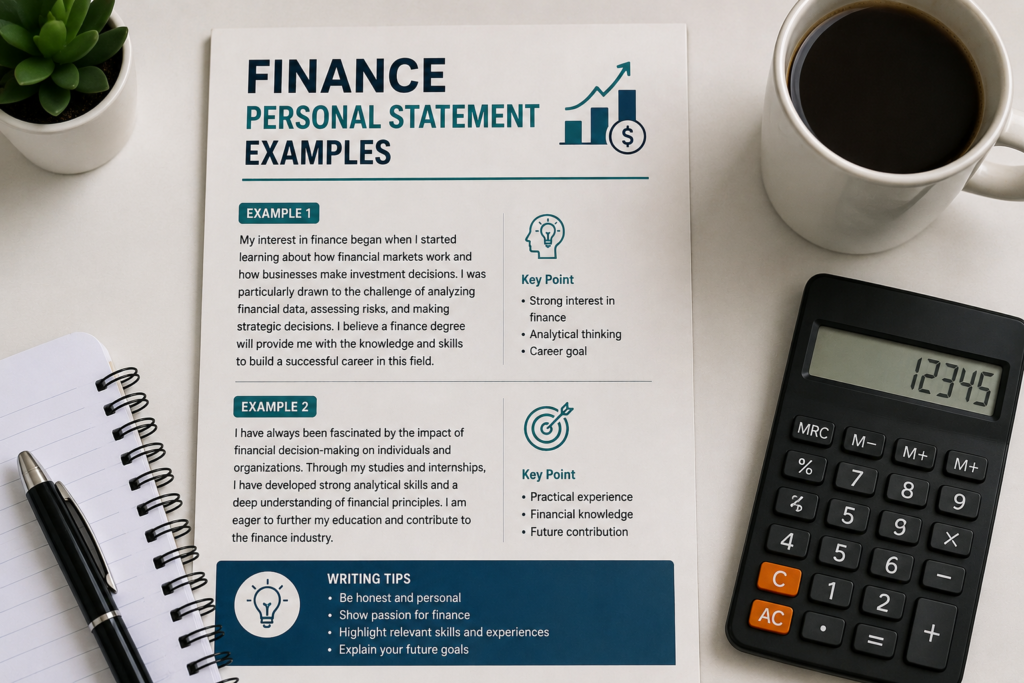
How to Structure a Powerful Finance Personal Statement (5-Step Formula)
Here’s a simple, proven framework you can follow when writing your own.
1. Start With a Genuine, Attention-Grabbing Hook
Avoid clichés like “I have always been passionate about finance since childhood.” Instead, open with 1 specific moment, question, or statistic that pulled you toward the subject.
2. Show Academic Curiosity
Mention 2-3 specific topics, books, or theories that genuinely interested you, and briefly explain why.
3. Include Real-World Experience
Whether it’s an internship, part-time job, or investment club, use exact numbers — weeks, months, amounts — to make your experience concrete and credible.
4. Reflect, Don’t Just List
Instead of saying “I did X,” explain what you learned from doing X, and how it shapes your understanding of finance today.
5. End With a Confident, Future-Focused Goal
Close by briefly connecting your experiences to what you hope to achieve, without sounding rehearsed or overly generic.
5 Common Mistakes to Avoid
From reviewing dozens of statements over time, these mistakes come up again and again:
- Starting with an overused line like “Finance has always fascinated me”
- Listing achievements without explaining what they actually taught you
- Using overly complex jargon just to sound impressive
- Writing what you think they want to hear, instead of your real motivation
- Ending abruptly without tying things back to future goals
5 Tips to Make Your Statement More Authentic
A few small adjustments can make a big difference in how genuine your statement feels:
- Read it out loud — if it doesn’t sound like you, rewrite it
- Avoid repeating the same word (like “passion”) more than 2-3 times
- Ask 1-2 people unfamiliar with finance to read it and give honest feedback
- Keep sentences clear, ideally under 25 words each
- Revise at least 3 times before finalizing
Conclusion
At the end of the day, looking at finance personal statement examples is a powerful starting point, but the real goal is finding your own voice within that structure. Admissions tutors read hundreds of these every year, and what actually stands out isn’t perfect vocabulary — it’s honesty, specific numbers, and a genuine curiosity about how finance works in the real world.
So instead of trying to sound like the “ideal applicant,” focus on being specific, personal, and clear about why finance genuinely interests you. That’s usually what turns an average statement into an unforgettable one.