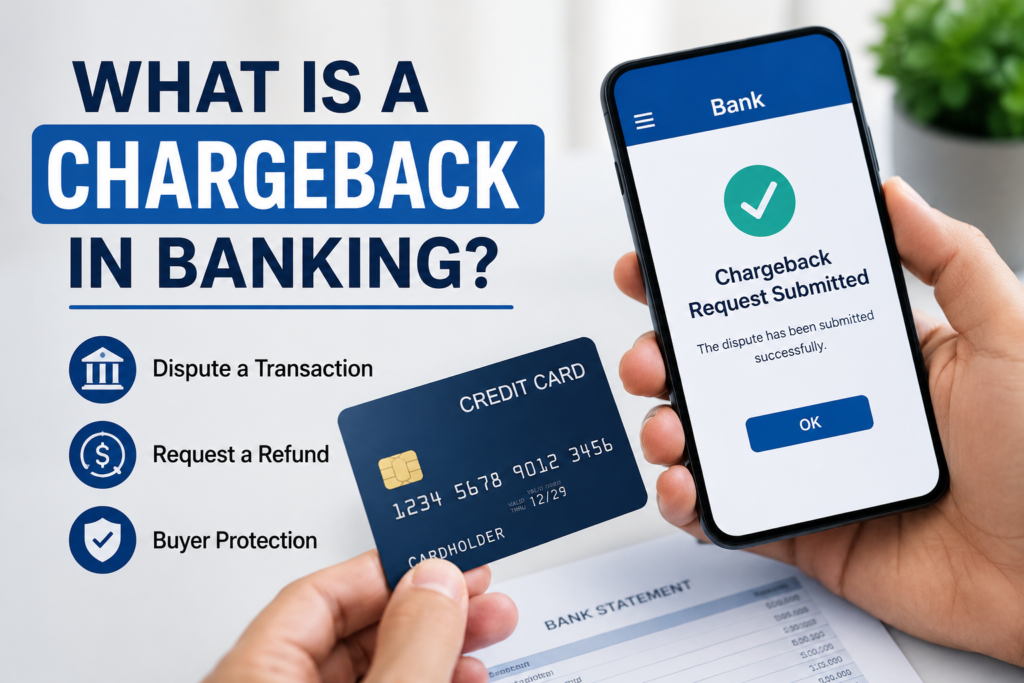
What is a chargeback in banking? A chargeback in banking is a forced reversal of a card transaction, initiated by your bank on your behalf, that pulls disputed funds back from a merchant’s account and returns them to you. If you’ve ever spotted a fraudulent charge on your debit or credit card statement, or paid for a product that never arrived, understanding what a chargeback in banking is can help you get your money back quickly.
This guide breaks down exactly what a chargeback in banking is, how it works, who is eligible to file one, what it costs everyone involved, and how to avoid the mistakes that cause banks to deny valid claims. By the end, you’ll understand this process better than most bank call-center staff explain it.
What Is a Chargeback in Banking? The Simple Definition
To fully answer what is a chargeback in banking, start with this: a chargeback is a transaction reversal that happens when a cardholder disputes a charge with their bank instead of asking the merchant directly for a refund. The bank investigates the claim and, if it’s valid, forces the money back from the merchant’s bank, often called the “acquiring bank.”
Chargebacks exist as a consumer protection tool built into the card network system (Visa, Mastercard, American Express, Discover). They were designed to protect people from fraud and dishonest merchants, giving buyers leverage even when a seller refuses to cooperate. Understanding what a chargeback in banking really means helps you know exactly when — and how — to use this protection.
Show Image
Chargeback in Banking vs. Refund vs. Dispute: Key Differences
People often use these terms interchangeably, but they are not the same thing.
| Term | Who Initiates It | Who Pays | Speed |
|---|---|---|---|
| Refund | Merchant | Merchant returns funds directly | Fast (days) |
| Dispute | Cardholder (informal inquiry) | Depends on outcome | Moderate |
| Chargeback | Cardholder’s bank (formal process) | Merchant, forcibly | Slower (weeks to months) |
A refund is voluntary and merchant-controlled. A chargeback is bank-controlled and involuntary from the merchant’s perspective — which is exactly why it carries more weight and more consequences.

How a Chargeback in Banking Works: Step-by-Step
Now that you know what a chargeback in banking is, it helps to see the mechanics behind it — this is why the process takes time and why documentation matters so much.
Step 1: The Cardholder Disputes a Charge
You contact your bank (the “issuing bank”) and explain why a transaction is wrong — fraud, non-delivery, wrong amount, or a defective product.
Step 2: The Bank Assigns a Reason Code
Every chargeback gets a reason code from the card network (e.g., “Fraud – Card Not Present” or “Goods Not Received”). This code determines what evidence is required and how the case proceeds.
Step 3: Provisional Credit Is Issued
In many cases, especially under Regulation E for debit cards, your bank credits your account temporarily while it investigates.
Step 4: The Merchant Is Notified
The merchant’s bank informs them of the chargeback. The merchant can accept it or fight back with evidence, called “representment.”
Step 5: Investigation and Resolution
The issuing bank reviews evidence from both sides. If the merchant can’t prove the transaction was legitimate, the chargeback stands and funds are permanently removed from their account. If the merchant proves otherwise, the provisional credit may be reversed.

Who Is Eligible to File a Chargeback in Banking?
Not every complaint qualifies for a chargeback in banking. Common valid reasons include:
- Unauthorized or fraudulent charges — you didn’t make the purchase
- Goods or services not received — you paid but nothing arrived
- Defective or not-as-described items — the product didn’t match what was advertised
- Duplicate billing — you were charged twice for one purchase
- Incorrect amount charged — the merchant billed more than agreed
- Subscription not canceled despite a documented cancellation request
Chargebacks are generally not appropriate for simple buyer’s remorse, minor dissatisfaction the merchant already offered to fix, or situations where you already received a refund.
Requirements and Documentation You’ll Need
Before filing, gather:
- Transaction date, amount, and merchant name
- Proof of communication with the merchant (emails, chat logs)
- Screenshots of the product listing or service description
- Delivery tracking information showing non-delivery, if applicable
- Bank or card statement showing the disputed charge
Most card networks require you to file within 60 to 120 days of the transaction or statement date, depending on the reason code and issuer policy.
Costs and Consequences of a Chargeback in Banking
A chargeback in banking isn’t free for anyone in the chain.
| Party | Typical Cost/Impact |
|---|---|
| Cardholder | Usually no direct cost, but delays in receiving funds |
| Merchant | Chargeback fee ($15–$100 per case), lost inventory, potential account termination if chargeback rates rise too high |
| Card networks | Administrative processing costs |
| Issuing bank | Investigation resources, though often absorbed as a cost of doing business |
Merchants who accumulate too many chargebacks (often above 1% of total transactions) risk being placed in card network monitoring programs, facing higher processing fees, or losing their merchant account entirely.
Real-World Example
Suppose you order a laptop online for $900. It never arrives, and the seller stops responding to emails. You contact your bank, file a chargeback citing “goods not received,” and provide your order confirmation and email trail. Your bank issues a provisional credit within 10 business days. The merchant fails to respond with tracking proof within the required window, so the chargeback is finalized and you keep your $900 back permanently.
Compare that to a scenario where you simply didn’t like the laptop’s color — that’s not chargeback-eligible, and you’d need to pursue a standard return or refund through the merchant instead.

Expert Tips for a Successful Chargeback
- Contact the merchant first whenever possible; banks look favorably on documented good-faith attempts to resolve issues directly.
- File promptly — waiting too long past the transaction date can make you ineligible.
- Keep everything in writing — phone calls are hard to prove; emails and chat transcripts are not.
- Use the correct reason code category — misclassifying your dispute can slow or sink your case.
- Track the case number your bank gives you and follow up if you don’t hear back within 30–45 days.
Common Mistakes to Avoid
- Filing a chargeback for a charge you actually authorized but forgot about
- Skipping merchant contact when the merchant had a clear, working refund policy
- Missing the filing deadline set by your card network
- Providing vague explanations instead of specific evidence
- Assuming a chargeback is instant — most cases take 30–90 days to fully resolve
Frequently Asked Questions About Chargebacks in Banking
1. How long does a chargeback in banking take to process? Most chargebacks resolve within 30 to 90 days, though complex fraud cases can take longer if the merchant disputes the claim with representment evidence.
2. Will I lose my provisional credit if I’m wrong? Yes. If the investigation finds the charge was valid, the bank can reverse the provisional credit and redeposit it into your account balance, sometimes creating a negative balance if funds were already spent.
3. Can a merchant refuse a chargeback? A merchant can contest a chargeback through representment by submitting evidence that the transaction was legitimate, but they cannot unilaterally block the bank’s investigation process.
4. Does a chargeback hurt my credit score? No. Chargebacks are between you, your bank, and the merchant — they are not reported to credit bureaus and do not appear on your credit report.
5. What’s the difference between a chargeback and simply calling customer service? Customer service refunds are voluntary and controlled by the merchant. A chargeback removes that control and puts your bank in charge of forcing the reversal, which is why it’s considered a last resort after direct resolution attempts fail.
6. Can I file a chargeback on a debit card the same way as a credit card? Yes, but debit card chargebacks fall under Regulation E rather than the credit card protections in the Fair Credit Billing Act, and timelines for provisional credit can differ slightly by bank.
7. What happens if I lose the chargeback dispute? If the bank rules in the merchant’s favor, the provisional credit is reversed and you may need to pursue other avenues, such as small claims court, if you still believe the charge was wrong.
8. Do chargebacks affect merchants even if the customer is wrong? Yes. Merchants often pay a chargeback fee regardless of the outcome, since the fee covers the administrative cost of processing the dispute, not just the result.
Conclusion: What Is a Chargeback in Banking, in Summary
So, what is a chargeback in banking? It’s a powerful consumer protection mechanism that lets your bank forcibly reverse a fraudulent, incorrect, or undelivered transaction on your behalf. A chargeback in banking differs from a simple refund because it’s bank-driven, formally documented, and backed by card network rules rather than merchant goodwill. Knowing the eligibility requirements, required documentation, and realistic timelines puts you in the strongest position to win a legitimate chargeback claim — while understanding the costs and consequences helps you use this tool responsibly rather than as a shortcut around ordinary customer service.