
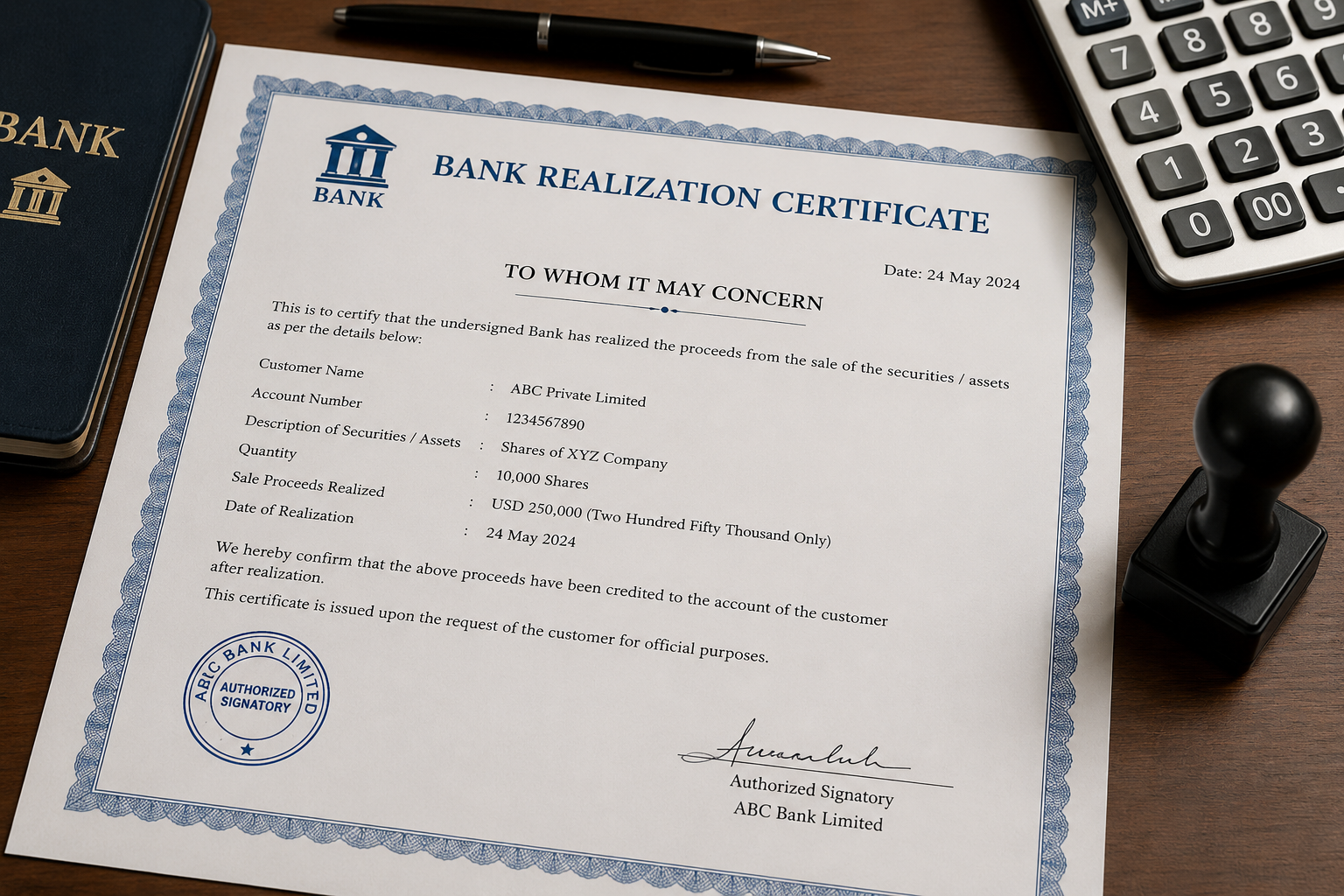
If you’re an exporter in India, you’ve probably heard the term bank realization certificate more than once. It’s one of those documents that sounds bureaucratic but actually plays a big role in whether you get paid, and whether you can claim valuable export benefits.
In this guide, we’ll walk through what this certificate is, why it matters, and how you can get one without unnecessary delays.
What Is a Bank Realization Certificate?
A bank realization certificate, often shortened to BRC, is an official document issued by a bank confirming that it has received payment for goods or services exported by a business. In simple words, it proves that the foreign buyer has actually paid the exporter, and the payment has been credited in convertible foreign exchange.
This certificate is issued only after the exporter’s bank verifies that the payment has genuinely come through from the overseas buyer, matching the shipping bill and invoice details.
Why Is a Bank Realization Certificate Important?
A bank realization certificate isn’t just paperwork sitting in a file. It serves several practical purposes:
- Proof of payment realization – It confirms that export proceeds have actually been received.
- Claiming export incentives – Schemes like duty drawback, RoDTEP, and other government incentives usually require this document.
- Compliance with RBI regulations – The Reserve Bank of India requires proof that export payments are realized within a specified time frame.
- Building credibility with authorities – Customs and DGFT offices often ask for it during audits or incentive verification.
Without this certificate, many exporters find it difficult to claim the benefits they’re otherwise entitled to.
How Is a Bank Realization Certificate Issued?
The process typically works like this:
- Export shipment takes place – Goods are shipped, and a shipping bill is generated.
- Buyer makes payment – The foreign buyer transfers payment to the exporter’s bank account.
- Bank verifies the transaction – The exporter’s bank matches the incoming payment against the relevant shipping bill and invoice.
- Certificate is generated – Once verified, the bank issues the certificate, either physically or, more commonly today, electronically through the Export Data Processing and Monitoring System (EDPMS).
Most banks in India now generate this certificate digitally, which has significantly reduced processing time compared to the older manual process.
Documents Required for a Bank Realization Certificate
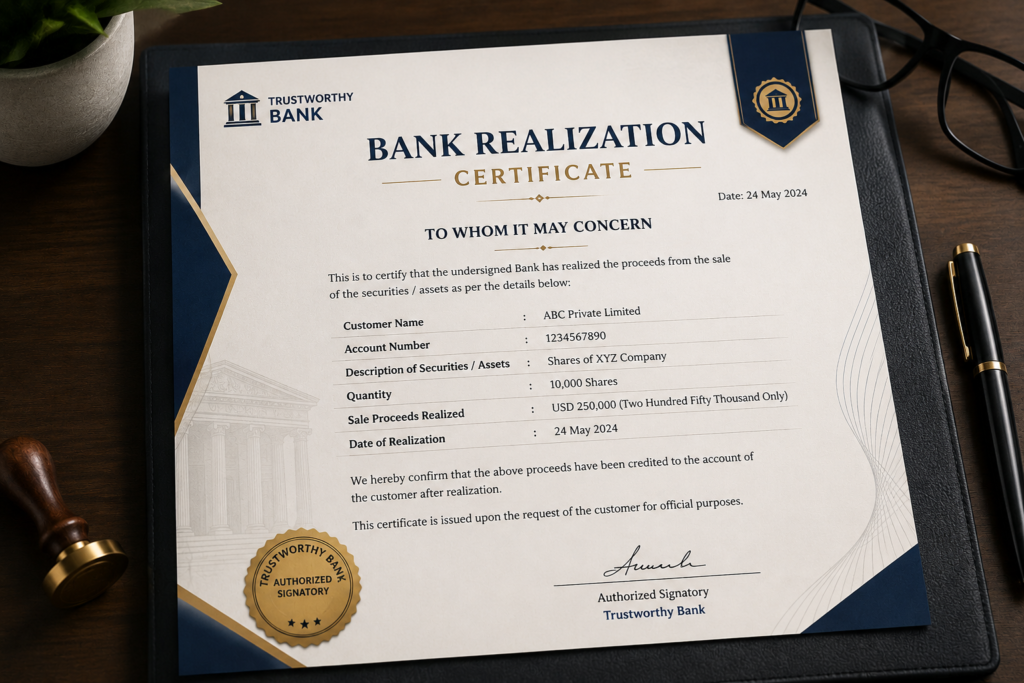
To get this certificate issued smoothly, exporters usually need to submit:
- Shipping bill copy
- Commercial invoice
- Foreign inward remittance details
- Export order or purchase order
- GST invoice details, if applicable
Having these documents ready and matching exactly with bank records helps avoid unnecessary back-and-forth with the bank.
Common Issues That Delay This Certificate
Many exporters face delays in receiving this document because of avoidable errors, including:
- Mismatched invoice values – Even small discrepancies between the invoice and the payment received can trigger manual review.
- Partial payments – If the buyer pays in installments, the certificate may only reflect the realized portion until full payment is received.
- Incorrect IEC or GSTIN details – Errors in the Importer Exporter Code or GST number can hold up processing.
- Delayed remittance from the buyer – If the overseas payment itself takes time, the certificate naturally gets delayed too.
Double-checking documentation before submission can save a lot of back-and-forth with the bank.
Bank Realization Certificate vs. Other Export Documents
It’s easy to confuse this certificate with other export-related paperwork, so here’s a quick distinction:
Shipping Bill
This document is generated at the time of export and confirms that goods have left the country. It doesn’t confirm payment.
Bank Realization Certificate
This confirms that payment for those exported goods has actually been received, which is a separate step that happens after the shipment.
Export Incentive Applications
These are separate filings (like RoDTEP or duty drawback claims) that often require the realization certificate as supporting proof, but they aren’t the same document.
How to Get a Bank Realization Certificate Faster
If you want to speed up the process, keep these tips in mind:
- Match your invoice and shipping bill details precisely before shipment.
- Follow up with your bank promptly once payment is received, rather than waiting.
- Use EDPMS-enabled banks, since electronic processing is generally faster than manual issuance.
- Keep your export documentation organized so your bank can verify transactions without delays.
- Reconcile partial payments quickly so the final certificate reflects the complete realized amount.
Working closely with your bank’s trade finance or forex department can also help resolve issues faster when they come up.
Frequently Asked Questions
Is a bank realization certificate mandatory for all exporters? It’s generally required if you want to claim export incentives or need to prove compliance with RBI’s payment realization timelines, even if it’s not mandatory for every single transaction.
How long does it take to get this certificate? With electronic processing through EDPMS, many banks issue it within a few days of payment realization, though timelines vary by bank and documentation accuracy.
Can this certificate be issued for partial payments? Yes, but it will typically reflect only the amount realized so far, with a subsequent certificate issued once the full payment comes through.
What happens if export proceeds aren’t realized within the RBI’s time limit? Delays beyond the prescribed period may require exporters to seek an extension from the bank or RBI, and could affect eligibility for certain incentives.
Digital vs. Physical Bank Realization Certificate
In the past, exporters had to collect a physical copy of this certificate from their bank branch, which often meant delays, paperwork, and multiple follow-ups. Today, most transactions are processed through the EDPMS platform, and the certificate is generated electronically.
The digital version offers several advantages:
- Faster turnaround – Verification happens automatically once payment details match.
- Easier record-keeping – Digital copies can be stored, searched, and shared instantly with authorities.
- Reduced errors – Automated matching reduces the chances of manual data entry mistakes.
- Direct integration with DGFT systems – This makes it easier to link the certificate to incentive claims without resubmitting documents separately.
Some smaller banks or older accounts may still rely on manual issuance, so it’s worth checking with your bank about which process applies to your account.
How Long Should You Retain This Certificate?
Even after your export incentive claim is processed, it’s a good idea to keep a copy of the certificate on file. Customs and tax authorities can request it during audits, sometimes years after the original transaction. Most exporters retain these records for at least five to seven years, in line with standard document retention practices for trade and tax compliance.
Keeping digital backups, organized by financial year and shipping bill number, makes it much easier to retrieve the right certificate if it’s ever requested later.
Final Thoughts
A bank realization certificate might seem like just another compliance document, but it plays a critical role in confirming that your export payments have actually landed, and in helping you claim the incentives you’ve earned. Keeping your documentation accurate and staying in touch with your bank can make the entire process much smoother.
If you’re regularly exporting, it’s worth setting up a simple internal checklist so every shipment’s paperwork lines up correctly from the start, saving you time and frustration down the line.