Best Instant Access Savings Accounts in the UK
If you want your money to earn interest without locking it away, the best instant access savings accounts can be a sensible place to keep an emergency fund or short-term savings.
The catch? The account offering the highest rate is not automatically the best choice. Some headline rates include temporary bonuses, others limit withdrawals, and some are only available if you meet additional conditions.
Current comparison data shows a wide spread of rates across the UK market. For example, Which? recently listed accounts paying around 4.2% to 5% AER, while other comparison services show promotional or conditional deals above that level.
So, what should you actually look for?
This guide compares the important features behind the best instant access savings accounts, explains the catches that are easy to miss, and shows how to decide which account fits your circumstances.
What Is an Instant Access Savings Account?
An instant access savings account lets you save money while retaining the ability to withdraw it when you need it.
Unlike a fixed-rate savings account, you generally do not agree to leave your money untouched for a set period. You also avoid the notice period associated with many notice savings accounts.
That flexibility makes these accounts particularly useful for money that has a job to do soon.
For example, you might use one for:
- An emergency fund
- A house deposit you may need within the next year
- A holiday fund
- Money set aside for annual bills
- Short-term financial goals
- Cash that you do not want sitting in a current account
However, “instant access” should not make you assume every account works in exactly the same way.
Some providers offer unrestricted withdrawals. Others use withdrawal limits, introductory bonuses or other conditions. This is one of the biggest points to check before opening an account.
Practical takeaway: If you might need the money unexpectedly, read the withdrawal terms before looking at the interest rate.
7 Best Instant Access Savings Accounts to Consider
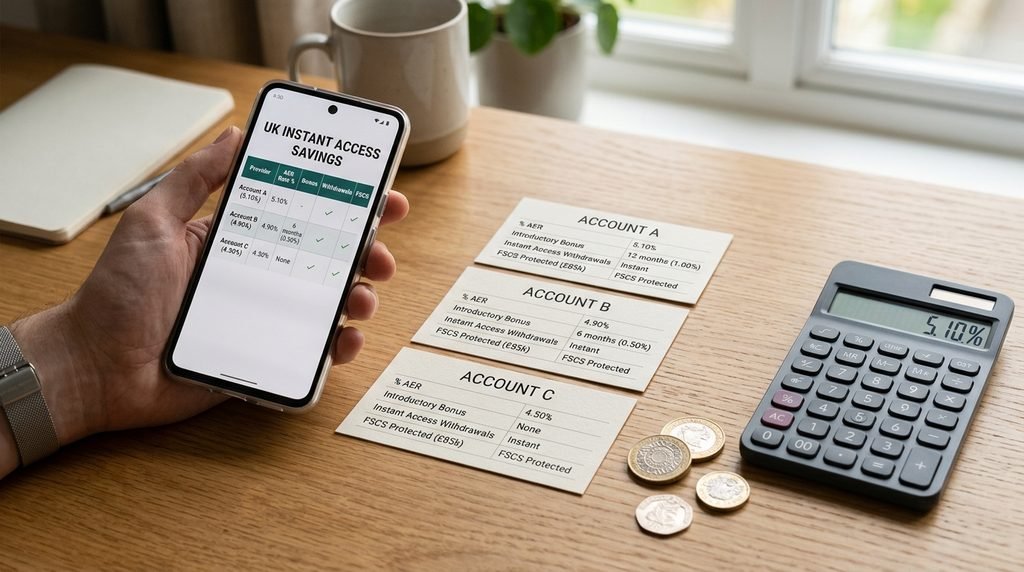
There is no single account that is best for everyone. The right choice depends on your balance, how often you expect to withdraw money, whether you qualify for a bonus and how much you value simplicity.
Current UK comparison tables show products from established banks, building societies and newer savings providers. Which? recently listed Cahoot Sunny Day Saver at 5% AER on qualifying balances, while First Active, Tembo Money and several other providers were around the mid-4% range.
Here are seven types of account worth investigating.
1. Cahoot Sunny Day Saver
Cahoot’s Sunny Day Saver has recently appeared near the top of instant-access comparison tables, with Which? reporting a 5% AER rate on balances up to £3,000 for 12 months.
That sounds attractive, especially for someone building a smaller emergency fund.
The important detail is the balance cap and introductory period. After the promotional period, the money can move to a different savings rate, so you should not simply open the account and forget about it.
For a saver with £3,000 or less, however, a competitive introductory rate can make a meaningful difference.
Best suited to: Smaller savings balances where the promotional rate fits your circumstances.
2. First Active Instant Access Savings Account
First Active’s instant access account has also appeared in recent comparison tables, with Which? reporting a 4.55% AER rate including a bonus.
The attraction here is straightforward: a competitive variable rate while keeping access to your cash.
As with any bonus-based account, though, check how long the bonus lasts and what happens afterwards. A rate that looks excellent today can become ordinary once the introductory period ends.
Best suited to: Savers who are comfortable monitoring the account and switching when the bonus expires.
3. Tembo Money HomeSaver
Tembo Money’s HomeSaver has recently appeared among the competitive instant-access options, with comparison data showing a rate around 4.55% AER and a relatively low opening amount.
The account can be particularly interesting for people saving towards a home-related goal.
However, do not choose an account solely because its name matches your savings goal. Compare the underlying rate, withdrawal rules, eligibility requirements and protection arrangements first.
Best suited to: Savers who want a competitive rate while keeping money accessible for a home-related objective.
4. Cahoot Simple Saver
The Cahoot Simple Saver has also featured in current best-buy tables. Recent Which? data showed an AER above 4.5% in its August 2026 comparison, although product issues and rates can change.
This is a useful reminder that “best” is often temporary in the savings market.
A provider can launch a new issue, close an old one or change the interest rate without the account remaining at the top of every comparison table.
Best suited to: Savers looking for a straightforward variable-rate option from an established provider.
5. Post Office Money Online Saver
Post Office Money’s Online Saver has recently appeared in comparison tables at around 4.31% AER.
It may not always have the absolute highest rate, but a competitive account does not need to be number one to be worthwhile.
For some savers, ease of opening, familiarity with the provider and straightforward account management can matter just as much as squeezing out the final fraction of a percentage point.
Best suited to: Savers who want a familiar provider and online access while retaining flexibility.
6. Charter Savings Bank Easy Access
Charter Savings Bank’s Easy Access account has also featured among recommended products in recent comparison data, with Which? reporting 4.21% AER.
This is a good example of why it pays to compare more than the first result in a savings table.
A slightly lower rate may still be attractive if the account has terms that suit your balance and withdrawal habits.
Best suited to: Savers prioritising a competitive rate and straightforward easy-access savings.
7. Chase Saver and Other Flexible App-Based Options
Chase’s Saver account continues to appear in UK savings comparisons, with Finder recently showing a boosted variable rate of 4.50% AER, including a temporary bonus.
App-based savings accounts can be convenient because you can manage your money from your phone. They may also offer useful features such as instant transfers between linked accounts.
Still, convenience should not replace due diligence.
Check whether you need another product from the provider, whether the headline rate includes a bonus, and which banking entity actually holds your deposit.
Best suited to: Savers who prefer mobile banking and want quick access to their savings.
Practical takeaway: Treat these as accounts to investigate, not permanent winners. The savings market moves quickly, so check the current AER and terms before transferring your money.
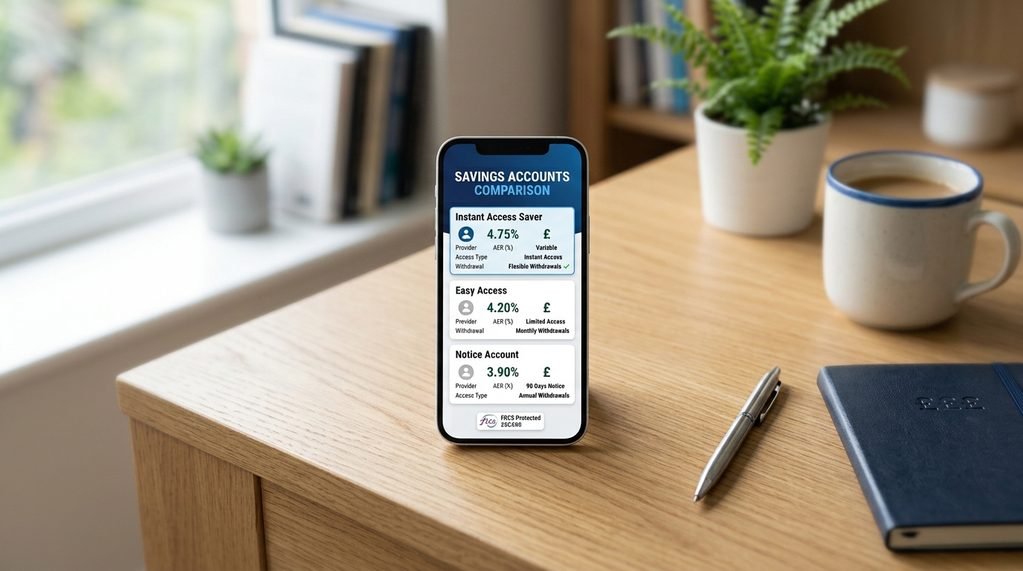
What Makes the Best Instant Access Savings Accounts Competitive?
Interest rate matters. It is not the whole story.
When comparing the best instant access savings accounts, I would look at at least six things.
1. AER
AER stands for Annual Equivalent Rate. It gives you a standardised way to compare savings rates, taking account of how interest is compounded.
For example, an account paying 4.5% AER is generally easier to compare with another account paying 4.3% AER than simply looking at the nominal interest rate.
But remember that a variable AER can change.
2. Withdrawal rules
This is where some attractive deals become less attractive.
An account might advertise itself as easy or instant access but restrict the number of withdrawals you can make.
For example, some high-paying products offer a better rate only if you make few or no withdrawals. Once you exceed the limit, the rate may fall.
Recent comparison research specifically highlights withdrawal restrictions as one of the catches behind some top-rate savings products.
If your savings are an emergency fund, this matters enormously.
3. Introductory bonuses
A bonus can make an account look much better than its underlying rate.
Suppose an account pays a competitive rate for 12 months and then drops significantly. You could earn good interest during the first year, but leaving the money there for another two years without checking the rate could cost you.
Set a calendar reminder for the bonus expiry date.
4. Minimum and maximum balances
Some accounts can be opened with £1. Others require hundreds or thousands of pounds.
There may also be a maximum balance that receives the headline rate.
For example, a 5% rate on £3,000 is very different from 5% on £100,000.
Always calculate the actual interest you expect to earn.
5. Deposit protection
Before transferring a large amount, check whether the provider is covered by the Financial Services Compensation Scheme.
FSCS deposit protection increased to £120,000 per eligible person, per authorised firm, from 1 December 2025.
One subtle point is that different brands can sometimes operate under the same banking authorisation. Therefore, spreading money across brands does not necessarily mean you have separate FSCS protection.
You can use the official FSCS protection checker to verify this.
Practical takeaway: Compare the rate, withdrawal conditions, bonus period, balance limits and protection together. A headline AER alone tells you very little.
Instant Access vs Easy Access vs Notice Savings
You will often see “instant access” and “easy access” used almost interchangeably.
In practice, the exact terms matter more than the label.
Instant access
This generally means you can withdraw your money without waiting for a notice period.
However, individual account conditions still apply.
Easy access
Easy-access accounts are designed to give you relatively flexible withdrawals, but the exact rules vary between providers.
Some may limit withdrawals or apply different rates depending on how you use the account.
Notice accounts
Notice accounts require you to give the provider advance notice before withdrawing money.
They can sometimes pay a better rate than ordinary easy-access savings, but you lose some flexibility.
Fixed-rate savings
Fixed-rate accounts normally require you to leave your money untouched for an agreed term or accept a penalty for accessing it early.
They can be useful when you know you will not need the money, but they are not normally suitable for an emergency fund.
Which one should you choose?
Think about when you could realistically need the money.
If you could need it tomorrow, instant or easy access makes sense. If you know you will not touch it for a year, a fixed-rate account may deserve a comparison.
How Interest and Bonuses Really Work
Interest sounds simple until you start comparing accounts.
Imagine you have £10,000 in savings and find an account paying 4.5% AER. Ignoring changes in the rate and compounding for simplicity, you might expect roughly £450 of interest over a year.
But your actual return can be different if:
- The rate changes
- The headline rate includes a temporary bonus
- The account has a balance cap
- You withdraw money during the year
- You only qualify for the advertised rate under certain conditions
That is why I prefer looking at the underlying rate and the rules behind it, rather than choosing the biggest number in a comparison table.
A simple example
Imagine two accounts:
Account A
- 4.75% AER
- Unlimited withdrawals
- No bonus
- £1 minimum opening deposit
Account B
- 5.25% AER
- Bonus lasts six months
- Three withdrawals allowed
- Rate falls afterwards
Account B appears better at first glance.
But if the money is your emergency fund and you might need to withdraw it several times, Account A could be the more useful choice.
This is one of the easiest mistakes to make when searching for the best instant access savings accounts.
Practical takeaway: Calculate your likely interest over the period you actually expect to hold the money, not just the first headline rate.
Are Instant Access Savings Accounts Safe?
For most UK savers, an instant access savings account with a properly protected UK-authorised bank or building society is a relatively straightforward way to hold cash.
The key protection to understand is the FSCS.
The FSCS currently protects eligible deposits up to £120,000 per person, per authorised firm if an eligible bank, building society or credit union fails.
That does not mean every savings product in the UK automatically receives FSCS protection.
You should check:
- Who actually holds your money?
- Is the provider authorised?
- Which banking licence applies?
- How much do you already hold with the same authorised firm?
- Does the relevant protection scheme cover the product?
This becomes particularly important if you have a large savings balance.
For example, suppose you have £100,000 in one protected institution and another £50,000 with a different brand operating under the same authorisation. You should not automatically assume the full £150,000 has separate protection.
The FSCS provides an official protection checker for this reason.
Practical takeaway: Check protection before opening the account, especially when your savings exceed £85,000 or are spread across several brands.
Tax on Interest From Instant Access Savings
Tax is another factor that can change which account is best for you.
In the UK, the interest you earn from ordinary savings accounts can count as taxable savings income. However, many people have allowances that mean they do not actually pay tax on all of their interest.
For the 2026/27 tax year, HMRC states that the Personal Savings Allowance is:
- £1,000 for basic-rate taxpayers
- £500 for higher-rate taxpayers
- £0 for additional-rate taxpayers
There is also a starting rate for savings of up to £5,000 for eligible lower-income savers.
An ISA works differently because interest earned inside an ISA is generally tax-free.
That can make an easy-access Cash ISA worth considering if you have a sizeable savings balance or expect to generate interest above your available allowances.
[Add internal link here: Best Easy Access Cash ISAs UK]
Why this matters
Suppose you are a higher-rate taxpayer with substantial cash savings. Two accounts may offer similar gross rates, but the tax treatment can affect the amount you actually keep.
So, when comparing the best instant access savings accounts, think in terms of net return, not just the advertised AER.
HMRC’s current guidance can help you check how savings interest is taxed.
Practical takeaway: If your savings are large enough to generate significant interest, check your Personal Savings Allowance and compare ordinary savings with an appropriate Cash ISA.
How to Choose the Best Instant Access Savings Account for You
Instead of asking, “Which account pays the highest rate?”, ask five better questions.
How much am I saving?
A high rate with a £3,000 maximum may be excellent for a £2,500 balance but less useful for someone with £50,000.
How often might I withdraw?
If the answer is “quite often”, avoid accounts that reduce your rate after withdrawals.
Can I monitor the rate?
Variable-rate accounts need attention.
You do not necessarily need to check every week, but reviewing your account every few months can stop you from unknowingly sitting on a poor rate.
Do I need the money for an emergency?
If yes, flexibility should probably be near the top of your priority list.
An emergency fund is not the place to chase a slightly higher rate while accepting inconvenient withdrawal restrictions.
Could tax change my decision?
For larger balances, compare the after-tax return.
A Cash ISA may be more appropriate depending on your circumstances and available allowance.
Common Mistakes to Avoid
The savings market is full of attractive numbers. That is exactly why it is easy to make a poor choice.
Chasing the highest rate blindly
The highest AER may come with a bonus, balance cap or withdrawal restriction.
Always read the product conditions.
Forgetting when a bonus ends
This is probably one of the easiest mistakes to avoid.
Set a reminder when you open the account. When the bonus ends, compare the new rate with the market.
Assuming “instant access” means unlimited withdrawals
It may not.
Read the withdrawal section in the account’s terms.
Ignoring FSCS protection
A high rate is not enough reason to ignore deposit protection.
Check the actual authorised firm holding your money.
Leaving everything in one account
For larger balances, consider whether you are exceeding the protection limit at one authorised institution.
Never reviewing your rate
Savings rates change.
A competitive account today might become uncompetitive six months later.
Practical takeaway: Put your savings on a review schedule. A quick comparison every few months can be worth far more than spending hours searching for the perfect account once.
Are the Best Instant Access Savings Accounts Worth It?
For many savers, yes.
The biggest advantage is simple: your money can earn interest while remaining accessible.
That combination makes instant access savings particularly useful for emergency funds and short-term goals.
They are not necessarily the best home for every pound you own, though.
If you are saving for a long-term goal, investing may deserve consideration. If you know you will not need the money for a set period, a fixed-rate account could offer a better return. And if tax is becoming an issue, an ISA may be more suitable.
The trick is to give each portion of your money a purpose.
Keep emergency cash accessible. Consider longer-term options for money you genuinely will not need soon. Then review your savings rates regularly.
Final Checklist Before Opening an Account
Before choosing one of the best instant access savings accounts, run through this checklist:
- Check the current AER.
- Confirm whether the rate is variable.
- Check whether a bonus is included.
- Find out when the bonus expires.
- Check withdrawal restrictions.
- Check the minimum deposit.
- Check the maximum balance earning the advertised rate.
- Confirm FSCS protection.
- Check whether another product is required for eligibility.
- Compare the account with Cash ISA alternatives if tax is relevant.
- Read the provider’s current terms before applying.
Rates and account conditions can change at short notice. The figures discussed in this guide reflect information available around August 2026 and should not be treated as a guarantee of future rates.
Before moving your money, verify the current AER, eligibility, withdrawal rules and protection directly with the provider.
The best instant access savings accounts are not simply the ones with the biggest number beside them. The best account is the one that gives you a competitive return while fitting the way you actually use your savings.
FAQ Section
1. What are the best instant access savings accounts in the UK?
The best instant access savings accounts depend on your balance, withdrawal needs and eligibility. Current comparison tables include products from Cahoot, First Active, Tembo Money, Post Office Money, Charter Savings Bank and Chase. Rates change regularly, so compare the current AER and account conditions before applying.
2. Are instant access savings accounts really instant?
Most instant access savings accounts allow you to withdraw money without giving advance notice. However, individual accounts can have withdrawal limits, bonus conditions or other restrictions. Always check the provider’s terms rather than relying only on the phrase “instant access” in the product name.
3. Which instant access savings account pays the highest interest?
The highest rate changes frequently as banks launch new products and introductory offers. Some accounts offer higher rates through temporary bonuses or withdrawal conditions. Therefore, the best instant access savings accounts should be compared using the underlying rate, bonus period, balance limits and withdrawal rules.
4. Are instant access savings accounts protected by FSCS?
Eligible deposits with UK-authorised banks, building societies and credit unions can receive FSCS protection up to £120,000 per eligible person, per authorised firm. However, different brands may share the same banking authorisation. Check the FSCS register or protection checker before depositing a large amount.
5. Do I pay tax on instant access savings interest?
You may have to pay tax on interest earned from an instant access savings account, depending on your income and available allowances. For 2026/27, the Personal Savings Allowance is £1,000 for basic-rate taxpayers and £500 for higher-rate taxpayers. Additional-rate taxpayers have no Personal Savings Allowance.
6. Should I choose an instant access account or a Cash ISA?
An instant access savings account can be useful when flexibility is your priority. A Cash ISA may be more attractive if you expect your savings interest to exceed your available tax allowances. Compare the current rates, withdrawal terms and your individual tax position before choosing.
FAQ Schema-Ready Question/Answer Pairs
Question: What are the best instant access savings accounts in the UK?
Answer: The best instant access savings accounts depend on your balance, withdrawal needs and eligibility. Current comparison tables include products from Cahoot, First Active, Tembo Money, Post Office Money, Charter Savings Bank and Chase. Rates change regularly, so compare the current AER and account conditions before applying.
Question: Are instant access savings accounts really instant?
Answer: Most instant access savings accounts allow you to withdraw money without giving advance notice. However, individual accounts can have withdrawal limits, bonus conditions or other restrictions. Always check the provider’s terms rather than relying only on the phrase “instant access” in the product name.
Question: Which instant access savings account pays the highest interest?
Answer: The highest rate changes frequently as banks launch new products and introductory offers. Some accounts offer higher rates through temporary bonuses or withdrawal conditions. Therefore, the best instant access savings accounts should be compared using the underlying rate, bonus period, balance limits and withdrawal rules.
Question: Are instant access savings accounts protected by FSCS?
Answer: Eligible deposits with UK-authorised banks, building societies and credit unions can receive FSCS protection up to £120,000 per eligible person, per authorised firm. However, different brands may share the same banking authorisation. Check the FSCS register or protection checker before depositing a large amount.
Question: Do I pay tax on instant access savings interest?
Answer: You may have to pay tax on interest earned from an instant access savings account, depending on your income and available allowances. For 2026/27, the Personal Savings Allowance is £1,000 for basic-rate taxpayers and £500 for higher-rate taxpayers. Additional-rate taxpayers have no Personal Savings Allowance.
Question: Should I choose an instant access account or a Cash ISA?
Answer: An instant access savings account can be useful when flexibility is your priority. A Cash ISA may be more attractive if you expect your savings interest to exceed your available tax allowances. Compare the current rates, withdrawal terms and your individual tax position before choosing.