
Being refused a bank account can be frustrating, especially if you need an account to receive your salary, pay bills, receive benefits or manage everyday spending.
The good news is that being refused one bank account does not necessarily mean you cannot get a bank account at all.
The right next step depends on why your application was unsuccessful. You may need to provide additional identification, correct an application error, consider a basic bank account or challenge the decision if you believe the bank has handled your application incorrectly.
Key Takeaways
- A bank can refuse an application for several reasons, including eligibility, identity checks and concerns about fraud or money laundering.
- Ask the bank why your application was refused where it is able to provide that information.
- Check your identification and personal details for mistakes.
- A basic bank account may be an option if you cannot qualify for a standard current account.
- People with poor credit may still be able to access basic banking services.
- If you believe the bank has treated you unfairly, you can make a formal complaint.
- If the complaint is not resolved, you may be able to take it to the Financial Ombudsman Service.
Why Might a Bank Refuse Your Application?
There is no single reason why a bank may reject an application.
The decision can depend on the type of account you applied for, your circumstances and the checks the bank needs to complete.
Possible reasons include:
- You do not meet the account’s eligibility requirements
- The bank cannot verify your identity
- Your address information cannot be confirmed
- You provided incorrect or inconsistent information
- You do not meet residency requirements
- The account includes borrowing facilities that you do not qualify for
- The bank has concerns about fraud or financial crime
- You have an existing relationship with the bank that affects eligibility
- The provider requires additional information before completing the application
MoneyHelper explains that banks normally need to verify who you are and where you live when you open an account. Depending on the account, applications can also involve credit checks.
A refusal therefore does not automatically mean that your credit history is the problem.
What to Do If You Are Refused a Bank Account
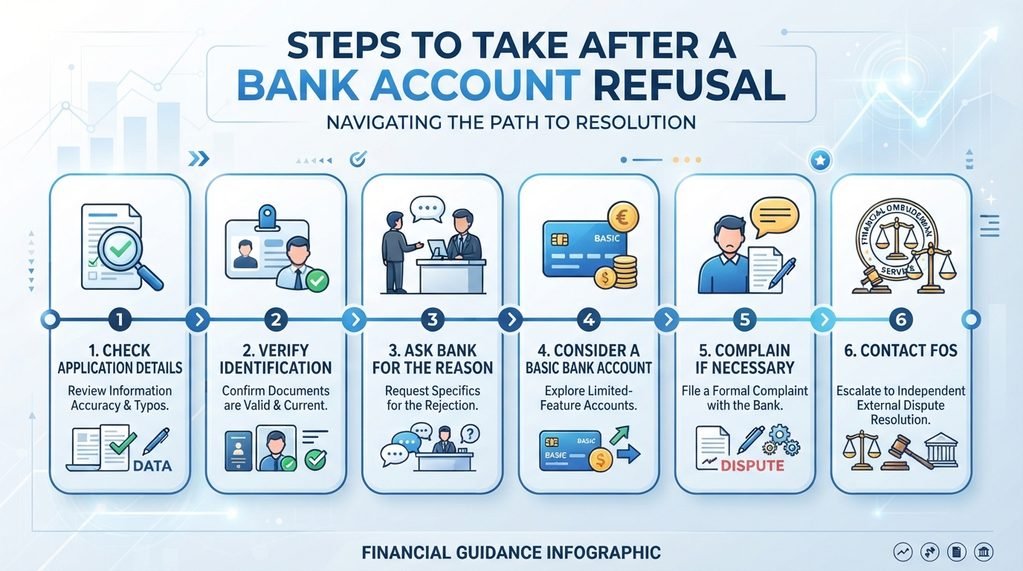
1. Check Whether Your Application Was Actually Declined
First, establish exactly what happened.
There is a difference between:
- Application declined
- Application delayed
- Identity verification failed
- Additional documents required
- Application referred for manual review
For example, if a bank cannot verify your identity automatically, it may ask you for another document rather than permanently refusing the account.
Check the message, letter or email you received.
If it is unclear, contact the bank using an official phone number or secure banking channel and ask whether your application has been formally declined.
2. Ask the Bank Why You Were Refused
If the bank has declined your application, ask whether it can explain the reason.
The amount of information a bank can give you may depend on the circumstances.
For example, banks may not disclose certain details where doing so could interfere with fraud or money-laundering controls.
MoneyHelper says that when a basic bank account application is declined, you should normally be told why unless the bank suspects fraud or money laundering.
Understanding the reason is important because it tells you what to do next.
For example:
| Possible problem | What you could do |
|---|---|
| Incorrect information | Correct the information |
| ID problem | Ask what alternative documents are accepted |
| Address verification | Provide acceptable proof of address |
| Standard-account eligibility | Consider a basic bank account |
| Poor credit history | Look at basic banking options |
| Fraud concern | Ask what complaint or review process is available |
| Unclear decision | Ask the bank for clarification |
Do not immediately submit several applications to different banks without understanding the original refusal.
3. Check Your ID and Personal Information
Identity problems are a common practical obstacle when opening a bank account.
Check that the information you supplied matches your documents.
Pay particular attention to:
- Full name
- Date of birth
- Current address
- Previous addresses
- Residency information
- Identification documents
- Contact details
A small mismatch can sometimes create a verification problem.
MoneyHelper lists documents such as passports, driving licences, utility bills, bank statements, HMRC correspondence and tenancy agreements among documents that may be accepted for identity or address checks, although the exact requirements vary between providers.
If you have recently moved house, recently arrived in the UK or do not have standard documents, contact the provider before submitting another application.
Ask what alternative evidence it accepts.
4. Consider a Basic Bank Account
If you were refused a standard current account, a basic bank account may be one of the most useful alternatives.
Basic bank accounts are designed to provide essential banking services without the borrowing facilities normally associated with an overdraft.
Depending on the provider, you can generally use one to:
- Receive wages
- Receive benefits
- Pay bills
- Make bank transfers
- Use a debit card
- Withdraw cash
- Set up Direct Debits
- Manage your money through online or mobile banking
MoneyHelper says basic bank accounts are generally available to people who do not qualify for a standard current account, including some people with poor credit histories.
They are not intended to provide the same borrowing features as a standard current account.
That can actually be useful if your immediate goal is simply to have somewhere to receive money and make everyday payments.
5. Look at Alternative Banking Options
If a standard current account is not available, you may have other options.
Depending on your circumstances, these can include:
Basic bank account
Often the first alternative to consider after being refused a standard current account.
Credit union current account
Credit unions are not-for-profit financial organisations, although eligibility and account fees vary.
MoneyHelper notes that credit union current accounts can be an option for people who struggle to open a standard bank account.
Prepaid card account
A prepaid card can allow you to spend and withdraw money without functioning like a traditional current account.
However, check the fees and whether the service supports the payments you need.
Another suitable bank account
Different providers have different products and eligibility criteria.
Being refused by one provider does not automatically mean another provider will refuse you.
However, check the eligibility requirements before making another full application.
6. Complain If You Think the Bank Has Treated You Unfairly
If you believe the bank made an error or failed to follow the appropriate process, you can complain.
Start with the bank.
Explain:
- What happened
- When you applied
- What information you provided
- What the bank told you
- Why you believe the decision or process was incorrect
- What outcome you want
Keep copies of relevant emails, letters and other communications.
MoneyHelper recommends contacting the bank first. If the issue is not resolved, you can make a formal complaint.
A complaint does not guarantee that the bank will reverse its decision.
However, it gives you a formal route to challenge mistakes or poor handling.
7. Escalate the Complaint If Necessary
If you complain to the bank and remain unhappy with its response, you may be able to take the matter to the Financial Ombudsman Service.
The Financial Ombudsman Service provides an independent complaint-resolution service for eligible financial complaints.
MoneyHelper says that if you are unhappy with the bank’s response, or the applicable response period has passed, you can take an eligible complaint to the Financial Ombudsman Service.
The process is free for consumers.
You normally need to complain to the bank first before escalating the matter.

Can You Get a Bank Account With Bad Credit?
Yes, potentially.
A poor credit history does not necessarily prevent you from having a bank account.
The important distinction is between banking services and borrowing.
A standard current account may come with an overdraft, while a basic bank account normally does not.
MoneyHelper specifically states that basic bank accounts can be an option for people with poor credit histories.
If you have been rejected because of your credit history, ask whether the provider offers a basic account or consider another provider that offers one.
Do not assume that you need to repair your credit score before you can access basic banking services.
Can You Get a Bank Account Without Proof of Address?
It can be more difficult, but the answer depends on the provider and your circumstances.
Banks need to verify customers, but the documents they accept can vary.
If you do not have a standard utility bill or similar document, ask the bank what alternatives it accepts.
This can be particularly important if you:
- Recently moved home
- Recently arrived in the UK
- Live in temporary accommodation
- Have no fixed address
- Do not have bills in your own name
The FCA’s 2026 review found that some banks were creating avoidable barriers for people with non-standard identification or no fixed address. The FCA said nine major banks and building societies had committed to improving access to basic bank accounts.
That means it can be worth specifically asking about a basic bank account rather than assuming you have no options.
What If You Are Refused a Basic Bank Account?
A basic bank account is not guaranteed to everyone.
MoneyHelper says an application can still be refused in circumstances such as:
- You could qualify for another type of account
- You cannot provide sufficient identity or address information
- You refuse a credit check used for identity purposes
- The bank has concerns about unlawful or fraudulent use
- There are other circumstances affecting eligibility
A bank can also refuse an application where there are fraud or money-laundering concerns.
If your basic-account application is refused, ask the provider for the reason where it can legally provide one.
If you believe you should have been offered an account and the decision was incorrect, use the bank’s complaints process.
Should You Apply to Another Bank?
Sometimes, yes.
Different banks have different account types, eligibility requirements and application processes.
But avoid making applications randomly.
A better approach is:
- Find out why the first application failed.
- Correct any errors.
- Gather the documents you need.
- Check the eligibility criteria for another account.
- Consider a basic bank account if appropriate.
- Apply only when you are reasonably confident the account fits your circumstances.
This can save you time and reduce unnecessary applications.
If the problem is your identification rather than your financial history, changing banks may not solve the underlying problem. You may need to resolve the verification issue first.
What If You Suspect a Fraud Marker Is Affecting You?
This situation requires more care.
Banks have obligations to prevent fraud and money laundering, and they may restrict what they can tell you about certain decisions.
If you believe inaccurate information about you is affecting your ability to open an account, ask the bank about its complaints process and what information it can provide.
Do not assume that you have a fraud marker simply because an account application was refused.
A refusal alone is not proof that a fraud marker exists.
If you are concerned about identity theft or fraudulent activity involving your details, consider getting appropriate independent advice and checking your credit information.
MoneyHelper also notes that account closures or restrictions involving suspected fraud can require different steps from an ordinary account rejection.
What If You Need an Account for Your Salary or Benefits?
Being without a bank account can create an immediate practical problem if your employer, pension provider or benefits service needs somewhere to send payments.
If you already have another suitable account, you may be able to use it temporarily.
If you cannot Open a Bank Account and are receiving benefits, there may be alternative payment arrangements depending on the benefit and your circumstances.
MoneyHelper explains that people who cannot open an account for certain benefit payments may be able to use the Government’s Payment Exception Service.
If this applies to you, check the latest GOV.UK guidance rather than assuming every benefit uses the same process.

How to Improve Your Chances of Opening an Account
There is no guaranteed way to get accepted, but you can make the application process easier by preparing properly.
Check your details
Make sure your name, address and date of birth are entered correctly.
Prepare your documents
Have acceptable identification and address documents ready before starting the application.
Choose an appropriate account
If you have poor credit or do not need an overdraft, a basic account may be more suitable than a standard current account.
Check eligibility first
Read the provider’s eligibility requirements before applying.
Be honest
Give accurate information about your circumstances.
Do not attempt to hide information or provide documents that are not genuine.
Ask for help
If you cannot complete an online application, ask whether the provider has another application or verification route.
Frequently Asked Questions
Why was my bank account application refused?
A bank may refuse an application because you do not meet its eligibility requirements, it cannot verify your identity or address, information is incorrect, or it has concerns relating to fraud or financial crime. The exact reason depends on the provider and circumstances.
What should I do if I am refused a bank account?
First, find out whether the application was actually declined and ask the bank why. Check your personal information and documents, then consider a basic bank account or another suitable alternative. If you believe the bank made an error, use its complaints process.
Can I apply to another bank after being refused?
Yes, potentially. Being refused by one bank does not automatically mean another provider will reject you. However, understand the reason for the first refusal and check eligibility before making another application.
Can I get a basic bank account after being refused?
Possibly. Basic bank accounts are designed for people who may not qualify for standard current accounts and generally provide essential banking services without an overdraft.
Can bad credit stop me opening a bank account?
Not necessarily. Poor credit can make some standard accounts harder to obtain, but basic bank accounts may still be available.
Can I complain if a bank refuses my application?
You can complain if you believe the bank has made an error or handled your application unfairly. Start with the bank’s complaints process. If the matter remains unresolved, you may be able to take an eligible complaint to the Financial Ombudsman Service.
Can a bank refuse a basic bank account?
Yes. Basic bank accounts have eligibility requirements and can be refused in certain circumstances, including some identity, fraud and eligibility situations.
What if I have no fixed address?
Having no fixed address can make banking more difficult, but it does not necessarily mean you have no options. The FCA has specifically identified barriers faced by people without a fixed address and said major banks are taking steps to improve access to basic accounts.
Does being refused a bank account damage my credit score?
It depends on what checks were carried out and the type of account you applied for. A bank-account rejection itself should not automatically be treated as proof of poor credit. Check your credit file if you are concerned about inaccurate information.
Should I keep applying until a bank accepts me?
It is better to understand why applications are being rejected before applying repeatedly. Check eligibility, correct errors and consider whether a basic bank account or another type of account is more appropriate.
Conclusion
If you are refused a bank account, do not assume that you have run out of options.
Start by finding out what happened. Check whether the application was actually declined, ask the bank for an explanation where possible and review your identity and address information.
If you cannot qualify for a standard current account, a basic bank account may provide the essential services you need without an overdraft. Other options, including some credit union or prepaid-card services, may also be worth considering depending on your circumstances.
If you believe the bank has made a mistake or treated you unfairly, use its formal complaints process. If the issue remains unresolved, an eligible complaint may be taken to the Financial Ombudsman Service.
The most important thing is to identify the reason for the refusal before deciding what to do next. That gives you a much better chance of finding an appropriate banking solution.