
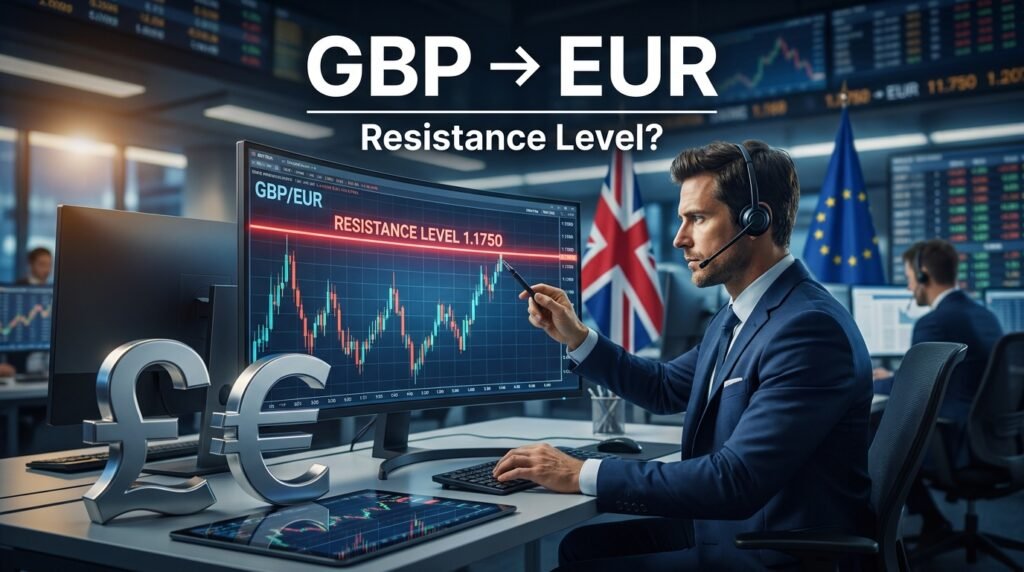
The pound to euro exchange rate resistance is an important technical concept for anyone following the GBP/EUR currency pair in 2026.
For UK travellers, businesses, investors and forex traders, resistance levels can help explain why the pound sometimes struggles to make further gains against the euro.
As of 14 August 2026, GBP/EUR was trading around €1.1696 per £1, with the market close to the important 1.1700 area. Recent technical analysis has also highlighted the 1.1800–1.1830 region as a major resistance zone.
But resistance is not a permanent ceiling. If buying pressure becomes strong enough, GBP/EUR can break above resistance and potentially move towards a new trading range.
This guide explains the latest GBP to EUR resistance levels, what they mean, how traders identify them and which economic factors could influence the pound against the euro during 2026.
What Is Pound to Euro Exchange Rate Resistance?
In forex trading, resistance is a price level where an exchange rate has previously struggled to move higher.
For GBP/EUR, resistance indicates an area where the pound may encounter increased selling pressure against the euro.
For example, if GBP/EUR repeatedly approaches 1.1700 but fails to remain above it, traders may consider 1.1700 an important resistance level.
If the exchange rate eventually moves above that level and remains there, the previous resistance can potentially become a new support level.
Simple Example
Suppose GBP/EUR is trading at:
£1 = €1.1690
If buyers repeatedly push the pair towards:
£1 = €1.1700
but the rate keeps falling back, 1.1700 could be acting as resistance.
A sustained move above that level could indicate stronger sterling momentum.
GBP/EUR Resistance Levels to Watch in 2026
Based on recent price action and technical analysis, several levels are particularly important.
| GBP/EUR level | Potential significance |
|---|---|
| 1.1700 | Immediate/key technical level |
| 1.1800 | Major resistance |
| 1.1828–1.1830 | 2026 high / major resistance zone |
| 1.1900 | Potential next upside area after a confirmed breakout |
These aren’t guaranteed targets. They’re technical reference levels based on recent market behaviour.
GBP/EUR reached approximately 1.1828 on 15 July 2026, making the 1.1800–1.1830 region particularly important for traders watching the next major breakout attempt.
1.1700: The First Important Resistance Level
The 1.1700 area has become an important short-term level for GBP/EUR.
Technical analysis has identified 1.1700 as a key area where a sustained break could improve the outlook for sterling.
On 14 August, GBP/EUR was around 1.1696, putting the exchange rate very close to this level.
What if GBP/EUR breaks above 1.1700?
A sustained move above 1.1700 could indicate that buyers are gaining control.
However, one short-lived move above resistance doesn’t necessarily confirm a breakout.
Traders often look for:
- A clear move above resistance
- Stronger momentum
- Follow-through in subsequent sessions
- Confirmation from other technical indicators
1.1800–1.1830: Major GBP/EUR Resistance
The 1.1800–1.1830 region is more significant.
GBP/EUR moved above 1.1800 during July but subsequently struggled to maintain the gains. The pair reached approximately 1.1828 on 15 July, creating an important 2026 high.
This means the area could become a major test for sterling.
What if GBP/EUR breaks 1.1830?
A decisive and sustained break above the previous 2026 high could indicate that the pound has regained strong upward momentum.
Some technical analysis has identified 1.1900 as a potential next area if GBP/EUR successfully clears the July high.
However, 1.1900 should be treated as a technical scenario, not a guaranteed forecast.
What Is Supporting the Pound in August 2026?
Several UK economic factors are currently relevant to GBP/EUR.
UK Economic Growth
The UK economy has shown some resilience.
Recent figures showed UK GDP increased by 0.4% in Q2 2026, while June monthly GDP increased by 0.3%. Reuters reported that stronger economic data has increased discussion around whether the Bank of England may need to raise interest rates again.
Stronger economic growth can support sterling if investors believe it could result in tighter monetary policy or fewer interest-rate cuts.
Bank of England Interest Rates
Interest rates are one of the biggest influences on GBP/EUR.
The Bank of England Bank Rate is currently 3.75%, following its July 2026 decision to keep rates unchanged. UK inflation was reported at 2.6%, above the Bank’s 2% target.
Higher UK interest rates can support sterling because they may increase the attractiveness of UK assets.
However, forex markets don’t simply look at the current rate.
Investors also consider what the Bank of England is likely to do next.
If markets begin pricing in higher UK rates, sterling could gain support.
If expectations shift towards rate cuts, GBP could come under pressure.
What Is Happening With ECB Interest Rates?
The European Central Bank is equally important for GBP/EUR.
At its 23 July 2026 meeting, the ECB kept:
- Deposit facility rate: 2.25%
- Main refinancing rate: 2.40%
- Marginal lending facility: 2.65%
The ECB said future decisions would remain dependent on incoming economic data.
The difference between UK and eurozone interest rates therefore remains an important factor for GBP/EUR.
If the Bank of England remains relatively more hawkish than the ECB, it could support sterling.
If the ECB becomes more hawkish or UK rate expectations weaken, the euro could strengthen.
UK Inflation and GBP/EUR
Inflation is another key factor.
When inflation remains elevated, central banks may face pressure to keep interest rates higher for longer.
For sterling, the key question is whether UK inflation remains high enough to prevent rapid monetary easing.
For the euro, traders watch eurozone inflation because it influences expectations for ECB policy.
Therefore:
Higher-than-expected UK inflation → potentially supportive for GBP
Lower-than-expected UK inflation → potentially negative for GBP
The actual market response depends on what investors had already priced into the exchange rate.
Eurozone Economic Data
GBP/EUR isn’t controlled by UK economic data alone.
Important eurozone indicators include:
- Inflation
- GDP growth
- Employment
- Consumer spending
- Manufacturing activity
- Services activity
- Wage growth
- ECB policy decisions
Stronger eurozone economic data can strengthen the euro and put downward pressure on GBP/EUR.
Weak European data can have the opposite effect.
Why Does GBP/EUR Resistance Matter?
Resistance matters because it can show where market sentiment is changing.
Imagine GBP/EUR rises from:
1.1500 → 1.1600 → 1.1700
If the pair repeatedly fails around 1.1700, that area becomes important.
If buyers eventually push through 1.1700 and the pair continues higher, traders may view that as evidence that the previous selling pressure has weakened.
This can create a potential move towards the next resistance area.
GBP/EUR Support vs Resistance
It’s important to understand the difference.
Resistance
A level where GBP/EUR has historically struggled to rise.
Support
A level where GBP/EUR has historically found buying interest.
For example:
Resistance: 1.1700 / 1.1800–1.1830
Support: Lower levels where previous declines have attracted buyers.
Support and resistance aren’t exact mathematical lines.
They’re often better understood as zones.
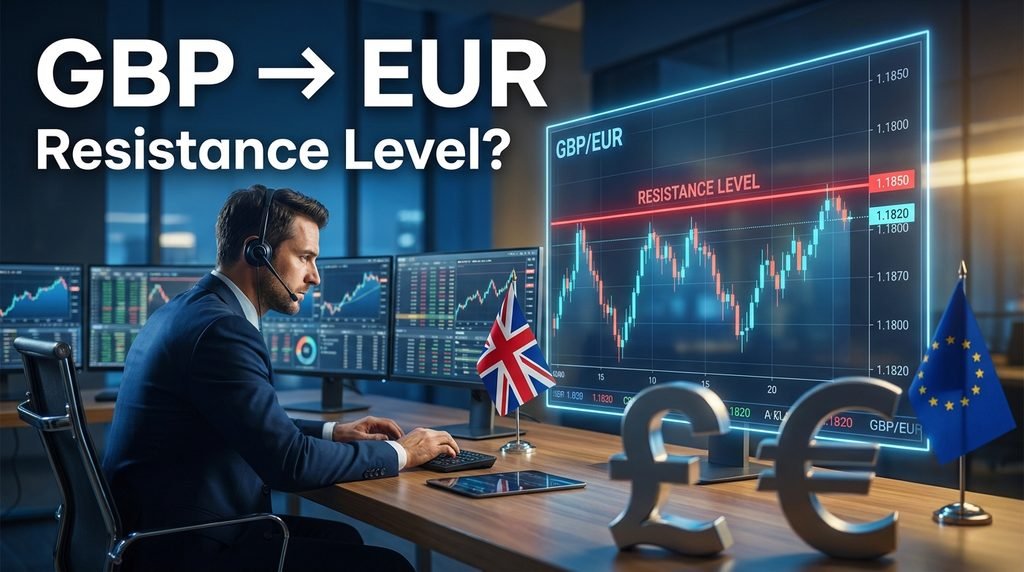
What Could Push GBP/EUR Above Resistance?
Several factors could potentially help sterling break higher.
1. Stronger UK Economic Data
Better-than-expected UK GDP, employment or business activity could support GBP.
2. Higher UK Interest-Rate Expectations
If markets expect the Bank of England to maintain or increase rates for longer, sterling could benefit.
3. Lower ECB Rate Expectations
If traders expect the ECB to become more accommodative, the euro could weaken relative to sterling.
4. Strong UK Inflation
Persistent inflation could reduce expectations for rapid UK rate cuts.
However, extremely high inflation isn’t necessarily positive for the pound because it can damage household purchasing power and economic growth.
5. Improved UK Investor Confidence
Stronger confidence in the UK economy could attract capital and support sterling.
What Could Push GBP/EUR Lower?
The opposite factors could weaken GBP/EUR.
UK Interest-Rate Cuts
If the Bank of England cuts rates more aggressively than expected, sterling could lose support.
Weak UK Economic Growth
Poor GDP or employment figures could pressure the pound.
Falling UK Inflation
Lower inflation can give the Bank of England more room to reduce rates.
Strong Eurozone Data
Improving eurozone economic performance could strengthen the euro.
Hawkish ECB
If the ECB signals tighter monetary policy, EUR could gain.
Political or Fiscal Concerns
Unexpected political or fiscal developments can cause currency-market volatility.
Pound to Euro Exchange Rate Resistance and Technical Analysis
Technical analysts use several tools to identify resistance.
These can include:
- Previous highs
- Moving averages
- Trendlines
- Fibonacci retracement levels
- RSI
- MACD
- Price patterns
- Trading volume
- Round-number levels
For GBP/EUR, psychological levels such as 1.1700, 1.1800 and 1.2000 can attract particular attention.
However, technical indicators should not be used in isolation.
Economic news can cause GBP/EUR to move sharply through a technical level.
What Is a False Breakout?
A false breakout happens when GBP/EUR moves above resistance but quickly falls back below it.
For example:
Resistance = 1.1700
GBP/EUR rises to:
1.1730
But then drops back to:
1.1650
That could indicate that buyers weren’t strong enough to maintain the breakout.
This is why traders often wait for confirmation rather than reacting to a brief move above resistance.
What Happens When Resistance Breaks?
A successful breakout can potentially change the market structure.
For example:
1.1700 resistance breaks
↓
GBP/EUR holds above 1.1700
↓
Previous resistance may become support
↓
Traders watch the next resistance around 1.1800
↓
A sustained break above 1.1830 could open the possibility of testing higher levels
This is a technical scenario, not a prediction that these moves will definitely happen.
GBP/EUR Forecast for the Rest of 2026
Predicting currencies months in advance is difficult.
The remainder of 2026 could be influenced by:
- Bank of England decisions
- ECB decisions
- UK inflation
- Eurozone inflation
- UK GDP
- Eurozone GDP
- Labour-market data
- Government fiscal policy
- Global risk sentiment
- Geopolitical developments
From a technical perspective, 1.1700 remains an important near-term area, while 1.1800–1.1830 represents a more significant resistance zone based on recent 2026 price action.
A sustained break above the 2026 high could shift attention towards higher levels.
On the other hand, repeated failure around resistance could keep GBP/EUR range-bound or expose the pair to another decline.
Is a Higher GBP/EUR Rate Good for UK Travellers?
It depends on what you’re doing with your money.
If:
£1 = €1.18
then £1 buys more euros than when:
£1 = €1.15
Therefore, a stronger pound can be beneficial for UK travellers going to countries that use the euro.
For example:
At £1 = €1.15:
£1,000 = €1,150
At £1 = €1.18:
£1,000 = €1,180
That’s a difference of:
€30
before considering exchange fees and provider spreads.
Is a Higher GBP/EUR Rate Good for UK Businesses?
It depends on the business.
A UK company importing goods from the eurozone may benefit from a stronger pound because euros become cheaper in sterling terms.
However, UK exporters selling products to eurozone customers may find that a stronger pound makes their products relatively more expensive in euros.
Therefore:
UK importers → potentially benefit from stronger GBP
UK exporters → potentially face challenges from stronger GBP
How Can You Track GBP/EUR Resistance?
If you want to monitor the pair, watch:
1. GBP/EUR exchange rate
Check the current market rate rather than relying on an old article.
2. Bank of England announcements
Interest-rate decisions can cause significant sterling moves.
3. ECB announcements
ECB policy can directly affect the euro.
4. UK inflation
Inflation changes can affect interest-rate expectations.
5. Eurozone inflation
This can influence ECB policy expectations.
6. UK GDP
Strong growth can support sterling.
7. Technical levels
Keep an eye on the key resistance zones.
Should You Exchange Pounds for Euros at Resistance?
This depends on your purpose.
If you’re simply travelling, trying to perfectly time the forex market can be unnecessary.
For larger transactions, such as buying property or transferring substantial amounts of money, exchange-rate movements can have a much bigger impact.
Rather than relying on a single resistance level, consider:
- Your required amount of euros
- Your timeframe
- Provider fees
- Exchange-rate spread
- Current GBP/EUR level
- Potential volatility
- Whether splitting the transaction makes sense
Never assume that a technical resistance level will definitely hold.

Pound to Euro Exchange Rate Resistance: Key Takeaways
The most important GBP/EUR levels currently include:
1.1700 — key near-term level
1.1800 — major resistance
1.1828–1.1830 — 2026 high / major resistance zone
1.1900 — potential next area if the major resistance breaks
These levels can change as new price action develops.
The biggest fundamental drivers to watch are Bank of England policy, ECB policy, UK inflation, eurozone inflation and economic growth.
Frequently Asked Questions
What is pound to euro exchange rate resistance?
It is a price area where GBP/EUR has historically struggled to rise because selling pressure has increased.
What is the key GBP/EUR resistance level in 2026?
The 1.1700 level is an important near-term area, while 1.1800–1.1830 is a more significant resistance zone based on recent 2026 price action.
What is the GBP/EUR 2026 high?
GBP/EUR reached approximately 1.1828 on 15 July 2026 in the historical data cited above.
What happens if GBP/EUR breaks 1.1830?
A sustained break could signal stronger sterling momentum. Some technical analysis has identified 1.1900 as a potential next area, although this isn’t guaranteed.
What makes the pound stronger against the euro?
Factors can include stronger UK economic data, higher UK interest-rate expectations, a more hawkish Bank of England and weaker eurozone economic conditions.
What makes the euro stronger against the pound?
Stronger eurozone data, more hawkish ECB policy, weaker UK economic data or lower UK interest-rate expectations can potentially support EUR against GBP.
Is GBP/EUR resistance the same as support?
No.
Resistance is an area where price can struggle to move higher.
Support is an area where price can find buying interest after falling.
Can GBP/EUR resistance levels change?
Yes. Resistance levels can change as new highs and lows form and as market conditions change.
Is 1.20 euros per pound possible?
It is possible for GBP/EUR to move to different levels, but nobody can guarantee that it will reach 1.20. Currency markets are affected by economic data, central-bank policy, geopolitical events and investor sentiment.
Should I use resistance levels to exchange currency?
Resistance can provide useful context, but it should not be the only factor in a currency decision. Exchange fees, spreads, your timeframe and the amount you’re exchanging are also important.
Final Thoughts
The pound to euro exchange rate resistance remains an important topic for anyone monitoring GBP/EUR in 2026.
The immediate 1.1700 area is an important technical threshold, while 1.1800–1.1830 represents a much stronger resistance zone following the July 2026 high.
Whether GBP/EUR can break higher will depend on both technical momentum and the fundamental outlook.
The Bank of England’s 3.75% Bank Rate, the ECB’s 2.25% deposit rate, UK inflation, eurozone inflation and economic growth will all remain important factors for the pound-to-euro outlook.
For travellers and businesses, a stronger pound can have practical consequences too. A higher GBP/EUR exchange rate means each pound buys more euros, although the final rate you receive from a bank or currency provider will depend on its spread and fees.
Most importantly, remember that support and resistance are not guarantees. A resistance level can break, a breakout can fail and unexpected economic news can move GBP/EUR rapidly.