
Paying a little extra towards your mortgage can make a surprisingly big difference over time.
Even a relatively small additional payment could reduce the amount of interest you pay and potentially help you become mortgage-free sooner. But the actual benefit depends on your mortgage balance, interest rate, remaining term, and how much you overpay.
A mortgage overpayment calculator UK can help you estimate these potential savings before you decide how much extra to pay.
This guide explains how mortgage overpayments work, how to calculate the potential savings, how to use an overpayment calculator step by step, and what UK homeowners should check before making additional payments.
Important: Mortgage terms vary between lenders and products. Always check your mortgage agreement or ask your lender about overpayment limits and any charges before making a large payment.
What Is a Mortgage Overpayment?
A mortgage overpayment is simply an extra payment made on top of your normal mortgage repayment.
For example, imagine your regular mortgage payment is:
£1,000 per month
You decide to pay:
£1,100 per month
The additional £100 is an overpayment.
You could also make a one-off payment, such as:
£1,000 + £5,000 extra payment
The additional money reduces the amount you owe, which can reduce the interest charged on the outstanding balance.
Many UK mortgages allow some level of overpayment, although restrictions can apply. MoneyHelper says many mortgages allow overpayments of up to 10% of the outstanding balance each year, but you should check your own mortgage agreement because the limit isn’t universal.
What Is a Mortgage Overpayment Calculator?
A mortgage overpayment calculator is a tool that estimates what could happen if you pay extra towards your mortgage.
It can help you estimate:
- How much interest you could save
- How much earlier you might repay the mortgage
- The effect of monthly overpayments
- The effect of a one-off payment
- How different overpayment amounts compare
For example, you could compare:
£50 extra per month
against:
£100 extra per month
and:
£200 extra per month
The results can help you understand how even small changes may affect the overall cost and length of your mortgage.
Why Does Overpaying Save Interest?
Mortgage interest is generally calculated based on the amount you still owe.
If you reduce the outstanding balance, future interest can be calculated on a smaller amount.
Here’s a simplified example.
Suppose you owe:
£200,000
You make a:
£10,000 overpayment
Your outstanding balance could then be reduced to around:
£190,000
The exact effect depends on your mortgage structure, interest calculation and lender.
The key idea is simple:
Lower mortgage balance → Less interest charged over time → Potentially faster repayment
MoneyHelper confirms that overpaying can reduce future interest and help you pay off a mortgage sooner.
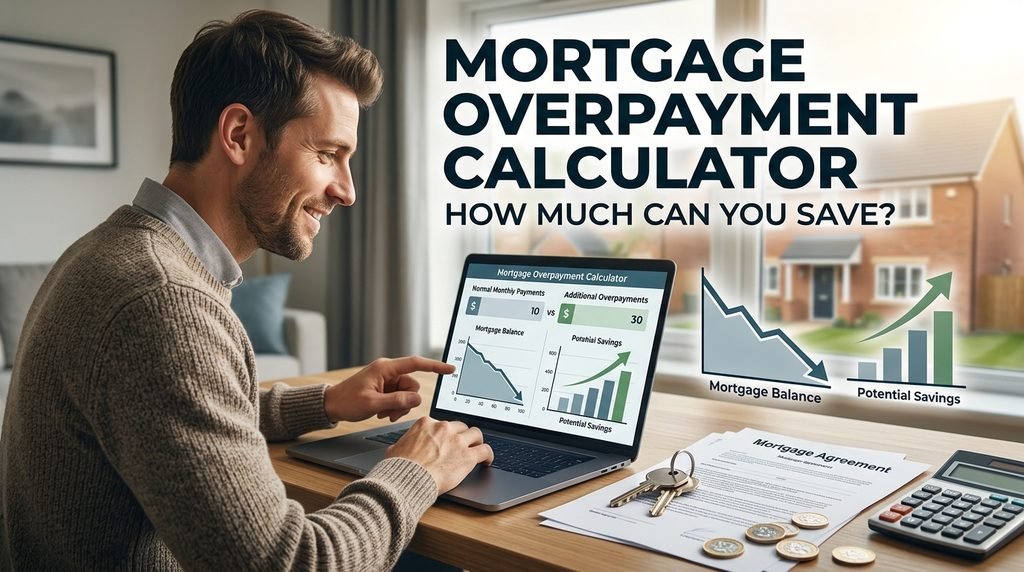
How to Use a Mortgage Overpayment Calculator UK
Using a calculator is usually straightforward.
You normally need a few pieces of information.
1. Enter Your Mortgage Balance
Start with the amount you currently owe.
For example:
Mortgage balance: £250,000
Don’t use the original amount you borrowed if you’ve already made repayments.
Use your current outstanding balance instead.
2. Enter Your Interest Rate
Next, enter your current mortgage interest rate.
For example:
Interest rate: 4.5%
If you’re on a fixed or discounted deal, use the rate that currently applies to your mortgage.
3. Enter Your Remaining Term
Enter how long remains on the mortgage.
For example:
Remaining term: 20 years
4. Enter Your Current Monthly Payment
If the calculator asks for your current payment, enter the amount you’re currently paying.
For example:
Monthly payment: £1,500
5. Enter Your Planned Overpayment
Now decide how much additional money you could realistically pay.
For example:
Monthly overpayment: £100
6. Compare the Results
The calculator should provide an estimate showing how the additional payment could affect your mortgage.
Depending on the calculator, you may see:
- Estimated interest saved
- New repayment date
- Reduced mortgage term
- Total payments
- Potential savings
Remember that calculator results are estimates. Your lender’s actual figures may differ.
Monthly vs One-Off Mortgage Overpayments
There are two common ways to overpay.
Monthly Overpayments
This means adding a fixed amount to your normal payment every month.
For example:
Normal payment: £1,200
Extra payment: £100
Total monthly payment: £1,300
The advantage is consistency.
You don’t need a large amount of cash available at once.
One-Off Overpayments
A one-off overpayment involves making an additional payment from savings or another source.
For example:
Mortgage balance: £180,000
One-off overpayment: £5,000
This can immediately reduce the balance, but you should check your lender’s rules before doing it.
Example: How an Overpayment Could Help
Let’s use a simple hypothetical example.
Imagine you have:
- Mortgage balance: £200,000
- Interest rate: 4.5%
- Remaining term: 20 years
- Extra payment: £100 per month
A calculator can compare the standard repayment schedule with the schedule after adding £100 each month.
The result may show that you:
- Repay the mortgage earlier
- Pay less interest
- Reduce the total amount paid over the mortgage term
The exact saving will depend on how your lender calculates interest and applies overpayments.
That’s why it’s better to use a calculator rather than guessing.
What Happens When You Overpay Your Mortgage?
There are generally two important benefits.
1. Your Balance Falls Faster
The extra payment reduces your outstanding mortgage balance.
2. You May Pay Less Interest
Because you’re borrowing less, you may pay less interest over the remaining term.
The combination can help shorten the mortgage.
However, your lender may treat overpayments differently depending on your mortgage product.
For example, some lenders may:
- Reduce your mortgage term
- Reduce future monthly payments
- Give you a choice
- Apply the overpayment according to the terms of your mortgage
Always check what happens to your mortgage after an overpayment.
Is There a 10% Overpayment Limit in the UK?
This is one of the most important points to understand.
Many UK mortgage products allow borrowers to overpay up to 10% of their outstanding mortgage balance per year without an early repayment charge, but this is not a universal rule for every mortgage.
MoneyHelper specifically notes that many mortgages allow overpayments of around 10% per year and recommends checking your mortgage terms.
For example, if you owe:
£200,000
and your mortgage allows 10% annual overpayments, your permitted amount could be:
£20,000
But don’t automatically assume this applies to your mortgage.
Some products may have different limits, calculation methods or conditions.
What Is an Early Repayment Charge?
An Early Repayment Charge (ERC) is a fee that can apply when you repay some or all of your mortgage earlier than allowed under the mortgage agreement.
This can be particularly relevant when you’re making a large overpayment.
For example, imagine your lender allows you to overpay up to a certain amount without a charge.
If you exceed that limit, an ERC could potentially apply to the excess or according to the terms of your mortgage.
The FCA explains that early repayment charges can apply when a mortgage is repaid in full or in part before the relevant date or event specified in the contract.
How to Check Your ERC
Before making a large overpayment:
- Find your mortgage offer or current mortgage statement.
- Check the overpayment section.
- Look for the annual overpayment allowance.
- Check whether an ERC applies.
- Check when the charge ends.
- Ask your lender if anything is unclear.
Don’t rely on a general “10% rule” without checking your own mortgage.
Should You Overpay During a Fixed-Rate Mortgage?
You may be able to overpay while on a fixed-rate mortgage, but the rules depend on the product.
Some fixed-rate mortgages allow a certain amount of penalty-free overpayment.
Others may charge an ERC if you exceed the permitted allowance.
So before making an extra payment, check:
Your fixed-rate period → Annual allowance → ERC → Minimum/maximum payment rules
The FCA notes that borrowers should understand any early repayment charges that may apply.
Is Overpaying Better Than Saving?
This is a common question, but there isn’t one answer for everyone.
Suppose your mortgage interest rate is relatively high while your savings account pays a lower rate after considering relevant tax.
Overpaying may look attractive because you’re effectively reducing borrowing on which interest is charged.
But you should also consider:
- Emergency savings
- Savings interest rates
- Tax
- Investment opportunities
- Mortgage ERCs
- Your financial goals
- Access to your money
Once you use savings to overpay a mortgage, getting that money back isn’t always straightforward.
That’s why keeping an emergency fund can be important before putting all available cash into your mortgage.
When Might Overpaying Not Be the Best Choice?
Overpaying can be useful, but it isn’t automatically the right move.
You may want to think twice if:
You Don’t Have an Emergency Fund
Unexpected expenses can appear at any time.
It may be sensible to maintain accessible savings before committing spare cash to your mortgage.
Your Mortgage Has a High ERC
If the charge is larger than the interest benefit, overpaying may not make financial sense at that point.
You Have More Expensive Debt
Credit cards or other high-interest borrowing may deserve attention first.
Your Savings Rate Is Higher
If your savings account provides a better after-tax return than the interest rate you’re paying on the mortgage, keeping the money in savings could potentially be more attractive.
You Need Easy Access to Your Money
Mortgage overpayments generally reduce your debt, but they don’t necessarily give you immediate access to that cash again.
How Much Should You Overpay?
There is no universal amount.
Start with what you can comfortably afford.
For example, you might consider:
- £25 per month
- £50 per month
- £100 per month
- £250 per month
- £500 per month
You could also make occasional lump-sum payments when you receive:
- A bonus
- An inheritance
- A tax refund
- A large cash gift
- Proceeds from selling an asset
The important point is not to overpay so aggressively that you leave yourself without enough money for everyday needs or emergencies.
Step-by-Step: How to Make a Mortgage Overpayment
If you’ve decided that overpaying is suitable for you, follow these steps.
Step 1: Check Your Mortgage Agreement
Find your overpayment allowance and any ERC.
Step 2: Check Your Current Balance
Use your latest mortgage statement.
Step 3: Decide What You Can Afford
Work out a realistic monthly or one-off amount.
Step 4: Use an Overpayment Calculator
Enter your balance, rate, remaining term and proposed extra payment.
Step 5: Compare Different Scenarios
Try several amounts.
For example:
£50 vs £100 vs £200 per month
This shows how your potential savings change.
Step 6: Confirm With Your Lender
Ask the lender how an overpayment will be applied.
Step 7: Make the Payment
Use your lender’s approved method.
Step 8: Check Your Mortgage Afterwards
Review your balance and confirm the overpayment has been applied correctly.
What Information Should You Have Before Using a Calculator?
For the most useful estimate, gather:
- Current mortgage balance
- Current interest rate
- Remaining mortgage term
- Current monthly payment
- Planned monthly overpayment
- Planned one-off payments
- Mortgage type
- Annual overpayment allowance
- Any applicable ERC
The more accurate your inputs, the more useful the estimate will be.
Can Overpayments Reduce Your Mortgage Term?
Yes, overpayments can potentially help you repay the mortgage sooner.
However, the exact result depends on how your lender applies additional payments.
Some lenders may allow you to keep your normal monthly payment while reducing the remaining term.
Others may recalculate the payment amount.
Ask your lender exactly how overpayments affect your mortgage.
What If You Want to Make a Large Lump-Sum Payment?
Don’t simply transfer a large amount without checking the terms.
Instead:
- Check your outstanding balance.
- Check your annual overpayment allowance.
- Check your ERC.
- Ask the lender how the payment will be applied.
- Confirm whether you need to request a term reduction.
- Keep enough cash for emergencies.
- Make the payment using the lender’s instructions.
This can help you avoid an unexpected charge.
Mortgage Overpayment Calculator UK: What the Result Really Means
A calculator is useful, but it shouldn’t be treated as a guarantee.
For example, a result might estimate:
Interest saved: £12,000
That doesn’t necessarily mean your lender will produce exactly the same figure.
Why?
Because real mortgage calculations can depend on:
- Daily or monthly interest calculations
- Payment dates
- Rate changes
- Overpayment timing
- Lender-specific rules
- Changes to the mortgage term
- ERCs
Use the calculator to understand the potential impact, then confirm important figures with your lender.
Frequently Asked Questions
What is a mortgage overpayment calculator UK?
It is a calculator designed to estimate how additional mortgage payments could affect your repayment term, interest costs and overall mortgage balance.
How much can I overpay on my mortgage?
Many UK mortgage products allow overpayments of up to 10% of the outstanding balance each year, but this isn’t a universal limit. Check your mortgage agreement before paying extra.
Does overpaying a mortgage reduce interest?
Generally, reducing the outstanding mortgage balance can reduce the amount of interest charged over time, depending on the mortgage terms and interest calculation method.
Can I overpay a fixed-rate mortgage?
You may be able to, but your mortgage product may have an annual allowance or ERC. Check your agreement before making an additional payment.
What is an early repayment charge?
An ERC is a charge that may apply when you repay some or all of a mortgage earlier than allowed under the contract.
Is it better to overpay monthly or make a lump sum?
Both can reduce the mortgage balance. The better option depends on your cash flow, mortgage terms, savings and financial goals.
Should I use all my savings to overpay my mortgage?
Usually, you should consider keeping an emergency fund and checking other financial priorities before using a large amount of savings to reduce your mortgage.
Can I overpay by £100 a month?
If your mortgage permits overpayments and the additional amount stays within your lender’s rules, you may be able to. Check the terms of your specific mortgage.
Does overpaying always reduce the mortgage term?
Not necessarily. Some lenders may reduce the term, while others may recalculate future payments. Ask your lender how additional payments are handled.
Final Thoughts
A mortgage overpayment calculator UK can be a useful starting point for anyone thinking about paying extra towards their mortgage.
It can show how different overpayment amounts could potentially affect the interest you pay and how quickly you become mortgage-free.
But don’t make the decision based on the calculator alone.
First, check your mortgage balance, interest rate and remaining term. Then check your lender’s overpayment allowance and any early repayment charges.
Many mortgages allow some penalty-free overpayment, often around 10% of the outstanding balance per year, but the exact rules depend on the mortgage product.
Finally, consider your wider finances.
Keeping an emergency fund, paying expensive debts and maintaining enough accessible savings can be just as important as reducing your mortgage.
The best overpayment strategy is one that reduces your mortgage efficiently without putting unnecessary pressure on your everyday finances.