

A woman I heard about recently nearly didn’t apply for Universal Credit at all — she’d been told, wrongly, by a friend that “any savings” would disqualify her. She had about £4,000 put aside from a redundancy payout. That myth alone probably stops more people claiming support they’re entitled to than almost any other misunderstanding about the system.
So let’s clear it up properly: how much savings can you have on Universal Credit, what actually counts as savings, and how the numbers work if you’re somewhere in between.
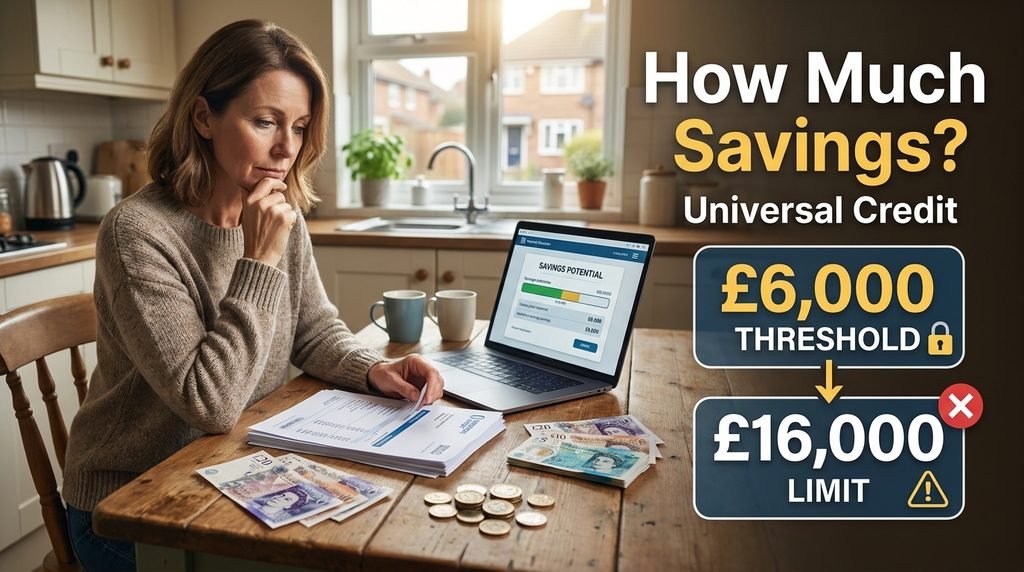
Quick answer: You can have up to £16,000 in savings and still claim Universal Credit. Below £6,000, your savings don’t affect your payment at all. Between £6,000 and £16,000, your payment reduces gradually. Above £16,000, you generally can’t claim.
That’s the headline. The detail below explains how each threshold actually works in practice.
Universal Credit Savings: The Three Thresholds
Universal Credit treats your money, savings and investments together as capital, and assesses it against three bands:
Under £6,000 — Ignored completely. It doesn’t matter whether you have £500 or £5,999; your Universal Credit payment isn’t affected by savings in this range.
£6,000 to £16,000 — This is where things start to reduce. Every £250 of savings above £6,000 is treated as generating £4.35 a month in “tariff income,” which comes straight off your Universal Credit payment.
Over £16,000 — In most cases, you’re not eligible for Universal Credit at all once your capital crosses this line.
Here’s how the tariff income calculation actually plays out with a real number. Say you’ve got £8,000 saved:
- The first £6,000 is ignored
- That leaves £2,000 above the threshold
- £2,000 ÷ £250 = 8
- 8 × £4.35 = £34.80 deducted from your monthly Universal Credit payment
If your savings sat at £10,000 instead, you’d have £4,000 above the threshold — that’s 16 units of £250, so 16 × £4.35 = £69.60 coming off your monthly payment. The deduction climbs steadily the closer you get to £16,000, until eventually the reduction effectively wipes out your entitlement anyway, even before you technically hit the upper limit.
To make the pattern clearer, here’s how the monthly deduction scales across the full range:
| Total savings | Amount above £6,000 | Monthly deduction |
|---|---|---|
| £6,500 | £500 | £8.70 |
| £7,000 | £1,000 | £17.40 |
| £8,000 | £2,000 | £34.80 |
| £10,000 | £4,000 | £69.60 |
| £12,000 | £6,000 | £104.40 |
| £14,000 | £8,000 | £139.20 |
| £15,999 | £9,999 | £173.91 |
Notice that even at £15,999 — just £1 below the upper limit — the deduction is already fairly substantial. For many claimants, once savings creep past around £13,000–£14,000, the tariff income deduction can end up nearly matching their remaining entitlement anyway, well before the hard £16,000 cut-off actually bites.
What Actually Counts as Savings for Universal Credit
This trips up a lot of people, because “savings” covers more than just a bank balance. Universal Credit counts the following as capital:
- Cash and money in current accounts, savings accounts, and Credit Union accounts
- ISAs of any kind
- Premium Bonds
- Stocks, shares and dividends
- Money held in your name that technically belongs to someone else — including savings you’re holding for a child
- Property you own that isn’t your main home
- Interest earned on any of the above
What generally doesn’t count:
- The home you actually live in
- Personal possessions (your car, furniture, and so on — within reason)
- Certain pension pots you haven’t yet accessed
- Money set aside through the government’s Help to Save scheme, which is treated differently and doesn’t reduce your Universal Credit the way ordinary savings do

If you’re jointly saving with a partner, joint accounts count toward your household’s total capital, not just your individual share — this is one of the more common points of confusion for couples claiming together.
The Migration Notice Exception — A Rule Worth Knowing
If you were previously on tax credits and received a Migration Notice telling you to move to Universal Credit, there’s a specific protection built in. If your savings are above £16,000 at the point you move over, you can still be eligible for Universal Credit for up to 12 assessment periods (roughly a year) before the normal upper limit applies.
This transitional protection is there specifically because moving to Universal Credit wasn’t your choice in that scenario — it was triggered by the DWP’s migration process. Important caveat: this protection generally doesn’t apply if you chose to move to Universal Credit voluntarily before receiving that notice. If you switched over by choice, the standard £16,000 limit applies from day one.
A Worked Example, Start to Finish
Let’s say your total household savings sit at £11,500.
- First £6,000 is disregarded entirely
- That leaves £5,500 above the threshold
- £5,500 ÷ £250 = 22
- 22 × £4.35 = £95.70 deducted from your monthly Universal Credit payment
If your normal monthly entitlement would otherwise have been, say, £450, you’d actually receive £354.30 that assessment period. If your savings then dropped to £7,000 the following month — perhaps because you’d spent some on essential costs — the deduction recalculates automatically based on the new figure.
This is also why keeping an eye on your online Universal Credit journal matters. Deductions adjust automatically as your reported capital changes, and it’s worth checking your statement matches what you’d expect based on your actual savings.
Savings Held for Children
A specific point of confusion is money set aside for children — a Junior ISA, a savings account in a child’s name, or money you’re holding “for when they’re older.” As a general rule, genuine Child Trust Funds and Junior ISAs held in a child’s own name are not counted as your capital, because legally the money belongs to the child, not to you.
Where it gets murkier is money that’s technically in your name but that you consider to be your child’s — say, a birthday gift you’re holding onto rather than money in a dedicated children’s account. If it’s sitting in an account under your own name, the DWP can treat it as your capital regardless of your intentions for it. If you want savings for a child to be genuinely excluded from your Universal Credit assessment, it generally needs to be held in an account specifically in the child’s name.
Self-Employed Claimants and Business Assets
If you’re self-employed, the line between personal savings and business capital isn’t always obvious, and Universal Credit does treat them somewhat differently. Money kept specifically for running your business — stock, equipment funds, or cash set aside to cover a tax bill you know is coming — can sometimes be treated differently from personal savings, though this isn’t automatic and depends on your specific circumstances and how clearly the money is earmarked for business use.
This is one of the areas worth getting proper advice on rather than assuming, because self-employment and capital rules interact in ways that catch out a lot of sole traders and freelancers claiming Universal Credit alongside irregular income.
Legal Ways to Manage Your Savings If You’re Close to £16,000
If your savings are creeping toward the upper limit, spending recklessly just to qualify isn’t the answer — but you’re not entirely without options either. A few genuinely legal approaches can help, provided you’re doing them for real financial reasons and not purely to game the system.
Contributing to a pension. Money paid into a personal or workplace pension isn’t counted as capital for Universal Credit purposes. If you’re able to, increasing your pension contributions — whether through your workplace scheme or a personal pension — reduces your accessible savings while still building long-term financial security rather than just disappearing. This is one of the few moves that genuinely helps both your Universal Credit position and your future at the same time.
Prepaying essential bills. Some regular costs allow advance payment — council tax, energy bills, and home insurance are common examples. Paying ahead on things you’d need to pay anyway reduces your savings balance without it being treated as deliberately depriving yourself of capital, since you’re settling a genuine future liability rather than getting rid of money for its own sake. That said, keep any prepayment reasonable and proportionate to your actual bills — a suspiciously large one-off payment timed right before an assessment is exactly the kind of thing the DWP looks at more closely.
Paying down existing debt. Clearing a credit card, loan, or other debt you already owe reduces your capital in a way that’s straightforwardly legitimate — you’re not disposing of money, you’re settling something you owed regardless of your Universal Credit claim.
None of these approaches guarantee a particular outcome, and what’s reasonable depends on your specific circumstances. If you’re unsure whether a particular move could be seen as deprivation of capital, it’s worth calling the Universal Credit helpline or speaking to Citizens Advice before acting, rather than assuming and finding out the hard way.
When Migration From Tax Credits Makes This Worse
This situation hits hardest for people who didn’t choose to move onto Universal Credit — they were migrated over from tax credits, which never assessed savings in the first place. Someone who spent years quietly building up £10,000 or £15,000 in savings under the old system can suddenly find that same nest egg working against them the moment they’re migrated, through no decision of their own.
It gets worse when a lump sum lands unexpectedly — a backdated pay rise, a bonus, an inheritance — and pushes savings over £16,000 partway through the 12-month transitional protection period. Because the migration protection only lasts for a fixed 12 assessment periods, a payment that arrives late in that window can end support abruptly, sometimes with little warning, even though the underlying savings might not feel like “wealth” in any meaningful sense — often it’s money set aside specifically for emergencies, house repairs, or supporting family.
If this happens to you, it’s worth checking your award notice carefully and querying the calculation if something seems off, rather than assuming the reduction is automatically correct.
If your capital is only slightly above £16,000, it’s worth being realistic about your options rather than looking for a way around the rule. Deliberately spending down savings specifically to qualify for Universal Credit — known as “deprivation of capital” — is something the DWP actively looks for, and if they decide that’s what happened, they can treat you as still having that money for assessment purposes, even though it’s actually gone.
That doesn’t mean every legitimate spend is suspect. Paying off debt, covering a genuinely necessary expense, or replacing a broken essential item with your own savings is normal financial behaviour, not deprivation of capital. The distinction the DWP looks at is largely about intent and timing — spending £10,000 on a holiday the week before applying for Universal Credit, specifically because you were about to be assessed, looks very different from paying down a credit card you’ve been chipping away at for months.
Yes — and this is one area where people genuinely get caught out. You’re required to report changes in your savings and capital to the DWP, not just wait to be asked. This includes:
- Receiving a lump sum (inheritance, redundancy payout, compensation, a gift)
- Savings crossing from one threshold into another
- Selling a property or other asset
- A change in how savings are held (for example, moving money into a partner’s name)
Failing to report a relevant change isn’t a minor administrative slip — it can lead to overpayments you’re later asked to repay, and in more serious cases, allegations of fraud. If you’re unsure whether something needs reporting, it’s generally safer to report it and let the DWP confirm than to assume it doesn’t matter.
What Happens If You Disagree With a Decision?
If your Universal Credit payment is reduced or stopped because of a savings assessment you believe is wrong, you can request a mandatory reconsideration before taking things further. This is the formal first step in challenging a DWP decision, and it’s worth doing promptly — there are time limits attached to how long you have to request one after a decision is made.
Universal Credit Savings vs Other Benefits
It’s worth knowing that the £6,000/£16,000 rule doesn’t apply universally across every benefit — this specific structure is for Universal Credit and several other means-tested benefits. Some benefits work completely differently:
| Benefit | How savings affect it |
|---|---|
| Universal Credit | £6,000–£16,000 tariff income rule; over £16,000 usually stops entitlement |
| PIP | Savings have no effect at all |
| Carer’s Allowance | Savings have no effect at all |
| Attendance Allowance | Savings have no effect at all |
| Housing Benefit (State Pension age) | Different threshold — £10,000, with its own calculation |
If your only income is a disability benefit like PIP, Attendance Allowance or Carer’s Allowance, your savings — however large — genuinely don’t factor into that specific payment. It’s only the means-tested benefits, Universal Credit chief among them, where the capital rules described here actually apply.
Common Questions
How much savings can you have on Universal Credit before it’s affected at all? Up to £6,000. Below that figure, your savings have zero impact on your Universal Credit payment.
How much savings can you have on Universal Credit before you lose it completely? Generally, £16,000 is the cut-off. Above that, most claimants aren’t eligible — with the migration notice exception covered above being the main exception to that rule.
Does my partner’s savings count too? Yes. If you claim as a couple, your combined capital is assessed together, not separately.
Do pensions count as savings for Universal Credit? Pension pots you haven’t started drawing from generally aren’t counted as capital. Once you start taking money out of a pension, that withdrawn amount can then count as savings or income depending on how it’s used.
What if my savings temporarily go over £16,000 because of a one-off payment? It’s still assessed against the actual figure at that point — the reason for the increase doesn’t exempt it, aside from the specific migration notice protection. Report the change promptly and check how it affects your claim.
Does the Help to Save scheme affect my Universal Credit? Balances built up specifically through the government’s Help to Save scheme are treated differently from ordinary savings and don’t reduce your Universal Credit in the same way. It’s designed to encourage low-income workers to build a savings habit without being penalised for it.
Final Thoughts
The short version really is this: savings under £6,000 don’t touch your Universal Credit at all. Between £6,000 and £16,000, your payment reduces gradually rather than disappearing overnight. Above £16,000, in most circumstances, you won’t be eligible to claim.
Where people go wrong isn’t usually the maths — it’s not knowing what counts as capital in the first place, or assuming any savings at all will disqualify them, which simply isn’t true. If your circumstances are close to a threshold, or you’ve had a lump sum land recently, it’s worth working through your actual numbers against these rules rather than guessing, and reporting any relevant change to the DWP as soon as it happens.
This guide is for general information and isn’t personal financial or benefits advice. Universal Credit rules can change, so always check the current thresholds and your own circumstances on GOV.UK or with an independent benefits adviser such as Citizens Advice or Turn2us before making decisions based on your savings.