If you’ve come across the HEMO share price and are trying to make sense of it, you’re not alone. HEMO belongs to Hemogenyx Pharmaceuticals, and unlike a steady, predictable blue-chip stock, this one can swing sharply in short periods of time — which makes it worth understanding before you look at any single number on a chart.
Let’s break it down simply, one piece at a time.
Quick Facts About HEMO
| Company | Hemogenyx Pharmaceuticals Plc |
| Ticker | HEMO |
| Exchange | London Stock Exchange (LSE) |
| Sector | Biotechnology / Pharmaceuticals |
| Focus | <cite index=”11-1″>Developing new medicines and treatments for blood and autoimmune diseases</cite> |
| Stock Type | Clinical-stage biotech (high volatility) |
| Dividends | None currently paid |
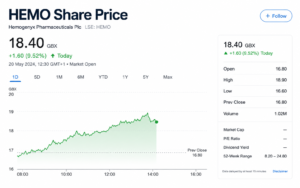
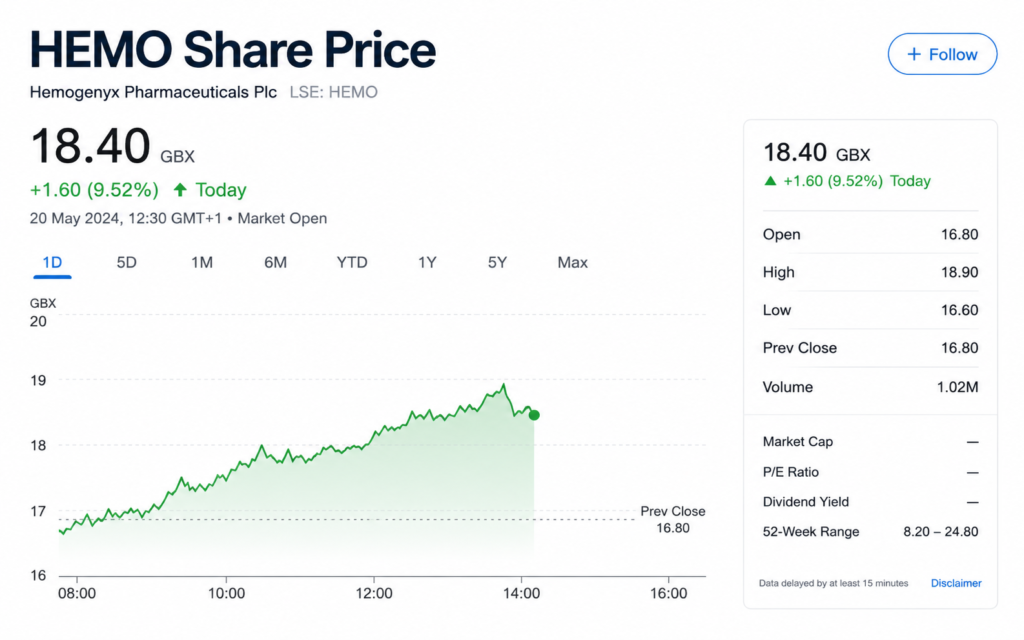
Prices change constantly during market hours — always check a live source like the LSE or your broker for today’s exact HEMO share price.
Why HEMO Is More Volatile Than Most Stocks
Here’s the simple version: Hemogenyx Pharmaceuticals is a clinical-stage biotech company. It’s still developing and testing its treatments, so it isn’t generating the steady product revenue an established company would.
That single fact explains most of what you’ll notice about HEMO:
- 📈 Sharp upward spikes often follow positive trial news
- 📉 Sharp drops can follow funding announcements or disappointing updates
- 🎢 Wide 52-week price ranges are common for this type of stock
- 🔄 Low trading volume on some days, which can make price swings feel even bigger
Quick takeaway: With biotech stocks like HEMO, the price reflects hope and progress on treatments still in development, not steady, predictable earnings.
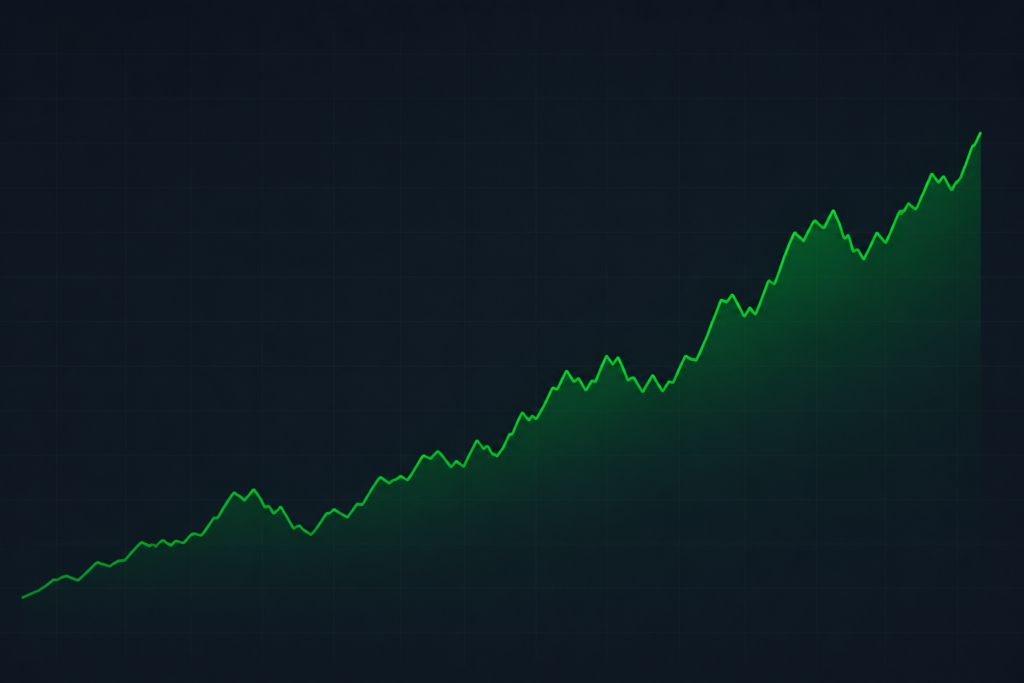
A Simple Way to Think About Biotech Stock Pricing
It helps to picture a clinical-stage biotech company as running on a timeline of milestones rather than quarterly sales numbers. Each milestone — a trial phase completing, a regulatory filing, a partnership announcement — acts like a checkpoint the market reacts to.
Between those checkpoints, the price can drift quietly. Right around a checkpoint, it often moves fast, in either direction. This is very different from, say, a retail company whose price mostly tracks steady sales and profit reports every quarter.
Quick takeaway: Think in terms of “milestones,” not “quarters,” when trying to understand why HEMO’s price jumps around.
What Actually Moves the HEMO Share Price
🧪 Clinical Trial Progress
Positive trial updates tend to boost investor confidence, and the share price along with it. Setbacks or delays can have the opposite effect just as quickly.
💰 Funding Announcements (Placings)
Biotech companies often raise money through share placings to fund ongoing research. These announcements can move the price, sometimes diluting existing shares in the process as new shares enter circulation.
🏛️ Regulatory and Grant News
Approvals, grants, or regulatory milestones are closely watched, since they signal how close a treatment is to reaching the market and generating future revenue.
🌍 Broader Biotech Sentiment
Even without company-specific news, overall investor appetite for high-risk biotech stocks can push prices up or down across the whole sector, HEMO included.
👥 Insider and Director Activity
When directors buy or sell significant amounts of stock, it’s sometimes read by the market as a signal of internal confidence (or caution), which can influence sentiment.
Quick takeaway: Watching company news and sector trends matters just as much as watching the price chart itself.
Key Metrics to Check Before Looking at HEMO
- Market Capitalisation — the total value the market currently places on the company
- 52-Week Range — how far the price has swung over the past year
- Trading Volume — higher volume usually means easier buying and selling without moving the price yourself
- Recent Announcements — often explain sudden price jumps a chart alone won’t show
- Shares in Issue — helps you understand how a placing might affect existing shareholders
Quick takeaway: Never look at the share price in isolation — pair it with recent news, volume, and share count for real context.
How to Read a HEMO Price Chart Without Overreacting

A single red or green day on the chart rarely tells the full story. Here’s a simple approach:
- Zoom out first. Look at 3-month and 12-month views before reacting to a single day’s move.
- Cross-check with news. A sharp move almost always lines up with an announcement — find it before assuming otherwise.
- Compare volume alongside price. A big price move on low volume can be less meaningful than one backed by high trading activity.
- Watch for patterns around funding rounds. Placings often precede short-term dips due to dilution, which can be a normal part of the cycle rather than a red flag.
Quick takeaway: Context turns a confusing chart into a much clearer story.
Simple Steps Before You Make Any Decision
- Check a live price source — LSE, your broker app, or a trusted financial site
- Read recent company announcements — trial updates, funding news, grants
- Look at the 52-week range, not just today’s number
- Assess your own risk tolerance — biotech stocks are not low-risk investments
- Avoid decisions based on hype alone — social media chatter often overstates short-term moves
- Diversify if you do invest — avoiding overexposure to a single volatile stock is a common risk-management approach
Quick takeaway: A few minutes of research beats reacting to a single headline or price spike.
A Word on Risk
Clinical-stage biotech stocks like HEMO can offer significant upside if a treatment progresses well, but they can also lose value quickly if trials disappoint or funding needs increase. This isn’t unusual for the sector — it’s simply part of investing in early-stage pharmaceutical development.
Some investors treat small-cap biotech stocks as a higher-risk portion of a broader portfolio, rather than a core, long-term holding. That approach doesn’t suit everyone, and it’s worth thinking through based on your own financial goals and how much volatility you’re comfortable sitting through.
Quick takeaway: Higher potential reward with HEMO-type stocks usually comes paired with higher potential risk — plan accordingly.
HEMO vs. a Typical Blue-Chip Stock
It’s easier to understand HEMO’s behavior when you compare it side by side with a large, established company:
| HEMO (Clinical-Stage Biotech) | Typical Blue-Chip Stock | |
|---|---|---|
| Revenue | Little to none yet | Steady, established |
| Price Driver | Trial milestones, news | Quarterly earnings |
| Volatility | High | Generally low to moderate |
| Dividends | None | Often paid regularly |
| Typical Investor | Higher risk tolerance | Broader range of investors |
This isn’t a judgment on either type of company — they simply serve different roles in an investment strategy, and understanding which one you’re looking at changes how you should read its price movements.
Quick takeaway: Comparing HEMO to a stable, established company side by side makes its price behavior much easier to understand.
A Quick Glossary for HEMO Investors
- Placing — when a company issues new shares to raise funds, which can dilute existing shareholders
- Clinical-stage — a company still testing its products in trials, rather than selling them commercially
- 52-week range — the lowest and highest price a stock has reached over the past year
- Market capitalisation — share price multiplied by total shares in issue, showing the company’s total market value
- Dilution — a reduction in existing shareholders’ ownership percentage after new shares are issued
- Volatility — how sharply and how often a stock’s price moves up or down over time
Quick takeaway: Knowing these basic terms makes reading any HEMO news update far less confusing.
Frequently Asked Questions
1. What does HEMO stand for? HEMO is the stock ticker for Hemogenyx Pharmaceuticals Plc, a London-listed biotech developing treatments for blood-related and autoimmune diseases.
2. Why does the HEMO share price move so much? As a clinical-stage biotech, HEMO’s value is closely tied to trial results, regulatory news, and funding announcements, all of which can shift the price quickly.
3. Is HEMO a stable, long-term stock? Not typically. Clinical-stage biotech companies carry higher risk, since success often depends on unpredictable trial outcomes rather than steady revenue.
4. Does HEMO pay dividends? No. Like most early-stage biotech companies still developing their products, HEMO does not currently pay dividends.
5. What causes sudden HEMO price spikes or drops? Common triggers include trial updates, funding rounds (placings), regulatory news, or grant announcements — all typical for the biotech sector.
6. Is HEMO a good investment? That depends entirely on your own risk tolerance and research. This article is for general information only, not personalized financial advice.
Conclusion
The HEMO share price isn’t just a number to glance at — it’s shaped by clinical trial progress, funding rounds, regulatory milestones, and broader sentiment toward high-risk biotech stocks. Understanding these moving parts gives you a much clearer picture than any single price point ever could.
As always, do your own research, check the latest company announcements, and consider your personal risk tolerance before making any investment decision. This article is for general informational purposes only and isn’t financial advice.