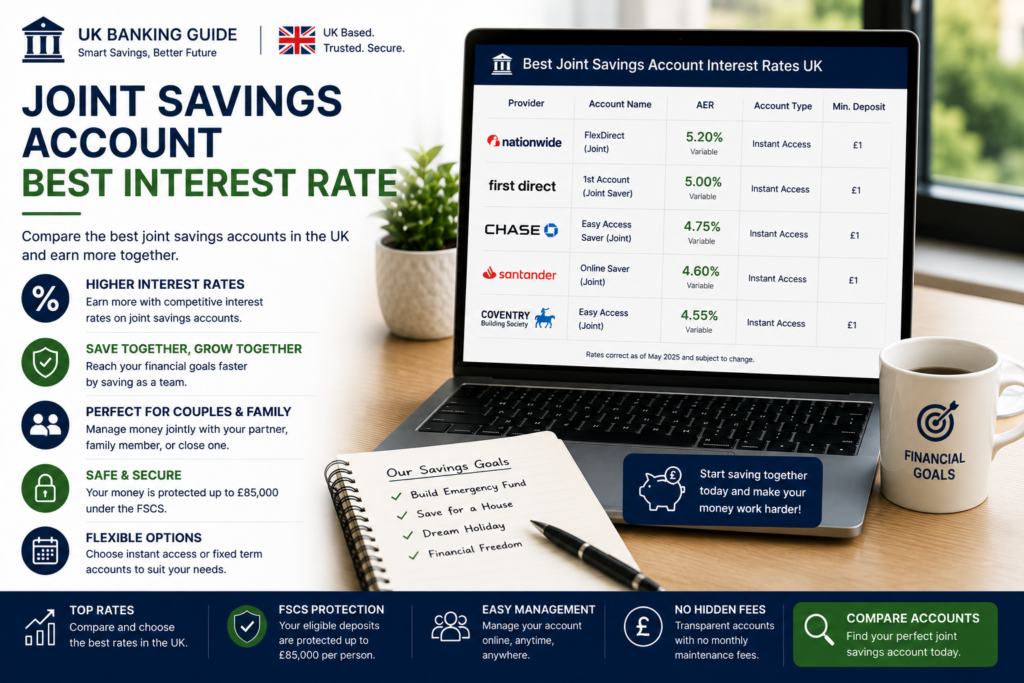
If you and a partner, family member, or friend are saving toward a shared goal, finding a joint savings account best interest rate you can both benefit from makes a genuine difference to how quickly that goal comes together. Whether it’s a house deposit, a wedding, a family holiday, or simply a shared emergency fund, the right account can meaningfully speed things up.
Here’s the thing: joint accounts aren’t just a regular savings account with two names on it. There are a few extra considerations — how withdrawals work, what happens if one person wants out, and how interest and tax are split — that are worth understanding before you commit.
It’s easy to focus entirely on the advertised rate and skip past these details, especially when you’re excited about a shared goal. But the accounts that work best long-term are usually the ones where both holders understood exactly how the account operates from the very start, not just what rate it paid.
This guide covers exactly how to compare joint savings accounts properly, what to watch for beyond the headline rate, and the mistakes that can quietly cause friction down the line.
Why the Right Joint Savings Account Best Interest Rate Matters
A shared savings goal often means a larger balance than either person might hold individually, which makes the interest rate you choose even more impactful. A small percentage difference between providers can translate into a genuinely noticeable amount over a year or two, especially with a healthy joint balance.
Beyond the rate itself, joint accounts introduce a layer of shared decision-making that individual accounts don’t have. Getting the setup right from the start avoids awkward conversations later about access, control, or how funds should be divided. Two people bring two sets of expectations to a shared account, and it’s far easier to align those expectations before any money changes hands than to renegotiate them once a disagreement has already surfaced.
Takeaway: Treat this as a joint financial decision from day one, not just a rate comparison exercise.

Tip #1: Compare Rates Across Multiple Provider Types
Don’t limit your search to your existing bank. High street banks, building societies, and digital-only providers all compete for joint savings deposits, and rates can vary meaningfully between them.
Comparison sites make this process quick, letting you filter specifically for joint account availability, since not every savings product is offered jointly. Some digital-only providers in particular have pushed rates upward in recent years to attract new customers, so it’s worth checking beyond the familiar high street names before settling on a choice, especially since these newer providers are often keen to build a customer base quickly.
Takeaway: Widening your search beyond your current bank often uncovers a noticeably better rate worth the extra few minutes of comparison.
Tip #2: Understand the Account Mandate Options
Joint accounts typically operate under either an “either to sign” or “both to sign” mandate. The former allows either person to manage the account independently, while the latter requires agreement from both holders for any transaction.
Neither option is inherently better — it depends on how much independent control each person wants, and how much trust and communication exists around shared finances. Couples managing household savings together often prefer the flexibility of “either to sign,” while those pooling funds for a specific, larger purpose sometimes feel more comfortable requiring both signatures for withdrawals, particularly for a large one-off purchase like a house deposit.
Takeaway: Choose a mandate that matches how you and your co-holder actually want to manage the account day to day.
Tip #3: Check Whether the Rate Is Fixed or Variable
A joint savings account best interest rate advertised today might not remain the best rate in six months if it’s variable and tied to wider economic conditions. Fixed rate options offer certainty for a set period, while variable rates can rise or fall with the broader market.
If predictability matters more to you and your co-holder than chasing the highest possible short-term rate, a fixed rate account may suit your shared goal better. This is especially relevant if you’re saving toward a fixed timeline, such as a wedding date or a planned house purchase, where knowing exactly how much interest you’ll earn removes one variable from an already complex plan.
Takeaway: Decide together whether certainty or flexibility matters more for your specific savings goal.
Tip #4: Clarify How Interest and Tax Are Handled
By default, interest earned on a joint account is usually split equally between holders for tax purposes, regardless of who contributed more to the balance. This matters if one holder pays a higher tax rate than the other, since it could affect how much of that interest is actually kept after tax.
It’s worth discussing this openly, and in some cases, checking with a tax advisor if your contributions or tax situations are significantly different from each other. For example, if one partner is a higher-rate taxpayer and the other isn’t, the standard 50/50 split for tax purposes might not reflect the most efficient arrangement for your specific circumstances, and a small adjustment could genuinely save money over time.
Takeaway: Understand the tax implications together before assuming the split will always work in both people’s favour.

Tip #5: Discuss What Happens If Circumstances Change
It’s not the most comfortable conversation, but agreeing in advance what happens to the account if a relationship ends, or if one person needs to withdraw their share unexpectedly, avoids serious complications later. Disagreements over jointly held savings are a genuinely common source of friction, precisely because the account was set up with good intentions and no clear plan for what happens if things change down the road.
Some couples choose to keep individual savings accounts alongside a joint one specifically for this reason, balancing shared goals with individual financial independence. This isn’t a lack of trust — it’s simply a practical way of keeping some financial flexibility for each person, regardless of how the joint savings goal progresses, and it can make future decisions considerably easier if priorities ever diverge.
Takeaway: A brief conversation early on can prevent a much more difficult one later.
How to Open a Joint Savings Account
Opening a joint account is usually straightforward, though most providers will ask for:
- Proof of identity for both account holders
- Proof of address for both account holders
- Details of an existing current account for transfers in and out
- Agreement on the account mandate before the application is submitted
- National Insurance numbers for both holders, in some cases, for tax reporting purposes
Most providers allow this to be done online, though a small number of building societies may still require an in-branch visit for joint accounts, particularly for larger initial deposits or if either holder is new to that institution and hasn’t previously been verified with them.
Takeaway: Have both sets of documents ready in advance to avoid delays caused by mismatched paperwork or missing signatories.
What to Look for Beyond the Interest Rate
While the interest rate matters, a few other features are worth comparing too:
- Whether the account allows instant access or requires notice for withdrawals
- Any minimum or maximum deposit limits
- Whether online and mobile banking access is available to both holders
- Customer service quality, particularly for resolving disputes or account changes
- How easily the account can be converted to an individual one if circumstances change
Takeaway: The best account balances a competitive rate with practical features that suit how you’ll actually use it.

Frequently Asked Questions
1. What is a joint savings account? It’s a savings account held in the names of two or more people, allowing shared access to deposit, withdraw, and manage funds together, typically used by couples, family members, or business partners saving toward a common goal.
2. How do I find the best interest rate for a joint savings account? Compare rates across banks, building societies, and digital providers using comparison sites, paying close attention to whether the rate is fixed or variable and any conditions attached, such as notice periods or minimum balances.
3. Do both account holders need to agree before withdrawing money? This depends on the account’s mandate. Some joint accounts allow either holder to withdraw independently, while others require both signatures for any transaction.
4. Is interest on a joint savings account split between holders? Yes, for tax purposes interest is usually split equally between account holders by default, though this can sometimes be adjusted depending on your specific circumstances and provider.
5. What happens to a joint savings account if the relationship ends? Typically, both parties need to agree on how to divide the funds, or the account may need to be closed and reopened individually. It’s worth discussing this possibility before opening the account.
6. Are joint savings accounts protected under FSCS? Yes, joint accounts are protected under the Financial Services Compensation Scheme, typically up to £85,000 per person, meaning a joint account can benefit from up to £170,000 of combined protection — provided the funds are held with the same FSCS-protected institution.
Final Thoughts
Finding a joint savings account best interest rate that works for both of you is about more than comparing headline numbers. Understanding the account mandate, how interest and tax are split, and what happens if circumstances change all matter just as much as the rate itself.
These conversations might feel unnecessary when things are going well, but they’re precisely what makes a joint account resilient when circumstances inevitably shift — a new job, a change in income, a house move, or simply evolving priorities between you and your co-holder.
Take the time to compare properly, have the slightly awkward conversations early, and you’ll end up with an account that genuinely supports your shared financial goal, rather than causing friction further down the line. A little upfront planning goes a long way toward making sure the account works smoothly for both of you, for as long as you need it.