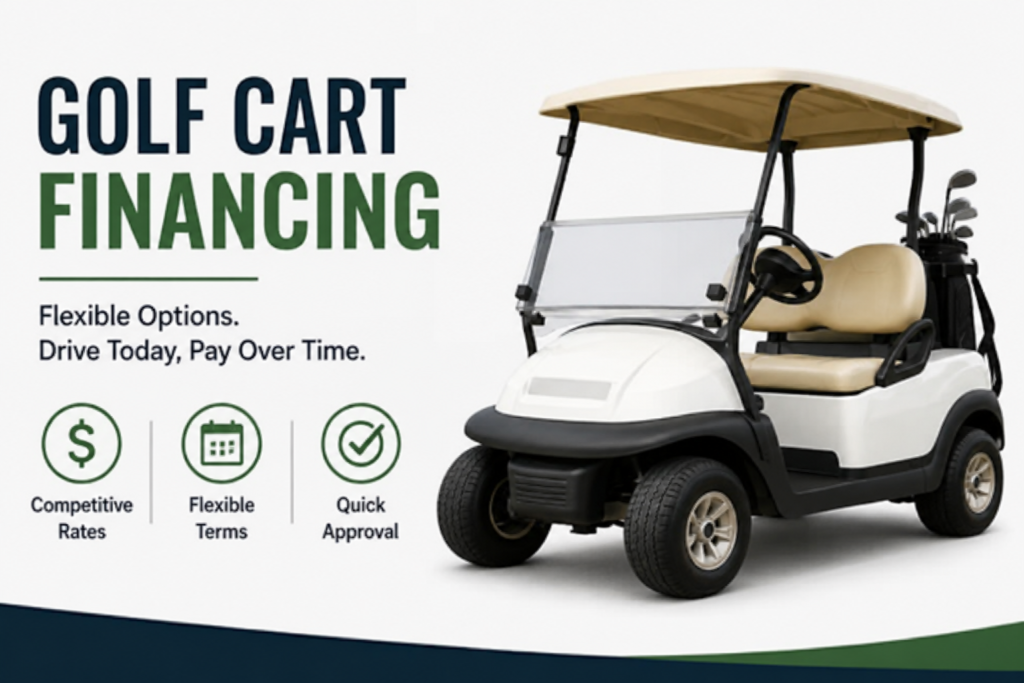
Walking onto a dealership lot to buy a golf cart is usually the fun part. Figuring out how to pay for it? That’s where most buyers get stuck.
Here’s the thing — golf cart financing has genuinely never had more options than it does right now. Manufacturers run 0% promotions, credit unions quietly offer some of the sharpest rates around, and even buy-now-pay-later apps have entered the space. That’s the good news.
The less-good news is that most buyers accept the first financing offer a dealer hands them without ever comparing it to anything else. And dealers, understandably, aren’t in a rush to point out that they can mark up interest rates for their own commission.
This guide breaks down every practical route to financing a golf cart, what each one actually costs, and how to avoid overpaying for something that should be a pretty simple purchase.
Why Golf Cart Financing Looks Different From a Car Loan
Before comparing options, it helps to understand what makes golf cart financing its own category. Most carts fall in the $5,000 to $15,000 range, which is small enough that approval rates tend to be high and paperwork tends to be light.
Loan terms are also more flexible than you’d expect. Many lenders offer terms from 12 months all the way up to 84 months, with the 36- to 60-month range being the sweet spot for most buyers who want manageable payments without dragging out interest for years.
Quick takeaway: Don’t assume golf cart financing works like a car loan. Terms, credit requirements, and approval speed are usually far more buyer-friendly — so it’s worth shopping around instead of settling for the first number you see.
1. Manufacturer 0% Promotions
If you qualify, this is almost always the best deal on the table. Major brands frequently run 0% installment promotions for well-qualified buyers, especially during seasonal sales events.
- These offers typically require a strong credit profile, often 700 or above
- Promotions usually can’t be combined with other rebates or discounts
- Terms are shorter than average, so monthly payments may be higher
Takeaway: Before you fall in love with a specific model, check whether the manufacturer currently has a 0% offer running. It can make an otherwise pricier cart the cheapest option overall.
2. Dealer In-House Financing
Most golf cart dealerships offer their own in-house financing, and it’s usually the fastest way to walk out with a cart the same day. Some in-house plans extend terms up to 84 months and even offer same-as-cash windows for buyers who can pay off the balance quickly.
- In-house plans often accommodate buyers with limited or poor credit history
- Approval can happen within minutes, right at the dealership
- Rates tend to run higher than manufacturer promotions or credit unions
Takeaway: In-house financing is convenient, but convenience has a price. Always ask for the APR in writing before signing, and compare it against at least one outside offer.
3. Credit Union Powersport Loans
This is the option most buyers skip, and it’s often a mistake. Credit unions frequently classify golf carts under “powersport” or recreational vehicle lending, and their rates tend to run noticeably lower than banks or dealer plans.
- Many credit unions offer rates 1 to 3 percentage points below typical dealer financing
- Membership is often easy to qualify for through location or a small donation
- Applications are usually quick, with approval possible within a day
Takeaway: Even a 15-minute credit union application can be worth it. Shaving a couple of percentage points off your rate adds up fast over a multi-year loan.
4. Specialty Powersports Lenders
Beyond dealers and credit unions, there’s a whole category of lenders that specialize specifically in golf cart financing and other recreational vehicles. These companies work with a wide range of credit profiles, from prime buyers to those with subprime credit.
- Many offer instant pre-qualification with no impact on your credit score
- Rate offers are often valid for a set window, like 30 days, giving you time to compare
- Some partner directly with dealers, so approval and purchase happen in one visit
Takeaway: Getting pre-qualified through a specialty lender before you shop gives you real negotiating leverage at the dealership — you already know what a fair rate looks like.
5. Personal Loans and Bank Financing
A traditional unsecured personal loan is another route, particularly if you’re buying from a private seller rather than a dealership. Since private sellers typically don’t offer in-house financing, arranging your own loan in advance is often necessary.
- Rates depend heavily on your credit score and existing debt
- Personal loans usually don’t require the cart itself as collateral
- Pre-approval gives you a firm budget before you start negotiating
Takeaway: If you’re buying secondhand, get pre-approved for a personal loan before you start browsing listings — it prevents you from falling for a cart that’s outside your real budget.
6. Credit Cards and Buy-Now-Pay-Later Apps
Some buyers use a 0% introductory credit card offer or a buy-now-pay-later service for smaller purchases or accessories, and occasionally for the cart itself. This can work well, but it comes with a real risk attached.
- Standard credit card APRs typically run 20% to 30% once the promotional period ends
- Buy-now-pay-later terms are usually short, from 3 to 36 months
- This route works best for accessories or upgrades rather than the full cart price
Takeaway: Only use this strategy if you’re confident you can pay off the balance before the promotional window closes. Otherwise, the interest can quickly outpace what you’d have paid with a standard loan.
7. Lease-to-Own Programs
Lease-to-own and rent-to-own plans have become more common, especially for buyers with limited or no credit history. Instead of a traditional loan, you make scheduled payments toward eventual ownership.
- These plans generally don’t require a hard credit check
- Monthly payments can be higher than a comparable loan over the same period
- Ownership only transfers once all payments are complete
Takeaway: Lease-to-own can be a genuine lifeline if your credit history is thin, but read the full payment schedule carefully — the total cost is often higher than financing through a credit union or bank.
How to Compare Golf Cart Financing Offers Properly
Once you’ve gathered a few offers, resist the urge to just look at the monthly payment. A lower monthly number can hide a longer term and more total interest paid over time.
Instead, compare the full picture: total interest cost, loan length, any prepayment penalties, and whether the rate is fixed or subject to change after an introductory period.
Takeaway: Ask every lender for the total repayment amount, not just the monthly figure. That single number tells you more about the real cost of golf cart financing than any advertised rate.
Final Thoughts
Golf cart financing in 2026 is more competitive and more buyer-friendly than it’s ever been, but that competition only benefits you if you actually compare your options. Manufacturer promotions, dealer plans, credit unions, and specialty lenders can all lead to very different total costs for the exact same cart.
That said, the “best” option really depends on your credit profile, your timeline, and how quickly you want to drive off the lot. A buyer with strong credit chasing a 0% promotion is in a completely different situation than someone financing through a lease-to-own plan with no credit history.
If there’s one habit worth building before you buy, it’s this: get at least one outside offer before you sign anything at the dealership. It takes fifteen minutes and it’s often the difference between a fair deal and an overpriced one.
5. FAQs Section
1. What is the best golf cart financing option available right now? A 0% manufacturer or dealer promotion is usually the best option for well-qualified buyers. If you don’t qualify, comparing a credit union powersport loan against a specialty lender offer is the next best step.
2. Can I get golf cart financing with bad credit? Yes. Many dealers offer in-house financing for buyers with poor or limited credit, and lease-to-own programs are also widely available. Expect higher rates or shorter terms compared to buyers with strong credit.
3. How long can you finance a golf cart for? Most golf cart financing terms range from 12 to 84 months, with 36 to 60 months being the most common. Longer terms lower your monthly payment but usually increase total interest paid.
4. What credit score do I need for golf cart financing? Many lenders prefer a score of 650 or higher, though some programs accept scores as low as 550. A higher score typically unlocks better rates and more flexible terms.
5. Is golf cart financing available for used carts? Yes, financing is generally available for both new and used golf carts, though private-seller purchases usually require arranging financing independently rather than through in-house dealer plans.
6. How much does a typical golf cart cost to finance? Most golf carts fall between $5,000 and $15,000, though luxury or street-legal models can cost more. The final financed amount depends on the model, accessories, and any down payment made.