

Offering finance to customers in the UK can make higher-value products and services more affordable by allowing customers to spread the cost over time.
But offering finance to customers in the UK is not simply a matter of adding a “pay monthly” button to your website. Depending on how the arrangement is structured, your business may be carrying out regulated consumer credit activity and could need authorisation from the Financial Conduct Authority (FCA).
The key question is not just “Can my business offer finance?” It is:
What type of finance are you offering, and what role does your business play?
This guide explains the main FCA rules businesses should consider before offering customer finance in the UK, including direct lending, credit broking, third-party finance, financial promotions and Buy Now Pay Later.
Important: Consumer credit regulation depends on the exact structure of your business and finance arrangement. This article provides general information, not legal or regulatory advice. Always check the latest FCA and GOV.UK guidance before launching or changing a finance arrangement.
Quick Answer: Can a UK Business Offer Finance to Customers?
Yes, but not every business can simply offer regulated consumer finance without checking its FCA requirements first.
If your business lends money, sells goods or services on credit, or arranges credit for customers, you may need FCA authorisation depending on the activity and any applicable exemptions or exclusions. GOV.UK specifically lists lending, selling goods or services on credit and arranging credit for other people among activities that may require consumer credit authorisation.
The requirements can differ depending on whether you:
- lend directly to customers;
- introduce customers to a third-party lender;
- act as a credit broker;
- provide interest-free instalments;
- use a third-party finance provider; or
- offer a Buy Now Pay Later arrangement.
So, before offering finance to customers, identify exactly what your business does and which party provides the credit.
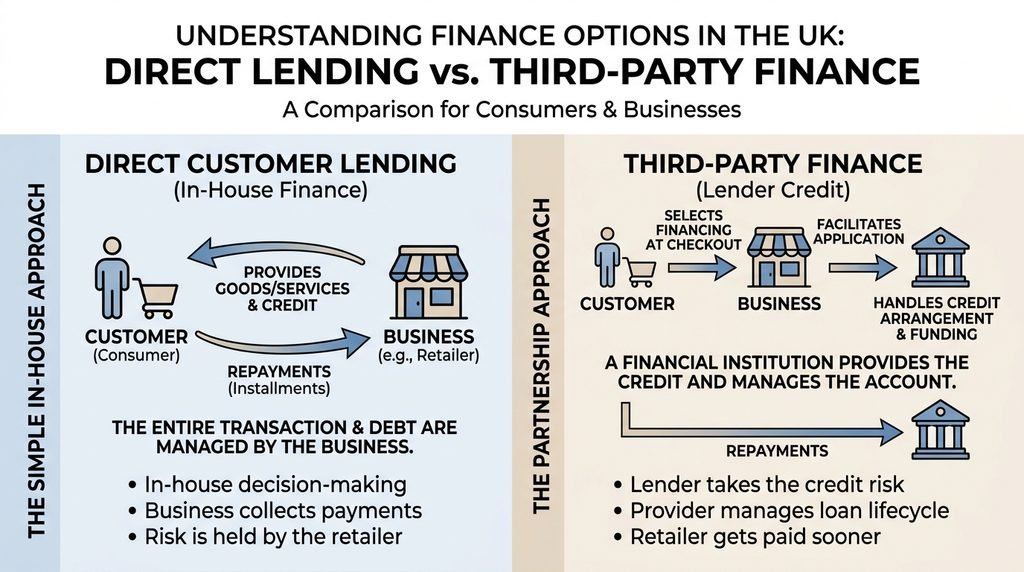
What Does Offering Finance to Customers Mean?
“Offering finance” can describe several different arrangements.
For example, a customer could purchase a £2,000 product and pay for it over 12 months. The finance might be provided by:
- your business;
- a bank;
- a specialist finance company;
- another credit provider; or
- a third-party finance platform.
Your business may also introduce the customer to a lender without providing the money itself.
That distinction is important because the regulatory requirements can be different.
Example of Customer Finance
Imagine a furniture company selling a £2,000 sofa.
The company could:
Option 1 — Lend directly:
The furniture company allows the customer to pay the £2,000 in monthly instalments.
Option 2 — Use a finance company:
The customer applies for finance from a separate lender, which provides the credit.
Option 3 — Act as a credit broker:
The furniture company introduces the customer to a lender and helps arrange the finance.
Although all three may be described as “offering finance”, they can have different regulatory implications.
Do You Need FCA Authorisation to Offer Finance?
In many cases, yes.
GOV.UK states that businesses must check whether their proposed activities require FCA authorisation to carry out regulated consumer credit activities. These activities can include lending money, selling goods or services on credit and arranging credit for others.
The FCA also has separate authorisation routes for consumer credit lenders and credit brokers.
This means you should establish your regulatory position before advertising or launching a customer-finance arrangement.
When You Are Lending Directly
If your business provides credit directly to customers, you may be operating as a consumer credit lender.
For example, a retailer could allow a customer to buy a £3,000 kitchen and repay the retailer over several months.
The FCA specifically includes suppliers that provide finance directly so consumers can pay for goods or services by instalments among the types of firms that may require consumer credit authorisation.
The exact permission required depends on the structure of the arrangement.
When You Are a Credit Broker
Credit broking is different from lending.
A business may be acting as a credit broker when it helps customers find credit or introduces them to a lender.
For example:
- A customer chooses a £3,000 product.
- The business introduces the customer to a finance provider.
- The finance provider assesses the application.
- The lender provides the credit.
- The customer repays the lender.
In this situation, the business may be carrying out regulated credit broking.
The FCA states that firms engaging in regulated consumer credit broking activities need the appropriate authorisation, subject to applicable exclusions and exemptions.
7 Essential Rules for Offering Finance to Customers in the UK
1. Check Whether Your Finance Activity Is Regulated
Never assume that finance is unregulated simply because it is offered alongside your main business.
Before launching a finance option, establish exactly what your business will do.
Ask:
- Who provides the money?
- Who signs the credit agreement?
- Who receives the repayments?
- Does the customer pay interest?
- Are there additional fees?
- Are you introducing customers to another lender?
- Are you providing the finance yourself?
- What happens if the customer misses a payment?
- Is the arrangement covered by a specific exemption or exclusion?
These questions can help you identify whether further FCA investigation or professional advice is needed.
GOV.UK lists several consumer credit activities that may require authorisation, including lending, selling goods or services on credit and arranging credit for other people.
2. Understand Whether You Are a Lender or Credit Broker
One of the most important steps when offering finance to customers is understanding your role.
A lender
A lender provides credit directly to the customer.
A credit broker
A credit broker helps introduce or arrange credit with another lender.
The FCA has separate guidance for consumer credit lenders and credit brokers because the regulatory requirements can differ.
Do not describe your business simply as “offering finance” without first establishing what regulated activity you are actually carrying out.

3. Check Whether You Need Limited or Full Permission
Some businesses may qualify for Limited Permission, while others need Full Permission.
The FCA explains that Limited Permission is available only for certain credit-related activities and specific circumstances. Other firms fall into Full Permission.
For example, certain businesses that introduce customers to finance providers in connection with selling their own goods or supplying their own services may qualify for Limited Permission if the relevant conditions are met.
However, not every business qualifies.
The FCA identifies circumstances where a business may instead need Full Permission, including certain forms of credit broking and lending.
Do not guess which permission applies to your business.
Check the current FCA guidance before launching your finance service.
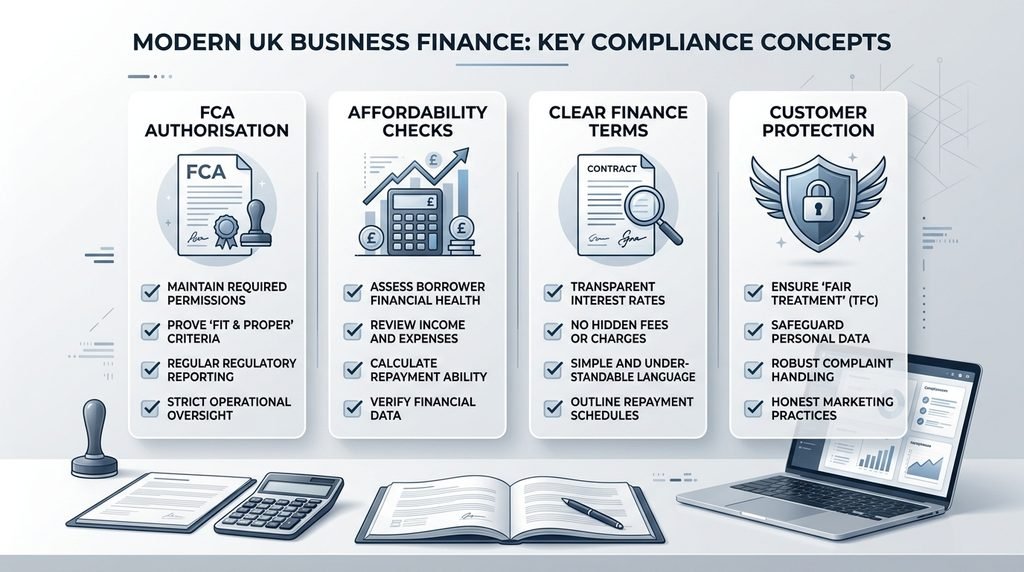
4. Consider Affordability and Customer Outcomes
Customer finance should not be treated simply as a sales technique.
Businesses involved in regulated consumer credit need to consider customer outcomes and their regulatory responsibilities.
The FCA expects authorised firms to put customers at the heart of what they do. For lenders, relevant considerations can include credit risk, affordability, arrears and forbearance policies.
For example, a business should avoid designing a finance offer that looks attractive because of a low monthly payment while making the overall cost difficult for customers to understand.
A responsible approach should consider:
- whether customers can understand the product;
- whether the finance is appropriate for the intended customer;
- affordability where applicable;
- what happens when customers fall behind;
- how complaints are handled; and
- how customers experiencing financial difficulty are supported.
5. Make Finance Costs and Terms Clear
Customers should understand what they are agreeing to before taking finance.
Depending on the arrangement, important information can include:
- amount borrowed;
- repayment period;
- interest rate;
- fees and charges;
- total amount payable;
- payment frequency;
- missed-payment consequences;
- cancellation or withdrawal rights where applicable; and
- other important contractual terms.
Avoid focusing only on the monthly payment.
For example:
“Only £100 per month!”
may sound attractive, but it does not tell the customer how long they will make payments or how much they will pay overall.
A clearer presentation explains the monthly payment, duration and total cost where applicable.
6. Check Your Financial Promotions
Your finance marketing needs careful attention.
A finance promotion could appear on:
- your website;
- product pages;
- checkout pages;
- advertisements;
- social media;
- email campaigns;
- brochures; or
- in-store materials.
Avoid unsupported claims such as:
- “Guaranteed approval”
- “Finance for everyone”
- “Everyone gets accepted”
- “No-risk finance”
- “Cheapest finance in the UK”
Finance promotions should give customers a fair and accurate understanding of the offer rather than focusing only on an attractive monthly payment.
If your business is acting as a credit broker, the FCA also expects firms to make clear to consumers that they are dealing with a broker rather than the lender.
7. Keep Your Compliance Arrangements Up to Date
Getting authorisation is not necessarily the end of your compliance responsibilities.
Authorised consumer credit firms can have ongoing obligations relating to areas such as regulatory reporting, fees, regulatory changes and customer treatment.
Businesses should consider appropriate processes for:
- compliance monitoring;
- customer complaints;
- financial promotions;
- record keeping;
- customer support;
- affordability;
- credit risk;
- arrears;
- forbearance;
- financial crime controls; and
- regulatory reporting where applicable.
The exact requirements depend on your permissions and business model.
Can a Small Business Offer Finance to Customers?
Yes, a small business can potentially offer customer finance, but being a small business does not automatically remove consumer credit requirements.
A retailer, tradesperson, dealership or service provider could become involved in regulated credit activity depending on how its finance arrangement works.
For example, a small business could:
Direct finance
The business provides credit to customers itself.
Third-party finance
The customer obtains finance from another lender.
Credit broking
The business introduces customers to a finance provider.
Finance at checkout
A third-party provider offers finance as part of the business’s online or in-store checkout.
The regulatory treatment can differ between these models.
Should You Use a Third-Party Finance Provider?
For many businesses, working with an established finance provider may be simpler than building a lending operation themselves.
A third-party provider may handle areas such as:
- credit assessment;
- customer applications;
- lending;
- credit agreements;
- repayment administration; and
- other parts of the finance process.
However, using a third-party provider does not automatically remove every responsibility from your business.
If your business introduces customers to a lender, you may still need to consider whether you are carrying out regulated credit broking.
The FCA specifically provides authorisation guidance for businesses involved in helping customers find or arrange credit.
Before signing an agreement with a finance provider, establish:
- Who is the actual lender?
- Who makes the credit decision?
- What FCA permissions does each party hold?
- What role does your business have?
- How are customers introduced?
- What information is given to customers?
- Who handles complaints?
- Who approves finance promotions?
- What happens if a customer has payment difficulties?
What About Buy Now Pay Later in the UK?
Buy Now Pay Later (BNPL) requires particular attention in 2026.
The FCA began regulating Deferred Payment Credit (DPC) on 15 July 2026. DPC is an interest-free form of credit that is repayable in 12 or fewer instalments over 12 months or less.
However, businesses should not assume that every interest-free payment arrangement is treated in exactly the same way.
The FCA states that DPC is regulated where the lender and supplier of the goods or services are different businesses. A DPC arrangement provided by the same business that supplies the goods or services is not regulated in the same way under these rules.
This distinction is particularly important for retailers and service providers.
What changed on 15 July 2026?
Before 15 July 2026, DPC arrangements were not regulated by the FCA in the same way.
From 15 July 2026, lenders providing regulated DPC became subject to FCA regulation or the applicable temporary permissions regime.
So, if your business is considering BNPL, do not rely on the assumption that:
“It is interest-free, so it is unregulated.”
Check the exact structure of the arrangement.
Common Mistakes Businesses Make When Offering Finance
Assuming interest-free means unregulated
Interest-free does not automatically mean that a finance arrangement can be ignored from a regulatory perspective.
DPC is a good example of why businesses need to examine the precise structure of a finance product.
Launching finance before checking FCA requirements
Do not advertise or launch a finance arrangement and investigate regulation afterwards.
Establish your regulatory position first.
Focusing only on the monthly payment
A low monthly payment may attract customers, but customers also need to understand the duration and overall cost where applicable.
Assuming the lender handles everything
A third-party lender may handle the lending process, but your business can still have responsibilities depending on its role.
Using aggressive finance advertising
Avoid misleading or unsupported claims about approval, affordability or cost.
Forgetting that regulations change
Consumer finance rules can change over time.
The introduction of FCA regulation for DPC on 15 July 2026 demonstrates why businesses should periodically review their finance arrangements.
How to Start Offering Finance to Customers Safely
If you are planning to introduce customer finance, use the following process.
Step 1: Define Your Finance Model
Decide exactly what you want customers to do.
Will they:
- pay in instalments?
- use retail finance?
- apply for a personal loan?
- use BNPL?
- apply through a third-party lender?
Step 2: Identify Your Role
Determine whether your business is:
- lending directly;
- acting as a credit broker;
- selling goods while another provider supplies the finance; or
- providing another type of payment arrangement.
Step 3: Check FCA Requirements
Review current FCA and GOV.UK guidance to determine whether the activity is regulated and what permission may be required.
Step 4: Choose the Right Finance Provider
If you decide to work with a third-party provider, check:
- its regulatory status;
- its role;
- the finance products it offers;
- customer support arrangements;
- complaints procedures;
- promotional requirements; and
- how customer applications are handled.
Step 5: Prepare Your Compliance Processes
Depending on your business model, you may need processes covering:
- customer treatment;
- affordability;
- complaints;
- financial promotions;
- credit risk;
- arrears;
- forbearance;
- financial crime; and
- record management.
Step 6: Review Your Customer Communications
Make sure customers can clearly understand the important terms, costs and repayment requirements before entering into the finance arrangement.
Step 7: Keep Monitoring the Rules
Do not treat compliance as a one-time task.
Review your finance arrangements periodically and check for regulatory changes.
Frequently Asked Questions
Can any UK business offer finance to customers?
Not automatically. A business may need FCA authorisation if it carries out regulated consumer credit activities. The exact requirement depends on the finance arrangement, the business’s role and any applicable exemptions or exclusions.
Do I need FCA authorisation if I introduce customers to a lender?
You may. Introducing customers to lenders can constitute regulated credit broking. The FCA has specific requirements for consumer credit brokers, although certain exclusions and permissions can apply.
Can I offer instalment payments for my own products?
It depends on the structure.
A supplier providing finance directly to customers can potentially fall within consumer credit regulation. The FCA identifies suppliers that provide finance directly so consumers can pay for goods or services by instalments among businesses that may require authorisation.
Is Buy Now Pay Later regulated in the UK?
Some BNPL arrangements are regulated differently depending on their structure.
The FCA began regulating Deferred Payment Credit on 15 July 2026. DPC is generally an interest-free form of credit repayable in 12 or fewer instalments over 12 months or less, subject to the relevant legal definition.
What is the difference between Limited Permission and Full Permission?
Limited Permission applies only to certain regulated activities and circumstances. Other firms need Full Permission. The FCA provides specific criteria for determining which category applies.
How can I check whether a finance company is authorised?
You can use the FCA’s Financial Services Register and Firm Checker to check a firm’s regulatory status and permissions.
What should I do if I am unsure whether my business needs FCA authorisation?
Start with the latest FCA and GOV.UK guidance and identify the exact activity your business intends to carry out.
If the position remains unclear, consider obtaining independent legal or regulatory advice before launching the finance arrangement.
Conclusion
Offering finance to customers in the UK can help businesses make higher-value products and services more accessible, but the finance model needs to be structured carefully.
The most important step is understanding what type of finance you are offering and what role your business plays.
Direct lending, credit broking and working with a third-party finance provider can create different regulatory considerations.
Before launching customer finance, check:
- whether FCA authorisation is required;
- whether you are a lender or credit broker;
- whether Limited or Full Permission may apply;
- how customers will be assessed and supported;
- how finance costs will be presented;
- whether your promotions comply with applicable rules; and
- whether your BNPL or DPC arrangement falls within the current regulatory framework.
Because UK financial regulation can change, always check the latest FCA and GOV.UK guidance before implementing or changing a customer-finance product.
For complex arrangements, professional legal or regulatory advice can help you determine the requirements for your specific business model.