
Faster Payments: What Are They?
Faster Payments are one of the most convenient ways to send money between UK bank accounts. They allow individuals and businesses to transfer money electronically without waiting several working days for a traditional bank payment to clear.
The Faster Payment System is operated by Pay.UK and has been available since 2008. It supports payments around the clock, including weekends and bank holidays. In 2025 alone, the system processed 5.55 billion transactions worth approximately £4.84 trillion.
For most people, the process feels simple: enter the recipient’s details, confirm the payment through your banking app or online banking, and the money can arrive very quickly.
But there is more happening behind the scenes.
Banks and payment providers connect to the Faster Payment System, while the Bank of England provides the settlement infrastructure that allows participating financial institutions to settle their obligations.
Key Takeaway
Faster Payments are designed for quick UK account-to-account transfers, but the exact delivery time and transaction limit can depend on the banks involved.
How Do Faster Payments Work?
Understanding Faster Payments is easier if you think of the process as a chain.
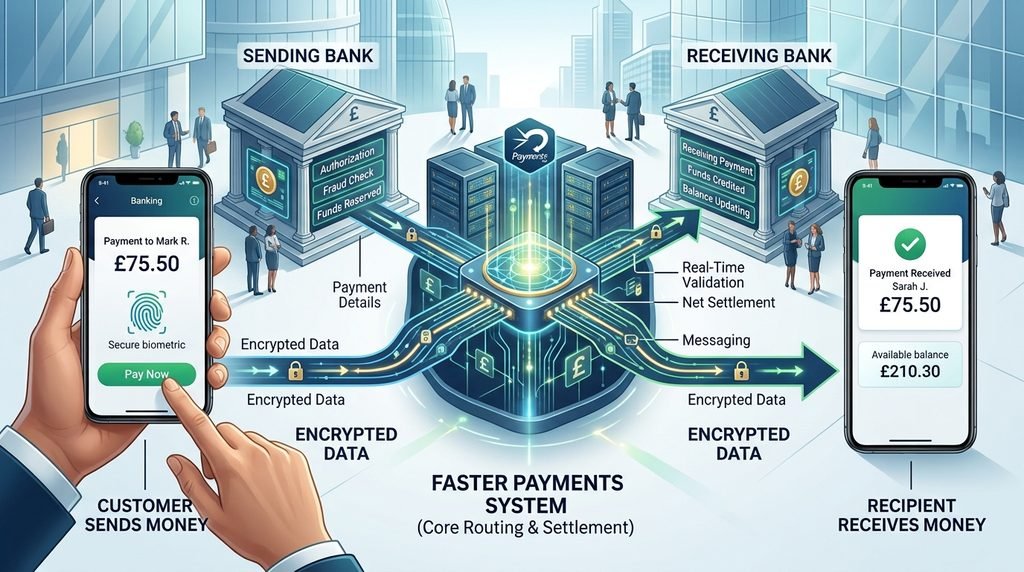
Imagine you are sending £500 to a friend. You open your banking app, enter their account number and sort code, add the amount, and approve the transaction.
Your bank then processes the instruction and sends the payment through the Faster Payment System.
The receiving bank receives the payment instruction and credits the recipient’s account.
When both financial institutions are direct participants, funds are usually available almost immediately. However, Pay.UK notes that payments can sometimes take up to two hours, and some transfers may take longer depending on the banks involved and when the payment is made.
The simplified process looks like this:
- You instruct your bank to make a payment.
- Your bank checks and authorises the transaction.
- The payment is routed through the Faster Payment System.
- The receiving bank receives the payment information.
- The recipient’s account is credited.
- Settlement takes place between the participating financial institutions.
It sounds straightforward because, from a customer’s perspective, it should be.
The complicated technology and settlement arrangements remain largely invisible.
Are Faster Payments Really Instant?
This is where the word “instant” can sometimes create unrealistic expectations.
Faster Payments are designed for near-real-time transfers, but near-instant does not always mean literally instantaneous.
A transfer may take longer because of:
- Bank security checks
- Fraud screening
- Technical issues
- The sending or receiving bank’s systems
- Whether the bank is a direct participant
- Additional verification requirements
- The time at which the transaction is initiated
So if a payment does not appear within seconds, it does not automatically mean something has gone wrong.
Key Takeaway
Use Faster Payments when speed matters, but allow some time for security checks or technical delays rather than assuming every transfer will arrive instantly.
7 Powerful Benefits of Faster Payments
Why have Faster Payments become such an important part of everyday banking?
The answer is convenience. But speed is only part of the story.
1. Payments Are Available 24/7
One of the biggest advantages is availability.
The Faster Payment System operates day and night, 365 days a year. That means customers can make eligible payments outside traditional banking hours.
For example, if you need to send money to a family member on a Sunday evening, you generally do not need to wait until Monday morning simply because branches are closed.
2. They Are Useful for Everyday Transfers
Faster Payments are particularly practical for everyday bank transfers.
People commonly use them to:
- Pay friends and family
- Transfer money between accounts
- Pay businesses
- Make online purchases
- Pay bills
- Send deposits
- Make urgent payments
The Bank of England describes the Faster Payment System as a key system used for account-to-account payments by households and businesses.
3. Businesses Can Receive Money Quickly
For businesses, faster access to incoming payments can make cash flow easier to manage.
Consider a small service company that asks a customer for a deposit before starting work. With a suitable bank transfer, the business may be able to confirm the payment much sooner than it could through a slower payment method.
That can reduce unnecessary waiting and improve the customer’s experience.
4. They Support Digital Banking
Faster Payments fit naturally into modern banking.
Customers can initiate eligible transfers through:
- Mobile banking
- Online banking
- Telephone banking
- Other supported payment services
This means customers do not necessarily need to visit a branch to make a payment.
5. They Can Handle Large Payments
The Faster Payment System itself supports individual payments of up to £1 million.
However, that does not mean your bank will allow you to send £1 million.
Banks and building societies can establish their own transaction limits based on factors such as the account type and payment method. Some providers also impose daily limits.
This distinction is important.
System limit ≠ your personal bank limit.
6. They Work for Individuals and Businesses
Faster Payments are not restricted to personal banking.
Businesses, charities, and other organisations can also use the system through participating financial institutions. Pay.UK says the system supports millions of individuals, businesses and charities across the UK.
7. They Reduce Waiting for Routine Transfers
Traditional payment methods can involve longer processing periods.
Faster Payments remove much of that waiting for eligible transfers, which is especially useful when timing matters.
Key Takeaway
The biggest practical benefit is flexibility: Faster Payments combine speed, 24/7 availability and broad everyday use.
Faster Payments vs Bacs vs CHAPS
Not every UK bank transfer uses the same payment system.
This is one area where people often get confused.
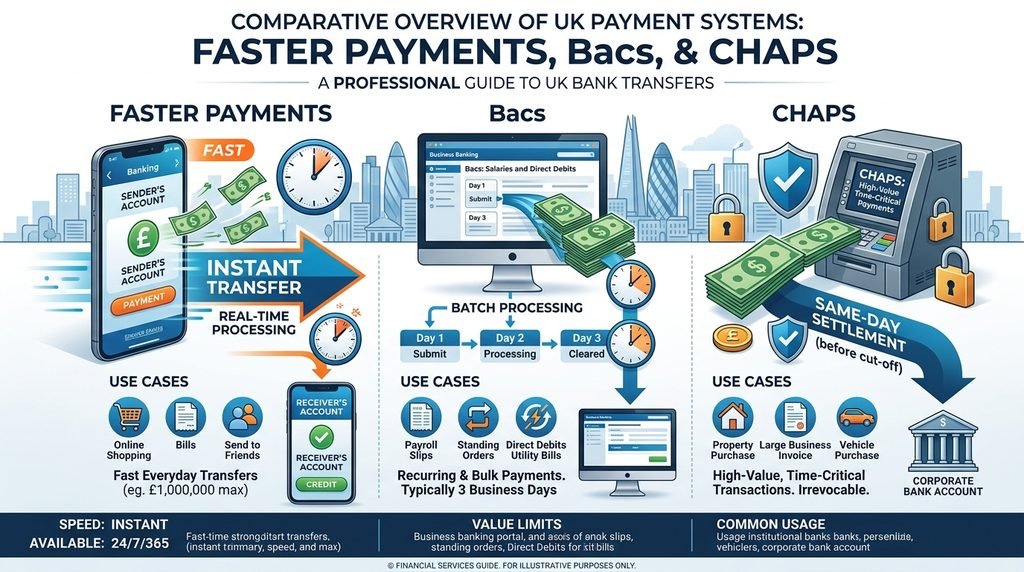
Faster Payments
Faster Payments are generally suitable when you want to send an eligible UK bank transfer quickly.
They operate 24/7 and support near-real-time payments.
Bacs
Bacs is commonly associated with recurring or scheduled payments.
It is widely used for:
- Salaries
- Direct Debits
- Other bulk payments
The Bank of England identifies Bacs as a system used for Direct Debits and Direct Credits, including salary and benefit payments.
CHAPS
CHAPS is different again.
It is the UK’s high-value payment system and is particularly relevant for time-critical, high-value sterling payments. The Bank of England operates CHAPS.
Here’s a simple comparison:
| Feature | Faster Payments | Bacs | CHAPS |
|---|---|---|---|
| Typical use | Everyday bank transfers | Salaries, Direct Debits | High-value/time-critical payments |
| Speed | Usually near real time | Typically slower | Same-day system |
| Availability | 24/7 | Working-day cycle | Banking-system timetable |
| Maximum system payment | Up to £1m | Different arrangements | Designed for high-value payments |
| Operator | Pay.UK | Pay.UK | Bank of England |
The right option depends on what you are trying to accomplish.
For an ordinary transfer to another UK bank account, Faster Payments will often be the most convenient choice. For a salary payment, Bacs may be more appropriate. For certain high-value transactions, CHAPS may be preferable.
Key Takeaway
Do not choose a payment method based on speed alone. Consider the payment’s purpose, value, timing and your bank’s available options.
Are Faster Payments Safe?
Speed is useful, but security matters even more.
Faster Payments are part of the UK’s regulated payment infrastructure, and the system is supervised as a recognised payment system. The Bank of England lists the Faster Payments Service among the UK payment systems it supervises.
However, no payment method can eliminate every risk.
The biggest concern for ordinary customers is often not the payment network itself but sending money to the wrong person or being tricked into authorising a fraudulent payment.
For example, someone may impersonate:
- Your bank
- A supplier
- A family member
- A property company
- A professional adviser
- A government organisation
The payment may be processed correctly because you authorised it. The problem is that the recipient was not who you believed they were.
Practical Safety Rules
Before sending a significant Faster Payment:
- Check the recipient’s details carefully.
- Do not rely solely on an email containing bank details.
- Confirm unexpected payment requests independently.
- Be suspicious of urgent demands for money.
- Never share your banking password or security codes.
- Contact your bank immediately if you believe you made a fraudulent payment.
For large business payments, consider having a second person verify the recipient details before authorisation.
This simple process can prevent expensive mistakes.
Key Takeaway
The fastest payment is not necessarily the safest payment. Take a few seconds to verify who you are paying before pressing the final confirmation button.
Faster Payments Limits: What You Need to Know
A common misconception is that every Faster Payment has a universal £1 million customer limit.
That is not how it works.
Pay.UK states that the Faster Payment System can support individual payments of up to £1 million, but individual banks and payment providers can impose lower limits.
Your bank might therefore have a much lower limit for:
- Mobile banking
- Online banking
- New payees
- Personal accounts
- Business accounts
- Telephone banking
Some providers may also impose daily limits.
Why Do Banks Set Their Own Limits?
Transaction limits can help financial institutions manage risk.
A bank may consider:
- Fraud exposure
- Account history
- Customer type
- Payment channel
- Security controls
- Regulatory requirements
For example, a bank could allow a higher transfer limit through a business banking platform than through a personal mobile banking app.
What If Your Payment Is Above the Limit?
If your bank will not allow the amount you need to send through Faster Payments, contact the bank and ask what alternatives are available.
Depending on the circumstances, another payment method may be more appropriate.
Do not split a large payment into numerous smaller transfers simply to bypass a bank’s security or transaction controls without first understanding why the limit exists.
Key Takeaway
Always check your own bank’s current Faster Payments limit. The system’s £1 million maximum does not guarantee that your account has access to that amount.
Why Can Faster Payments Be Delayed?
Most Faster Payments are quick, but delays can happen.
A useful first step is to avoid assuming the worst.
Bank Security Checks
Banks use fraud and security monitoring to identify unusual activity.
A transfer that looks different from your normal behaviour may receive additional checks.
Technical Problems
Banking applications and payment infrastructure occasionally experience technical problems.
If a bank is experiencing an outage, a payment may not appear as quickly as expected.
Incorrect Recipient Details
Entering incorrect information can cause problems.
Always check:
- Account name
- Account number
- Sort code
- Payment reference
- Amount
A typo in payment information can turn a straightforward transfer into a stressful situation.
Receiving Bank Processing
Even though Faster Payments are designed for rapid transfers, Pay.UK explains that payments can sometimes take up to two hours and may take longer in some circumstances.
If the recipient has not received the money after a reasonable period, check the transaction status with your bank.
What Should You Do If a Payment Is Missing?
Follow this order:
- Check your banking app for the payment status.
- Confirm the recipient details.
- Ask the recipient to check their account again.
- Check whether your bank has reported an outage.
- Contact your bank if the issue remains unresolved.
Avoid sending the same payment again immediately. You could accidentally create a duplicate payment.
Key Takeaway
A delayed Faster Payment does not necessarily mean the money is lost. Check the transaction status and recipient details before taking further action.
Faster Payments for Businesses
For businesses, Faster Payments can be more than a convenient transfer option.
They can support smoother day-to-day cash management.
A company may use Faster Payments to receive customer payments, pay suppliers, move funds between business accounts or handle urgent expenses.
Benefits for Small Businesses
Small businesses often operate with tighter cash-flow margins than larger organisations.
Getting paid quickly can help with:
- Supplier payments
- Staff expenses
- Stock purchases
- Emergency costs
- Customer refunds
- Short-term cash management
But speed should not replace good financial controls.
Create a Payment Verification Process
If several employees can make payments, establish a simple approval procedure.
For example:
Step 1: Employee prepares the payment.
Step 2: Another authorised person checks the recipient details.
Step 3: The payment is approved.
Step 4: The transaction is recorded.
This may seem excessive for a small transfer. It becomes much more valuable when the amount involved is substantial.
Keep Payment Records
Businesses should maintain clear records of outgoing and incoming payments.
Record:
- Date
- Amount
- Recipient
- Purpose
- Reference
- Person who approved the payment
Good records make reconciliation easier and can help when investigating an unexpected transaction.
Key Takeaway
For businesses, Faster Payments work best when combined with strong payment controls rather than used as a substitute for them.
The Future of Faster Payments
The UK’s payment infrastructure is continuing to evolve.
The Bank of England and other authorities are working on the next generation of retail payments infrastructure, with a focus on resilience, innovation and greater choice for consumers and businesses.
That does not mean Faster Payments are disappearing overnight.
Pay.UK continues to operate the existing Faster Payment System, while work is underway to develop future infrastructure.
The direction is clear: digital payments are becoming increasingly available, connected and immediate.
For consumers, this could eventually mean smoother account-to-account payments and new ways to pay businesses.
For businesses, better payment infrastructure could improve reconciliation, cash management and customer experiences.
That said, the technology behind payments may change faster than the habits of the people using them. Security, reliability and trust will remain just as important as speed.
Key Takeaway
Faster Payments are already a major part of UK banking, but the wider payments ecosystem is continuing to modernise.
A Simple Checklist Before Sending a Faster Payment
Before approving an important transfer, take 30 seconds to check everything.
- Confirm the recipient’s name.
- Check the account number.
- Check the sort code.
- Verify the amount.
- Confirm the payment reference.
- Make sure the request is genuine.
- Check your bank’s transaction limit.
- Keep a record of the payment.
- Never share security credentials.
- Contact your bank immediately if something looks suspicious.
This small habit can save considerable time and money.
Frequently Asked Questions About Faster Payments
What are Faster Payments?
Faster Payments are electronic UK bank transfers designed to move money between participating bank accounts quickly. The system operates 24 hours a day, 365 days a year, and is commonly used for everyday personal and business payments. Payments are generally near real time, although some transactions can take longer.
How long do Faster Payments take?
Faster Payments are usually completed very quickly, often within seconds or minutes. However, Pay.UK states that payments can sometimes take up to two hours, while certain circumstances may result in longer processing times. Bank security checks and the institutions involved can affect the timing.
Are Faster Payments available on weekends?
Yes. The Faster Payment System operates day and night, 365 days a year. This means eligible payments can generally be initiated and processed outside normal branch opening hours, including weekends and bank holidays. However, individual banks may apply their own processing or security procedures.
What is the maximum Faster Payments limit?
The Faster Payment System supports individual payments of up to £1 million. However, your bank or payment provider can impose a lower limit. Personal and business limits may also differ, so customers should check their bank’s current terms before attempting a large transfer.
Are Faster Payments safe?
Faster Payments are part of the UK’s recognised payment infrastructure, but customers still need to protect themselves against fraud. Always verify the recipient’s details, be cautious about unexpected payment requests, and contact your bank immediately if you believe you have sent money to a fraudster.
What is the difference between Faster Payments and Bacs?
Faster Payments are generally designed for quick account-to-account transfers, while Bacs is widely used for Direct Debits and Direct Credits such as salaries. Faster Payments operate 24/7, whereas Bacs payments follow a different processing cycle. The best option depends on the purpose and timing of the payment.