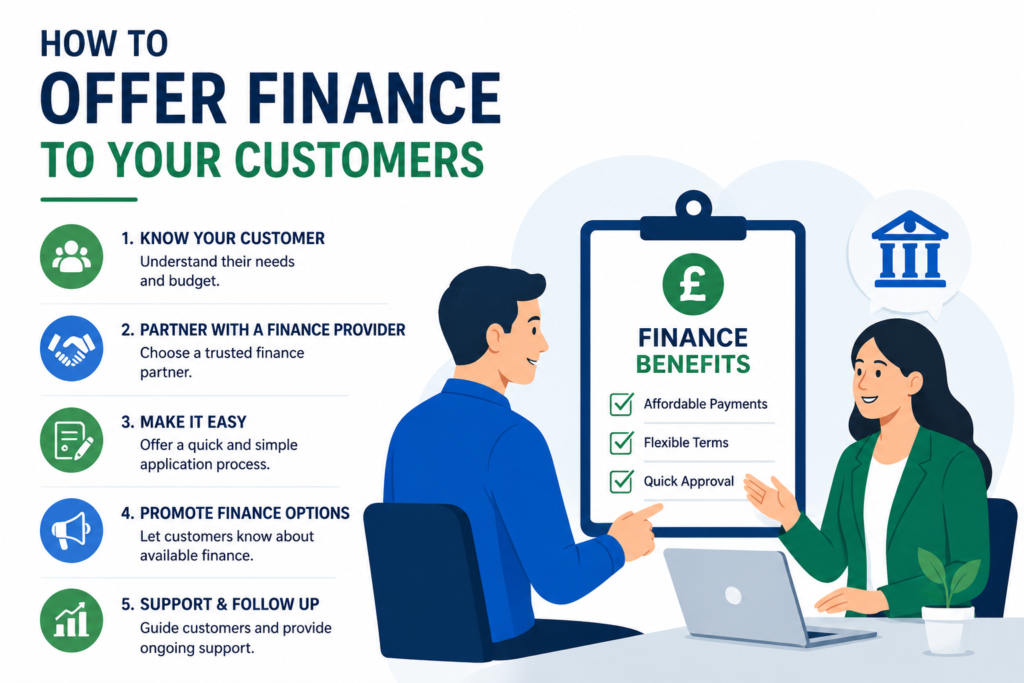
If you’ve ever lost a sale because a customer said the price simply wasn’t manageable right now, learning how to offer finance to your customers could be the single change that turns that “no” into a “yes.” It’s one of the most effective ways small businesses increase order values without discounting anything at all.
Here’s the thing: offering finance doesn’t mean taking on the risk of unpaid instalments yourself. Most businesses partner with a third-party finance provider who handles the credit checks, repayments, and risk, while you simply get paid upfront in full.
It’s a strategy that’s grown enormously in retail, home improvements, healthcare, and even professional services, precisely because customers have come to expect flexible payment options as standard practice. Businesses that haven’t yet worked out how to offer finance to their customers are often quietly losing sales to competitors who have already figured it out.
This guide walks through exactly how to offer finance to your customers step by step, the main providers worth considering, and the mistakes that can quietly undermine the whole approach.
Why Learning How to Offer Finance to Your Customers Pays Off
Customers increasingly expect flexible payment options, particularly for larger purchases. Businesses that don’t offer any form of finance can lose sales to competitors who do, simply because the monthly figure feels more manageable than one large upfront payment.
Beyond winning hesitant customers, offering finance can also increase average order values, since customers financing a purchase are often more willing to add extras once the cost is already spread over several months. A customer financing a sofa, for example, might be far more open to adding a matching armchair once the difference is only a few extra pounds a month rather than a large one-off sum added to the total bill.
Takeaway: Understanding how to offer finance to your customers properly can directly improve both conversion rates and order values.

Step #1: Choose the Right Provider — How to Offer Finance to Your Customers
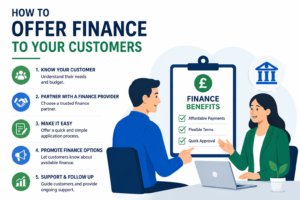
The first step in learning how to offer finance to your customers is selecting a provider that suits your business type and average transaction size. Providers like Klarna, PayPal Credit, Divido, and V12 Retail Finance all cater to different business sizes and industries.
Compare their fees, integration options, and how quickly customers are approved, since a clunky application process can lose a sale just as easily as not offering finance at all. It’s also worth checking whether a provider specialises in your particular sector, since some are better suited to retail, while others focus more on services like dentistry, veterinary care, or home improvements.
Takeaway: The right provider match matters as much as the decision to offer finance in the first place.
Step #2: Understand the Fees — How to Offer Finance to Your Customers Cost-Effectively
Most finance providers charge businesses a percentage of the transaction value, deducted before you receive payment. This fee varies depending on the provider, the finance term offered to customers, and your industry.
It’s worth comparing these fees against the expected uplift in sales, since even a modest percentage fee is often outweighed by the additional revenue generated from customers who wouldn’t have purchased otherwise. Many businesses find that once they properly track the numbers over a full quarter or year, the fee pays for itself many times over through additional sales volume alone.
Takeaway: A finance provider’s fee should be judged against the incremental sales it generates, not viewed in isolation.
Step #3: How to Offer Finance to Your Customers at Checkout
Once you’ve chosen how to offer finance to your customers, integrating the option clearly into your checkout or in-store process is essential. Many providers offer plugins for popular e-commerce platforms, along with point-of-sale integrations for physical stores.
Displaying the monthly cost prominently, rather than just the total price, often significantly increases the likelihood customers will choose the finance option. A customer who sees “£25 a month” rather than “£600 total” is often far more likely to proceed with a purchase they were previously hesitant about committing to.
Takeaway: Make the finance option visible and easy to understand at the exact point customers are deciding whether to buy.
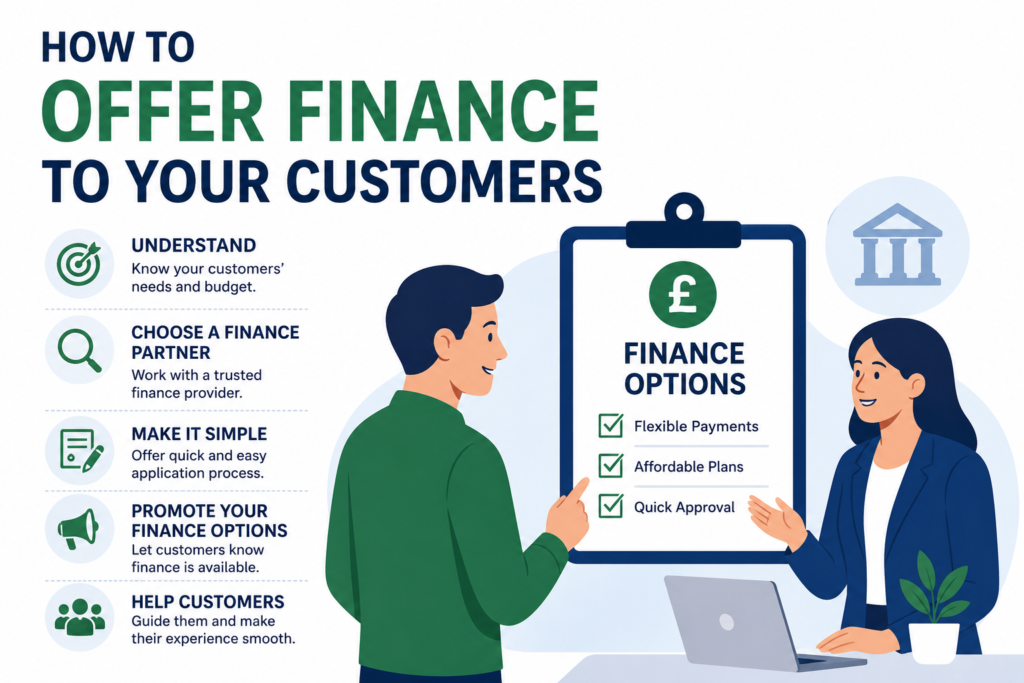
Step #4: Train Staff on How to Offer Finance to Your Customers
Staff who understand how to offer finance to your customers clearly and confidently can significantly increase uptake. Customers often need a brief, simple explanation of how the process works before they feel comfortable choosing it.
A short script or set of talking points — covering approval speed, monthly costs, and eligibility — helps staff introduce the option naturally during a sales conversation, rather than as an afterthought. Role-playing common customer questions during training can also help staff feel more confident bringing up finance without sounding overly salesy or pushy about it.
Takeaway: Well-trained staff turn a finance option from a hidden feature into an active sales tool.
Step #5: Track the Results of How to Offer Finance to Your Customers
Once your finance option is live, keep an eye on approval rates and customer feedback. A provider with unusually low approval rates can quietly cost you sales, even if their fees looked competitive on paper.
Checking in periodically with your provider, and reading customer reviews of the application process, helps you spot problems before they meaningfully affect your sales. It’s also worth tracking how many customers who see the finance option actually go on to use it, since a low take-up rate might signal the option isn’t visible or well-explained enough to your customers.
Takeaway: A finance option is only as good as its real-world approval rate and customer experience.
Step #6: Stay Transparent — How to Offer Finance to Your Customers Honestly
Customers need to clearly understand interest rates, repayment terms, and any penalties for missed payments before committing. Being transparent about these details builds trust and reduces the risk of complaints or disputes further down the line.
Most reputable finance providers handle this disclosure directly, but it’s worth reviewing the customer-facing terms yourself to make sure they’re clear and not buried in small print. A customer who feels misled about repayment terms is far more likely to leave a negative review, which can damage your reputation well beyond the single transaction and affect future sales too.
Takeaway: Transparency protects both your customers and your business’s reputation.
Step #7: How to Offer Finance to Your Customers Through Active Promotion
Simply having a finance option available isn’t enough — actively promoting it, through website banners, in-store signage, or email marketing, significantly increases how many customers actually use it.
Highlighting the monthly cost in your marketing, rather than just the total price, often makes higher-value products feel considerably more accessible to a wider range of customers. Some businesses even build entire promotional campaigns around a finance offer during peak shopping periods, since it can be a genuinely compelling reason for hesitant customers to finally commit to a purchase they’d been putting off.
Takeaway: An unpromoted finance option rarely gets used — visibility drives uptake just as much as availability.
Common Mistakes to Avoid: How to Offer Finance to Your Customers the Right Way
- Choosing a provider based purely on the lowest fee, without checking approval rates
- Failing to train staff to mention or explain the finance option confidently
- Burying the finance option deep in the checkout process where customers don’t notice it
- Not promoting the option actively through marketing channels
- Overlooking customer feedback about the application experience
- Assuming every finance provider suits every industry equally well
Takeaway: Avoiding these common pitfalls makes the difference between a finance option that quietly underperforms and one that genuinely drives sales.
Frequently Asked Questions About How to Offer Finance to Your Customers
1. What does it mean to offer finance to your customers? It means allowing customers to pay for a product or service in instalments, usually through a third-party finance provider, while your business still receives full payment upfront from the provider itself.
2. Is it expensive to offer finance to your customers? Providers typically charge a percentage fee per transaction, similar to card processing fees, though this is often offset by increased sales volume and higher average order values across your business.
3. Do I need to be a large business to offer finance to customers? No, many finance providers work with small and medium businesses, with straightforward online integration that doesn’t require significant technical resources or a dedicated development team to set up.
4. Does offering finance put my business at financial risk? Generally, no. The finance provider takes on the credit risk and repayment responsibility, while your business receives payment in full at the time of sale, regardless of what happens with the customer’s repayments afterward.
5. How quickly can I start offering finance to customers? Many providers can have your business set up within a few days, particularly for straightforward retail or service-based businesses with standard transaction types and minimal custom integration needs.
6. Which industries benefit most from offering customer finance? Higher-value purchases — furniture, home improvements, dentistry, and electronics, for example — tend to see the biggest boost in conversions when finance options are introduced, since the monthly cost feels far more manageable than the total price.
Final Thoughts
Learning how to offer finance to your customers is one of the more reliable ways to increase both conversions and average order values, particularly for businesses selling higher-value products or services. The process itself is straightforward once you’ve chosen the right provider, integrated it clearly, and trained your team to present it with confidence.
It’s also a strategy that tends to compound over time — as staff become more comfortable presenting the option and customers become more aware it’s available, uptake typically increases further, without any additional cost to your business or marketing budget.
Get these fundamentals right, and offering finance to your customers can quietly become one of your most effective, genuinely low-effort sales tools going forward.