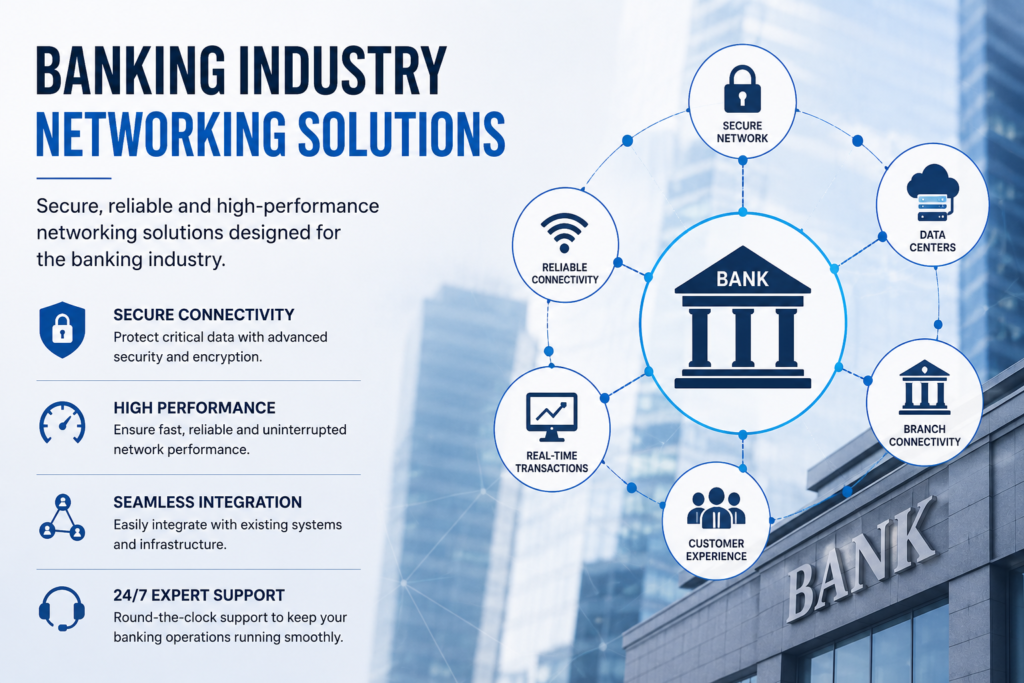
Ask any bank’s IT leader what keeps their network team busy, and the answer rarely comes down to a single project. Banking industry networking solutions have to juggle a genuinely demanding mix of requirements at once: near-zero downtime, strict regulatory compliance, protection against increasingly sophisticated cyberattacks, and seamless connectivity across branches, data centers, and digital banking platforms, all while keeping costs under control.
Here’s the thing worth knowing upfront: this isn’t just a technical decision handed to IT. The network genuinely is the business for a modern bank. Every mobile transaction, every branch interaction, every fraud detection system depends on connectivity that simply cannot fail. Let’s walk through what actually matters when evaluating banking industry networking solutions today.
Why This Function Has Become So Strategic
A decade ago, network infrastructure was largely a background utility, important, but rarely a board-level conversation. That’s changed considerably. With digital banking now handling billions of transactions globally, network reliability directly affects customer trust, regulatory standing, and competitive positioning.
A few forces are driving this shift:
- Rising customer expectations for instant, always-available digital banking experiences
- Increasing regulatory scrutiny, requiring demonstrable data protection and system resilience
- Growing cyberattack sophistication, targeting financial institutions specifically due to the value of the data involved
- Legacy infrastructure costs, with many banks still spending the majority of IT budgets simply maintaining aging systems
Quick takeaway: If your network strategy is still being treated as a purely technical afterthought rather than a strategic priority, that’s often the clearest sign it’s overdue for a serious review.
Core Requirements for Banking Industry Networking Solutions
Not every network solution designed for general enterprise use translates well to banking specifically. A few requirements matter more here than in most other industries.
- Low latency, high capacity connectivity, since delayed transactions or slow-loading digital banking platforms directly damage customer confidence
- Network segmentation, isolating sensitive systems and customer data to limit the impact of any potential breach
- Redundancy and failover capability, ensuring branch and digital services stay operational even if a single connection or data center experiences an issue
- Regulatory-aligned data handling, since financial data protection requirements are typically stricter and more specific than general business compliance standards
Quick takeaway: When evaluating any vendor, ask specifically how their solution handles failover during an outage. A vague answer here is a genuine warning sign for a bank that can’t tolerate downtime.
Security: The Non-Negotiable Priority
Security deserves its own dedicated focus within banking industry networking solutions, since banks remain one of the most consistently targeted sectors for cyberattacks, given the direct financial value of the data involved.
Key security elements worth prioritizing include:
- Zero-trust architecture, where no device or user receives automatic access without ongoing verification
- Wireless intrusion prevention, since wireless networks are frequently the weakest link in an otherwise secure infrastructure
- Continuous monitoring and anomaly detection, flagging unusual traffic patterns before they escalate into genuine incidents
- Micro and macro-segmentation, limiting how far an attacker could move even after gaining initial access
Quick takeaway: Layered security, multiple defensive measures working together, matters more than any single “best” security feature. No single control should be treated as sufficient on its own for financial-grade protection.
Connecting Branches, Data Centers, and Digital Channels
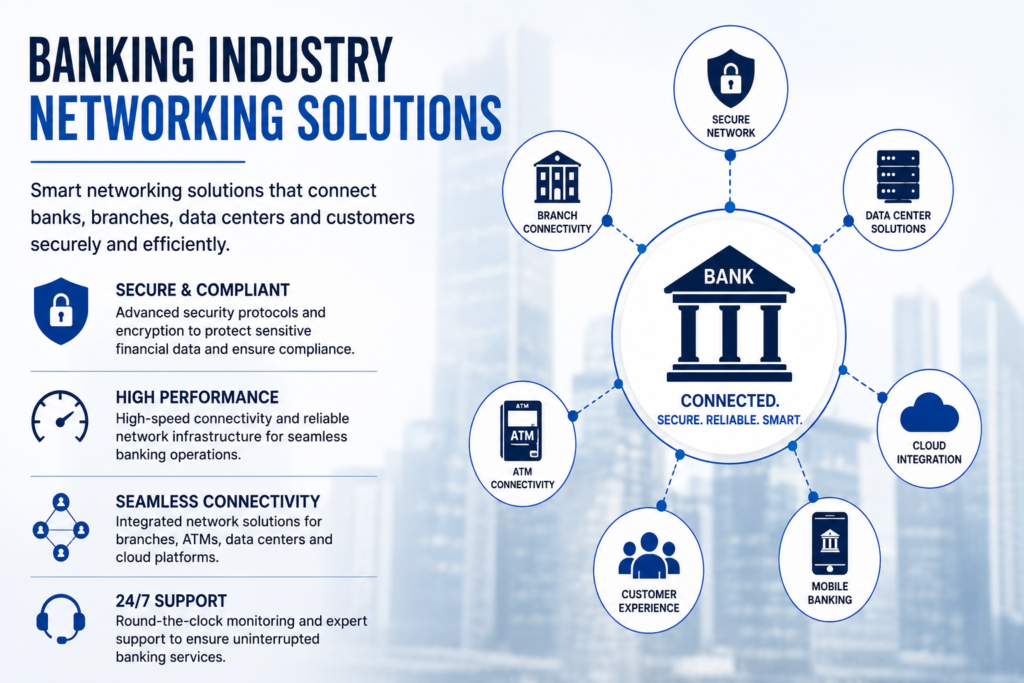
A modern bank rarely operates from a single location, and banking industry networking solutions need to connect physical branches, core data centers, and digital banking platforms into one cohesive, reliable system.
- Branch connectivity, supporting everything from teller transactions to in-branch Wi-Fi for customers and staff
- Data center networking, handling core transaction processing with the resilience and capacity banking workloads demand
- Cloud and hybrid connectivity, as many banks increasingly blend private infrastructure with public cloud services for flexibility
- Digital channel support, ensuring mobile and online banking platforms perform reliably regardless of transaction volume
Quick takeaway: Consistency across all these environments matters more than peak performance in any single one. A fast data center connection means little if branch connectivity or mobile channel performance lags noticeably behind.
Cloud Migration and Hybrid Infrastructure
Many banks are moving away from fully on-premise infrastructure, and this shift directly shapes what modern banking industry networking solutions need to support going forward.
- Scalability on demand, allowing capacity to expand during high transaction periods without major hardware investment
- Faster deployment of updates, since cloud environments typically receive security patches and improvements more frequently than legacy on-premise systems
- Cost predictability, with subscription-based models replacing unpredictable hardware repair and replacement costs
- Reduced maintenance burden, freeing internal IT teams to focus on strategic priorities rather than routine upkeep
Quick takeaway: A hybrid approach, combining cloud flexibility with the control of private infrastructure for the most sensitive core systems, tends to suit most established banks better than an all-or-nothing migration.

How to Evaluate a Networking Solutions Provider
With so many vendors positioning themselves around AI, automation, and security, it helps to have a clear, practical framework for evaluating banking industry networking solutions providers.
- Ask for financial-sector-specific references, not just general enterprise case studies, since banking has genuinely distinct requirements
- Request clear documentation on compliance alignment, confirming the solution supports your specific regulatory obligations
- Evaluate support responsiveness, since network issues in banking require rapid resolution, not standard business-hours ticketing
- Confirm integration capability with your existing core banking systems and third-party fintech partnerships
Quick takeaway: A vendor’s marketing language around AI and automation matters far less than their actual track record supporting financial institutions specifically through real incidents and audits.
Common Mistakes Banks Make With Network Infrastructure
A handful of recurring issues show up across banks evaluating or upgrading their banking industry networking solutions.
- Focusing on cost alone, without weighing the long-term operational impact of choosing an underpowered or poorly supported solution
- Migrating peripheral systems to the cloud while leaving core operations on legacy infrastructure, missing much of the potential benefit
- Underestimating the importance of branch-level connectivity, focusing improvement efforts almost entirely on data centers and digital channels
- Delaying network security upgrades, treating them as optional rather than foundational to the institution’s regulatory standing
Quick takeaway: A phased, incremental modernization approach, proving value at each stage before expanding further, tends to produce more sustainable results than attempting a single large-scale infrastructure overhaul all at once.
5. FAQs
Q1: What are banking industry networking solutions? They’re the network infrastructure and connectivity systems banks use to connect branches, data centers, and digital banking platforms, built around strict requirements for security, reliability, and regulatory compliance.
Q2: Why is network security so critical for banks specifically? Banks hold highly valuable financial data, making them frequent cyberattack targets. Strong network security, including segmentation and continuous monitoring, is essential to protecting both customers and regulatory standing.
Q3: Should banks migrate fully to cloud-based networking? Most established banks benefit from a hybrid approach, combining cloud scalability for flexible workloads with private infrastructure for the most sensitive core banking systems.
Q4: What’s the biggest mistake banks make when upgrading network infrastructure? Focusing primarily on cost, or migrating peripheral systems to the cloud while leaving core operations on legacy infrastructure, are among the most common and costly mistakes.
Q5: How important is branch connectivity compared to digital channels? Both matter significantly. Inconsistent performance between branches and digital channels undermines the overall customer experience, even if one specific area performs exceptionally well.
Q6: What should banks look for when choosing a networking solutions provider? Look for financial-sector-specific experience, clear regulatory compliance alignment, responsive support, and proven integration capability with existing core banking systems.
Final Thoughts
Banking industry networking solutions have evolved from a background IT concern into a genuinely strategic priority, directly shaping customer experience, regulatory standing, and competitive resilience. Any bank evaluating banking industry networking solutions today should weigh low latency, strong security, consistent performance across branches and digital channels, and a realistic, phased approach to modernization ahead of chasing every new feature a vendor markets.
Whether your institution is just starting to modernize or refining an already mature network strategy, the underlying priorities stay consistent: reliability, security, and genuine alignment with how your bank actually operates day to day.
For broader industry context on financial technology infrastructure standards, the Bank for International Settlements’ publications offer authoritative, non-commercial reference material.