

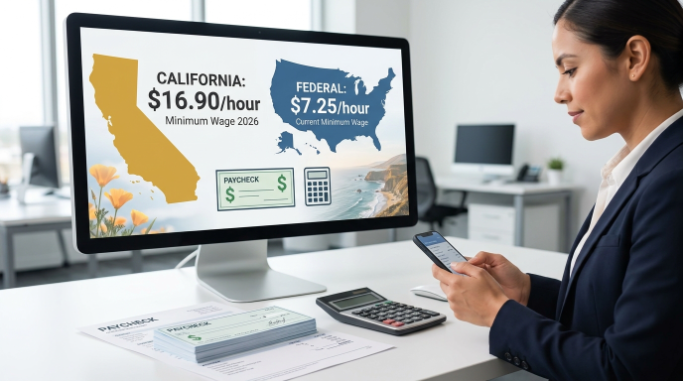
If you’re looking for the minimum wage California employers must pay in 2026, the statewide rate is $16.90 per hour for most employees. However, that’s not always the final amount. Some cities and counties have higher local rates, while certain industries, including covered fast-food and health-care jobs, have separate minimum-wage requirements.
Understanding the correct rate is important for both employees checking their pay and employers managing payroll.
What Is the Minimum Wage California Rate in 2026?
The general minimum wage California rate is $16.90 per hour from January 1, 2026.
The statewide rate generally applies to employers regardless of their number of employees. However, a worker may be entitled to a higher rate if a local minimum-wage ordinance or industry-specific law applies.
| Year | California State Minimum Wage |
|---|---|
| 2023 | $15.50/hour |
| 2024 | $16.00/hour |
| 2025 | $16.50/hour |
| 2026 | $16.90/hour |
| 2027 | $17.40/hour |
California’s statewide minimum wage is adjusted annually using an inflation-based formula, subject to limits established by state law.
For the latest official rate, check the California Department of Industrial Relations minimum wage information.
Will California Minimum Wage Increase in 2027?
Yes. California’s statewide minimum wage will increase to $17.40 per hour on January 1, 2027.
That is a $0.50 increase from the 2026 rate of $16.90.
Employers should update payroll systems and wage notices before the new rate takes effect. Employees should also check their first pay period after January 1 to make sure the applicable rate has been used.
Does Every California Worker Get $16.90 Per Hour?
Not necessarily.
The statewide rate is the baseline for most covered employees, but three important factors can change the applicable minimum wage:
- Where the employee works
- What industry the employee works in
- Whether a specific legal exemption applies
For example, a worker in a California city with a local minimum wage above $16.90 generally must receive the higher local rate.
Are California Local Minimum Wages Higher?
Yes. Several cities and counties have their own minimum-wage ordinances.
A local government can establish a rate higher than the California statewide minimum. This means two employees working in different California cities may legally have different minimum wages.
For example, the City of Los Angeles minimum wage is $18.42 per hour effective July 1, 2026.
Workers should therefore check both the California statewide rate and the local wage law that applies to their workplace.
Internal link opportunity: Link the phrase “California minimum wage by city” to your relevant internal guide.

What Is the Minimum Wage for Fast-Food Workers in California?
Covered fast-food restaurant employees have a separate minimum wage of $20 per hour.
This rate was established under California’s fast-food minimum-wage law and applies to qualifying fast-food employees.
However, not every restaurant or food-service employee automatically falls under the $20 rate. The legal definition of a covered fast-food restaurant and employee should be checked before applying the special rate.
External link opportunity: Link “California fast-food minimum wage rules” to the California Department of Industrial Relations.
What Is the Minimum Wage for Health-Care Workers?
California has also established separate minimum-wage requirements for certain health-care workers.
The applicable rate can depend on the type of health-care facility, employer, and other factors. Some covered categories have scheduled increases during 2026.
Because these rules are more complicated than the general statewide rate, health-care employers and employees should check the applicable California wage schedule instead of assuming that $16.90 is the correct amount.
External link opportunity: Link “California health-care minimum wage requirements” to the official California wage regulations.
Is California Minimum Wage Higher Than the Federal Minimum Wage?
Yes.
The federal minimum wage is $7.25 per hour, while California’s general statewide minimum wage is $16.90 per hour in 2026.
When state or local law provides greater protection than federal law, employers generally must follow the higher applicable requirement.
| Wage | 2026 Rate |
|---|---|
| Federal minimum wage | $7.25/hour |
| California statewide rate | $16.90/hour |
| Covered California fast-food rate | $20.00/hour |
| Los Angeles city rate | $18.42/hour |
External link opportunity: Link “federal minimum wage” to the U.S. Department of Labor’s official minimum-wage information.
Does California Minimum Wage Apply to Part-Time Workers?
Yes.
Part-time employees are generally protected by California minimum-wage laws just like full-time employees.
Working fewer hours does not automatically allow an employer to pay a lower hourly rate. The employee must generally receive at least the applicable minimum wage for covered hours worked.
The same principle can apply to temporary and seasonal employees, although specific exemptions and employment classifications should always be reviewed.
Does California Have a Different Minimum Wage for Teenagers?
California does not generally allow employers to pay a lower minimum wage simply because an employee is a minor.
A covered minor employee is generally entitled to the applicable minimum wage.
Separate child-labor laws can restrict when and how minors may work, so minimum-wage rules should not be confused with rules governing working hours and permitted occupations.
Can Tips Count Toward California Minimum Wage?
No.
California generally does not allow employers to use employee tips as a credit against the minimum-wage requirement.
For example, if the applicable minimum wage is $16.90 per hour, an employer cannot simply pay $12 per hour and claim that the employee’s $4 in tips makes up the difference.
Tips belong to employees and are treated separately from the employer’s obligation to pay the applicable minimum wage.
How Does Minimum Wage Affect Overtime in California?
Minimum wage and overtime are separate payroll requirements.
For many nonexempt employees, California overtime rules generally require additional pay when an employee works more than:
- 8 hours in a workday
- 40 hours in a workweek
- 8 hours on the seventh consecutive day of a workweek
Double-time rules can also apply in certain circumstances.
If an employee’s regular hourly rate were exactly $16.90, one-and-a-half times that rate would be $25.35 per hour.
However, actual overtime calculations can depend on the employee’s regular rate and other forms of compensation.
Internal link opportunity: Link “California overtime rules” to your detailed overtime guide.
What Is the California Exempt Employee Salary Threshold in 2026?
For certain California overtime exemptions, the salary requirement is tied to twice the state minimum wage for full-time employment.
With the 2026 statewide minimum wage of $16.90, the annual salary threshold is:
$16.90 × 2 × 40 hours × 52 weeks = $70,304 per year
Therefore, the salary component of certain exemptions is $70,304 annually in 2026.
However, earning this salary does not automatically make an employee exempt from overtime. The employee must also meet the applicable duties and other legal requirements.
How Much Will the Minimum Wage California Rate Be in 2027?
The statewide rate will be $17.40 per hour starting January 1, 2027.
| Year | Statewide Rate |
|---|---|
| 2026 | $16.90/hour |
| 2027 | $17.40/hour |
Businesses should review their payroll software, employee compensation, wage notices, and budgeting before the increase takes effect.
Employees can compare their hourly rate with the new statewide requirement after January 1, while remembering that local or industry-specific rates may be higher.
How Can You Check the Correct California Minimum Wage?
If you’re unsure which rate applies, follow these steps:
1. Identify Where the Work Is Performed
Find the city and county where the employee actually performs the work.
2. Check the Statewide Rate
For 2026, the general California minimum wage is $16.90 per hour.
3. Check Local Wage Laws
Search for a city or county minimum wage that may be higher than the statewide rate.
4. Check the Industry
Determine whether the employee works in an industry with a special minimum-wage requirement.
5. Review Overtime Requirements
Check whether the employee is nonexempt and whether overtime is owed in addition to regular wages.
6. Check Official California Guidance
Use the California Labor Commissioner’s Office for current wage orders, minimum-wage information, and employee rights.
External link opportunity: Add a DoFollow link to the official California Labor Commissioner’s Office.
What Should You Do If You Are Paid Less Than Minimum Wage?
If you believe your employer has paid less than the legally required wage, start by collecting your records.
Useful documents include:
- Pay stubs
- Timesheets
- Work schedules
- Employment agreements
- Emails and text messages about working hours
- Records of tips or commissions
- The location where you performed the work
You can then compare your pay with the applicable state, local, and industry-specific requirements.
If the issue is not resolved, you can contact the California Labor Commissioner’s Office or seek appropriate legal advice.
Common Minimum Wage California Mistakes to Avoid
Assuming $16.90 Applies Everywhere
It is the statewide general rate, but local governments can establish higher minimum wages.
Ignoring Industry-Specific Rates
Covered fast-food and certain health-care employees can be subject to separate wage requirements.
Using Tips to Make Up the Difference
California generally does not permit an employer to use tips as a credit toward the minimum wage.
Assuming Salary Means No Overtime
An employee must satisfy the applicable exemption requirements. Salary alone does not automatically eliminate overtime rights.
Forgetting Local Wage Changes
Local minimum wages can change independently of the statewide rate. Employers should review applicable local requirements regularly.
Key Takeaways
- The general minimum wage California rate is $16.90 per hour in 2026.
- The statewide rate generally applies regardless of employer size.
- Some California cities and counties require higher hourly wages.
- Covered fast-food employees have a $20-per-hour minimum wage.
- Certain health-care workers are covered by separate minimum-wage schedules.
- California does not generally allow tips to count toward an employer’s minimum-wage obligation.
- Many nonexempt employees are also protected by California overtime laws.
- The salary component of certain overtime exemptions is $70,304 per year in 2026.
- California’s statewide minimum wage increases to $17.40 per hour on January 1, 2027.
- Employees and employers should check state, local, and industry-specific rules before determining the correct wage.
Frequently Asked Questions
What is the minimum wage in California in 2026?
The general California statewide minimum wage is $16.90 per hour in 2026. Local governments and certain industries may require a higher rate.
What will California minimum wage be in 2027?
California’s statewide minimum wage will increase to $17.40 per hour on January 1, 2027.
Is California minimum wage the same in every city?
No. Some California cities and counties have their own minimum wages that are higher than the statewide rate.
Can tips be used to meet California minimum wage?
No. California generally does not allow employers to use employee tips as a credit toward the employer’s minimum-wage obligation.
What is the minimum wage for fast-food workers in California?
Covered fast-food restaurant employees have a minimum wage of $20 per hour under California’s fast-food wage law.
Do part-time workers receive California minimum wage?
Generally, yes. Part-time status does not by itself allow an employer to pay a covered employee below the applicable minimum wage.
Do minors receive California minimum wage?
Generally, yes. California does not establish a lower minimum wage simply because an employee is a minor.
What is the exempt salary threshold in California for 2026?
The salary component of certain California overtime exemptions is $70,304 per year in 2026. Other exemption requirements must also be satisfied.
What should I do if my employer pays less than minimum wage?
Keep your wage and time records, compare your pay with the applicable state and local requirements, and contact the California Labor Commissioner’s Office or an employment professional if necessary.
Conclusion
The minimum wage California employers generally must pay in 2026 is $16.90 per hour, but workers should not assume that this is always the final applicable rate. Local ordinances and industry-specific laws can require substantially more.
The best approach is to check the employee’s work location, industry, employment classification, and applicable wage rules. Employers should also prepare for the statewide increase to $17.40 per hour on January 1, 2027.
For authoritative and current information, use official California labor resources before making payroll or wage decisions.






1 thought on “Minimum Wage California: 2026 Rates, Rules & 2027 Increase”